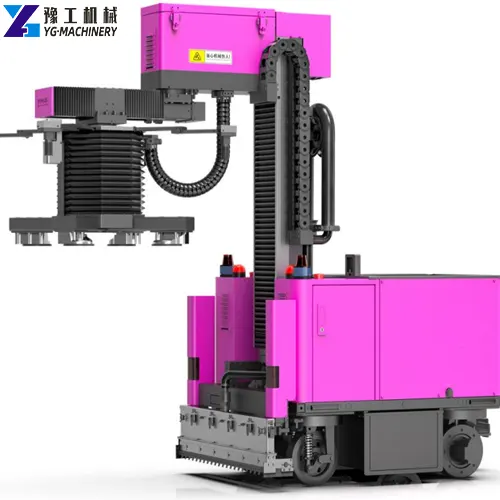
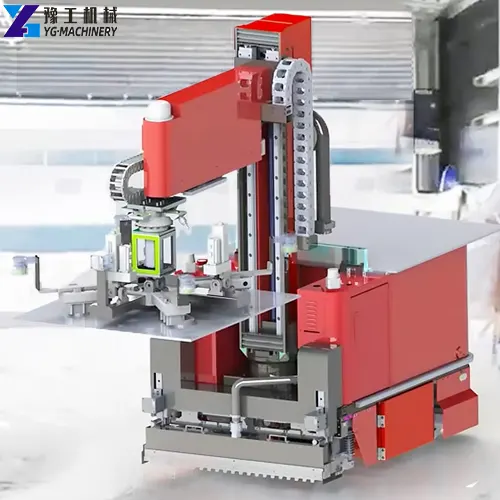
Traditional manual tile laying suffers from several industry pain points, including a shortage of skilled tilers, high labor costs, inconsistent laying quality, high rates of hollow tiles, and the difficulty of laying large tiles. This is especially true for large-scale, high-end renovation projects, where low efficiency and unpredictable project schedules have become core bottlenecks hindering the scaling up of the renovation industry. Tile laying robots, also known as fully automatic tile-laying robots, tile-laying manipulators, or intelligent floor tile laying machines, are intelligent construction robots that integrate vision positioning, robotic arm operation, and automatic material feeding into a single automated tile-laying system. Their core function is to replace manual labor in standardized large-area tile laying operations, reducing reliance on skilled tilers while improving construction efficiency and quality consistency.
YG, a professional manufacturer of intelligent construction equipment, specializes in fully automatic tile laying robots, compatible with various mainstream tile types. Currently, their equipment has been exported in batches to countries such as the UAE, Saudi Arabia, Singapore, Australia, Germany, and the United States, and is widely applicable to residential renovations, commercial complexes, hotel renovations, and other scenarios, particularly suitable for regions with high labor costs and strong demand for high-end renovations.
Click to Learn More About Tile Laying Robots
YG Automatic Floor Tile Laying Machine Technical Parameters
| Parameter Items | YG-TP600 | YG-TP800 | YG-TP900Pro |
| Applicable Brick Types and Specifications | 400*400/600*600mm | 600*600 / 800*800mm | 800*800 / 900*900 / 600*1200mm |
| Maximum Weight per Brick | ≤20kg | ≤35kg | ≤50kg |
| Construction Efficiency (Continuous Operation) | 80-100㎡/day | 150-180㎡/day | 180-250㎡/day |
| Laying Flatness Error | ≤2mm | ≤1mm | ≤0.5mm |
| Matching Precision | ±1mm | ±0.8mm | ±0.5mm |
| Groin Filling Rate | ≥90% | ≥93% | ≥95% |
| Overall Dimensions (Length × Width × Height) | 1100*750*1600mm | 1150*800*1800mm | 1200*900*1850mm |
| Overall Weight | ≤500kg | ≤700kg | ≤850kg |
| Navigation Method | Laser + Marking Assist | SLAM Autonomous Navigation | SLAM + Visual Fusion Navigation |
| Battery Capacity | 100Ah | 180Ah | 240Ah |
| Battery Life | > 5 h | > 6 h | > 8 h |
| Charging Time | 4-5 h | 5- 6 h | 6- 7 h |
| Control Method | Remote control + semi-automatic | Touchscreen + Fully Automatic | Touchscreen + Fully Automatic + Remote Monitoring |
Click to Learn More About Tile Laying Robots
What Scenarios Are Suitable for Tile Laying Robots?
- Commercial complexes and shopping malls. Large public areas such as shopping malls, shopping centers, and pedestrian streets with uniform tile patterns make them ideal for efficient tile laying robots. A robot can complete a lobby of several thousand square meters in just a few days, producing straight, even seams and an excellent visual effect.
- Public areas of transportation hubs. Airport terminals, high-speed rail stations, subway stations, and bus stations have massive amounts of floor tiles in their lobbies and passageways, requiring high levels of flatness and aesthetics. Robots offer high precision and consistency, fully meeting high-standard acceptance requirements.
- Office buildings and commercial buildings. Lobbies, public corridors, and elevator halls in high-rise office buildings often have limited construction time due to property regulations, with limited opportunities for nighttime or weekend work. Robots offer high efficiency, completing large-area tiling in a short time and minimizing disruption to tenants.
- Hotels and restaurants. Hotel lobbies, banquet halls, restaurants, and corridors require high-quality floor finishes. Robots lay tiles with even grout lines and precise pattern matching, achieving an overall effect far superior to manual work. Moreover, the faster turnaround time allows hotels to open sooner.
- Industrial plants and warehouses. Factory workshops and logistics warehouses often require the laying of wear-resistant floor tiles or industrial ceramic tiles. The large areas and relatively simple working conditions make them ideal for robotic installation. Furthermore, industrial projects have tight deadlines, where the high efficiency of robots is even more pronounced.
- Hospitals and schools. Hospital operating rooms, corridors, and wards, as well as school classrooms and corridors, have strict requirements for floor flatness and construction quality, while construction must not disrupt normal operations. Robots offer low noise and high efficiency, making them ideal for scenarios where construction and renovation are carried out simultaneously.
- Residential bulk finishing. Bulk finishing projects in residential buildings, with uniform unit types and standard tile patterns, are perfectly suited for large-scale robotic tile installation. Robots are most efficient, especially in areas with solid tiles, where manual work can be done in corners and irregular areas, significantly improving overall construction speed.
- Exhibition halls and convention centers. Large-scale buildings such as exhibition halls, convention centers, and stadiums often require tens of thousands of square meters of floor tiles, and construction periods are usually very tight. Multiple robots working together can complete large-area tiling in a short time, meeting project deadlines.
Click to Learn More About Tile Laying Robots
How Does a Tile-Laying Robot Work?
- Step 1: Scanning and Mapping (“Scanning”). Before construction, the robot uses a top-mounted LiDAR scanner to scan the entire construction area, identifying boundaries such as walls, pillars, and doorways, automatically generating a digital floor plan. The operator sets parameters such as the starting point, laying direction, and grout width on the touchscreen. The robot’s software automatically calculates the optimal laying path and the precise position of each tile.
- Step 2: Tile Retrieval (“Retrieve”). The robot moves above the tile storage rack, the vacuum suction cup descends, picks up a tile, and then rises again. The suction cup system has multiple independent suction cup units that automatically adjust the suction cup position and suction force according to the size of the tile to ensure a firm grip. An air failure protection device ensures that the tile will not fall in the event of an accidental power outage.
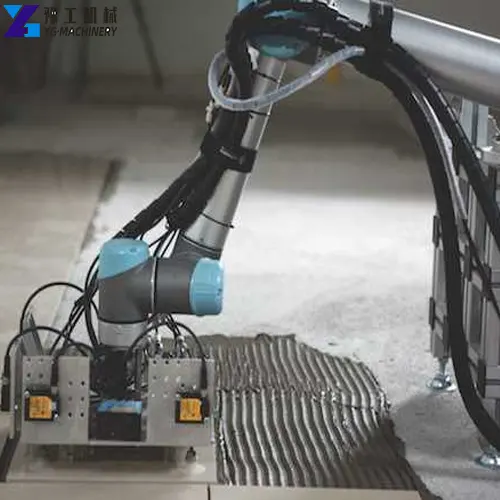
- Step 3: Adhesive Application and Smoothing (“Apply”). Tile adhesive is delivered to the adhesive application mechanism by a pump system. A notched trowel evenly applies the adhesive to the back of the tile or the ground according to the set thickness. The scraper tooth pitch automatically matches the tile size—smaller teeth for smaller tiles, larger teeth for larger tiles—ensuring the right adhesive layer thickness.
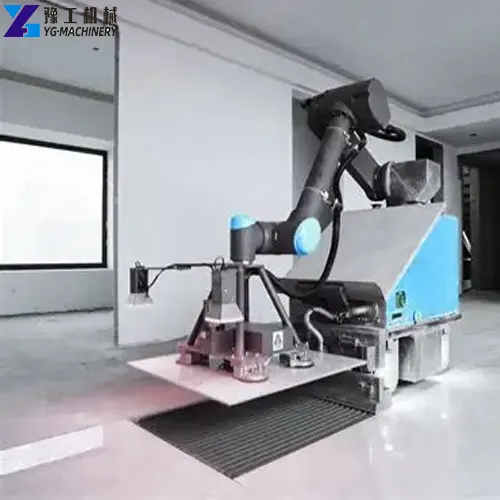
- Step 4: Positioning, Laying, and Pressing (“Pressing”). The robot moves to the target laying position, identifies the existing tile joints using a vision camera, precisely adjusts its position, aligns, and slowly places the tile. Upon landing, a four-point vibration system activates, simulating manual “kneading and pressing” to fully fill the tile with adhesive, expel air bubbles, and ensure a full grout coverage of over 95%. Pressure sensors monitor the pressing force in real time to prevent tile breakage.
- Step 5: Moving to the Next Position (“Moving”). After one tile is laid, the robot moves to the next laying position along a pre-planned path, repeating steps two through four, working continuously one tile after another. When encountering obstacles, the robot automatically slows down or detours and alerts personnel with audible and visual alarms.
Throughout the process, the robot works like a tireless and skilled bricklayer, precise, stable, and continuous, while humans only need to perform auxiliary tasks such as replenishing bricks, adding tile adhesive, and monitoring the operating status.
Click to Learn More About Tile Laying Robots
What Factors Determine the Price of a Tile Laying Robot? How Can I Purchase One?
Price Factors
- Automation Level: Semi-automatic remote-controlled models are cheaper, while fully automatic autonomous navigation models are more expensive, with a price difference of 3-5 times.
- Applicable Brick Size: Larger bricks require higher suction cup load and structural strength, resulting in a higher price.
- Positioning Accuracy: Higher accuracy levels increase sensor and algorithm costs.
- Additional Functions: Remote monitoring, data statistics, and multi-machine collaboration functions increase costs.
- Customization Needs: Explosion-proof, dustproof, and waterproof upgrades, as well as special brick type customizations, require additional charges.
- Quantity and Accessories: Bulk purchases offer discounts; additional batteries, spare suction cups, and training services are charged separately.
Purchase Channels and Methods
YG Machinery, as a manufacturer, offers direct sales. Customers can contact us to purchase through the following methods:
- WhatsApp/WeChat/Phone: +86 136 1385 6800
- Email: admin@ygmachinerycore.com
- Official Website: Browse product details and inquire about pricing online.
YG Offers Flexible Cooperation Methods
- Complete Machine Sales: Suitable for clients with long-term projects and large workloads.
- Sample Testing: Clients can send tile samples to the factory for installation testing to verify the effect before purchasing.
- Video Factory Visit: Supports video conferencing to visit the factory and view sample machine demonstrations, convenient for overseas clients.
- After-Sales Guarantee: One-year warranty on the whole machine, lifetime technical support, readily available inventory of vulnerable parts, and fast global shipping.
Click to Learn More About Tile Laying Robots
Frequently Asked Questions About YG’s Tile-Laying Robot
A1: No, they can’t completely replace manual labor, but they can handle 70%-80% of the work involved in laying whole tiles. Robots are most efficient in large, regular areas; however, for corners, tile cutting, and irregular areas, manual assistance is still necessary. A human-robot combination offers the best efficiency and cost-effectiveness.
A2: One person is sufficient for the standard setup, responsible for adding tiles, applying adhesive, and monitoring the operation. For large projects with a fast pace, two people can work together for even higher efficiency. Operation is simple; 3-5 days of training is sufficient to operate independently.
A3: They are best suited for large, regular spaces, such as shopping malls, airports, office building lobbies, and factories. For small-area home renovations or complex floor plans, the efficiency advantage is not significant; manual labor remains more flexible.
A4: Robotic tile laying achieves a full grout coverage rate of 93%-95% or higher, far exceeding the 80%-90% achieved manually, significantly reducing the rate of hollow spots. However, this is contingent on proper substrate preparation, correct tile adhesive mixing ratios, and accurate robot parameter adjustments.
A5: Under normal use and maintenance, its lifespan is 5-8 years. Core components such as the motor, sensors, and control system are highly reliable. Wear parts are mainly suction cups, sealing rings, and toothed blades, which are low-cost and easy to replace.
A6: YG provides global after-sales service. Common problems can be resolved through remote video guidance; replacement parts are shipped quickly from our domestic warehouse, with international express delivery such as DHL/FedEx reaching customers in 3-7 days; for major malfunctions, on-site service by technicians can be arranged (travel expenses are calculated separately). The entire machine comes with a one-year warranty.