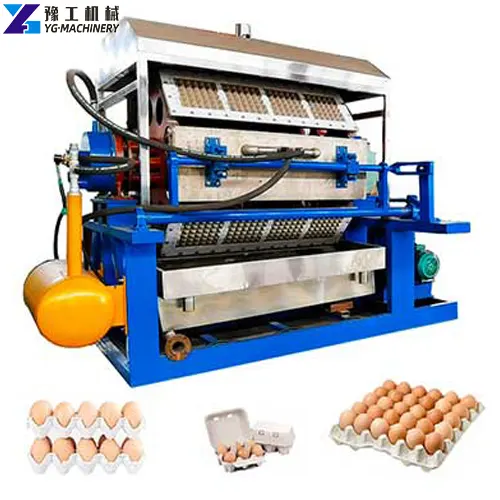
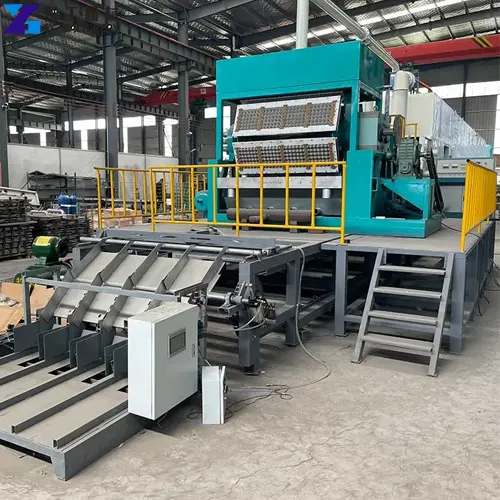
In the poultry farming and food packaging industries, traditional plastic packaging is costly and environmentally unfriendly, while handmade paper trays are inefficient and of inconsistent quality. Egg tray production machines, also known as pulp egg tray forming machines, waste paper egg tray machines, or egg tray processing equipment, are specialized equipment that uses waste newspapers, cardboard boxes, and waste paper as raw materials to produce paper egg trays through pulping, forming, and drying processes. Their core advantages are extremely low raw material costs and environmentally friendly, biodegradable products. By changing the molds, they can also produce fruit trays, cup holders, industrial product liners, and many other products, making them widely applicable.
YG, as a professional pulp forming equipment manufacturer, provides a complete range of solutions from single machines to complete production lines, including entry-level small egg tray making machines and large-scale egg tray production lines to meet different production needs. Currently, our equipment has been exported in batches to countries with rapidly developing agriculture and animal husbandry, such as Nigeria, Kenya, Indonesia, Mexico, Egypt, and Uzbekistan, and is especially suitable for regions with abundant waste paper resources and moderate labor costs. If you are interested, please contact us now for more product information.
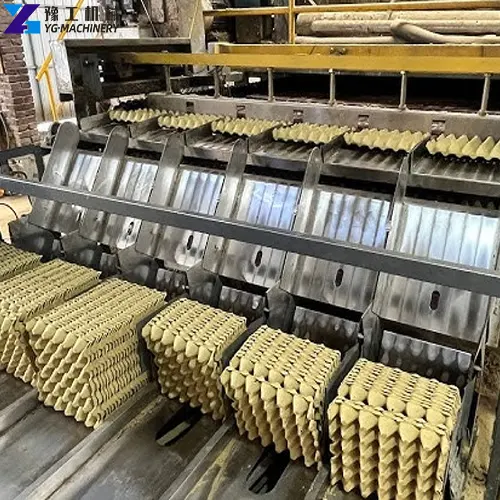
Want More Information on Egg Tray Production Lines? Click Here to Send an Inquiry
YG Egg Tray Production Machine Technical Parameters
| Model | Production Capacity (pcs/h) | Forming Modulus | Total Power (kW) | Paper Consumption (kg/h) | Water Consumption (kg/h) | Suitable Drying Method |
| YG-3×1 | 800-1000 | 3 | 32 | 64 | 160 | Natural air drying |
| YG-4×1 | 1000-1500 | 4 | 36-42 | 96 | 240 | Natural/Brick kiln |
| YG-3×4 | 1700-2200 | 12 | 55-74 | 144 | 360 | Brick kiln/Metal |
| YG-4×4 | 2000-2800 | 16 | 58-88 | 200 | 500 | Brick kiln/Metal |
| YG-4×8 | 4000-4500 | 32 | 127-144 | 340 | 850 | Metal drying |
| YG-5×8 | 5000-5500 | 40 | 153-190 | 425 | 1063 | Metal drying |
| YG-6×8 | 6000-6500 | 48 | 226-239 | 520 | 1300 | Metal drying |
| YG-8×8 | 8000-9000 | 64 | 374 | 640 | 1600 | Metal drying |
Want More Information on Egg Tray Production Lines? Click Here to Send an Inquiry
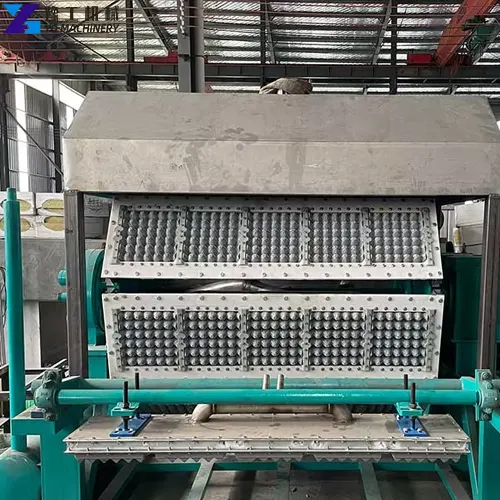
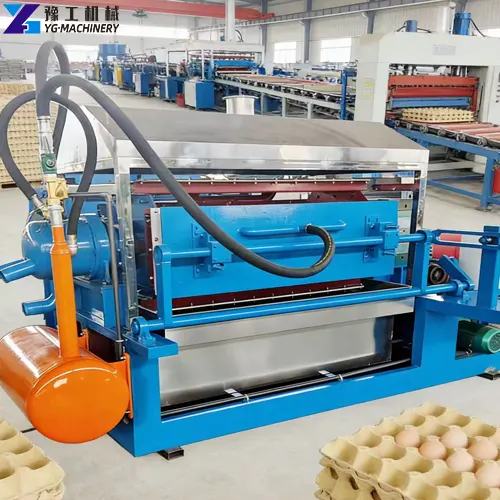
Hot-Selling Markets and Suitable Regions of YG Egg Tray Making Machine
YG egg tray machines have been exported to over 100 countries and regions worldwide. Major hot-selling markets include:
- African Market: Countries such as Nigeria, Kenya, South Africa, Tanzania, Ghana, and Ethiopia are experiencing rapid growth in egg consumption, have abundant waste paper resources, and low labor costs, making them ideal for egg tray production. Nigeria and South Africa are the two largest markets in Africa.
- Southeast Asian Market: Countries such as Indonesia, the Philippines, Vietnam, Thailand, and Malaysia have developed agriculture, large egg and fruit production, and increasing demand for environmentally friendly packaging. Indonesia and Vietnam are core markets in Southeast Asia.
- Middle Eastern Market: Countries such as Saudi Arabia, the UAE, Oman, and Qatar rely on imported food packaging, have insufficient local production capacity, and are experiencing rapid growth in demand for metal drying lines due to low oil and energy prices.
- Latin American Market: Countries such as Mexico, Brazil, Colombia, Chile, and Peru have developed agriculture and food processing industries, and the trend of pulp packaging replacing plastic is evident. Mexico’s proximity to the US market has led to rapid growth in export-oriented egg tray factories.
- South Asian Market: Countries like India, Pakistan, and Bangladesh have large populations, rapidly increasing egg consumption, and abundant and low-cost waste paper resources, resulting in strong demand for small and medium-sized egg tray machines.
Characteristics of Regions Ideal for Egg Tray Production Investment:
Abundant waste paper resources, developed egg or fruit industries, moderate labor costs, and a dry climate with little rainfall (advantages of natural drying) or low energy prices (advantages of artificial drying). If your region meets 2-3 of these conditions, egg tray production is a worthwhile entrepreneurial direction to consider.
YG Other Related Pulp Molding Equipment
- Fruit Tray Production Line: Produces apple trays, mango trays, kiwi trays, and other fruit packaging. Molds are compatible with egg tray machines.
- Cup/Coffee Tray Production Line: Produces disposable paper cup trays and coffee cup holders, suitable for the catering and takeout industries.
- Industrial Lining Production Line: Large-scale pulp molding equipment for producing cushioning linings for the electronics, home appliances, and auto parts industries.
- Seedling Tray/Rice Seedling Tray Production Line: Produces biodegradable pulp seedling containers for agriculture and horticulture.
- Tableware Production Line: Produces disposable biodegradable tableware such as paper cups and bowls, in response to plastic ban policies.
- Customized Mold Services: Develops customized pulp molding molds based on customer product design drawings.
YG can provide planning, design, and equipment configuration solutions for the entire pulp molding workshop based on customer product planning and production capacity requirements, achieving one-time investment, multi-product production, and maximizing return on investment.
Want More Information on Egg Tray Production Lines? Click Here to Send an Inquiry
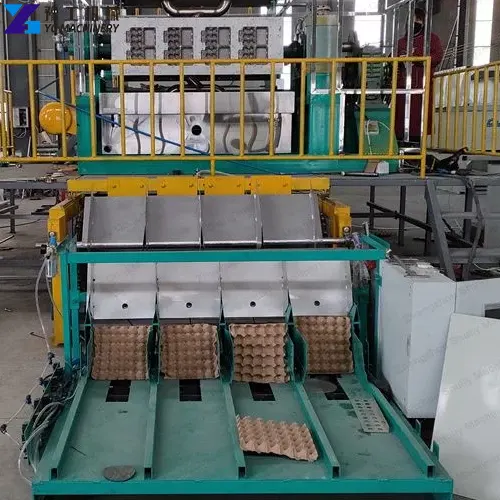
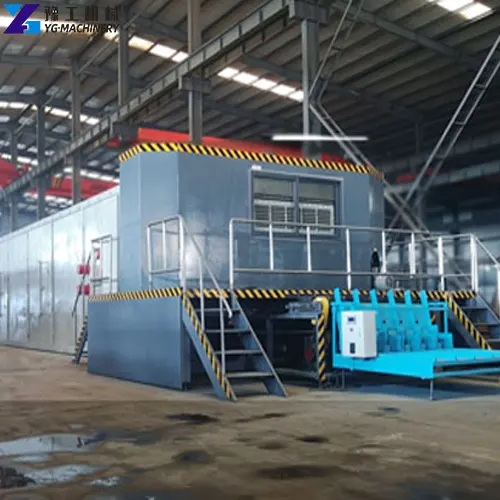
Case Studies of Nigerian and Polish Customers Purchasing YG Egg Tray Production Lines
Case Study 1: Small Egg Tray Factory in Lagos, Nigeria (Natural Sun-Drying Solution)
- Client Background: Mr. Adeleke, from Lagos, Nigeria, previously operated a poultry farm and needed to purchase a large number of egg trays daily for egg packaging. Local egg trays were of poor quality and prices were constantly rising.
- Solution: In June 2025, Adeleke purchased a YG-4×1 small egg tray making machine from YG, with a capacity of 1500pcs/h, using a natural sun-drying solution. Considering Nigeria’s long dry season and abundant sunshine, YG engineers recommended starting with natural sun-drying to reduce initial investment, and upgrading to a drying system once the market opened up.
- Results: After the equipment arrived, YG technicians provided remote guidance for installation and commissioning, and production was successfully completed in just 10 days. Currently, it operates 8 hours a day, producing approximately 10,000-12,000 egg trays daily, meeting the needs of his own farm and supplying more than a dozen surrounding farms and supermarkets. The production cost of each egg tray is approximately 3 Naira, with a selling price of 10-12 Naira, resulting in a gross profit margin exceeding 70%.
- Customer Testimonial: “YG’s machines are excellent and easy to operate. Our workers learned them in just two days. The Nigerian sun is very strong, so natural drying is perfectly sufficient, saving us the cost of drying equipment. Now, we not only use the egg trays ourselves for free, but selling them has also become a new source of income. We plan to add an even larger machine in the second half of the year.” — Adeleke, Lagos, Nigeria
Case Study 2: Medium-Sized Egg Tray Production Line in Warsaw, Poland (Metal Drying Solution)
- Customer Background: GreenPack, based in Warsaw, Poland, is a company specializing in environmentally friendly packaging, serving food and agricultural clients in several Eastern European countries. With the advancement of the EU’s plastic ban, pulp packaging orders have grown rapidly.
- Solution: In March 2025, GreenPack purchased a YG-5×8 fully automatic pulp molding egg tray machine production line from YG, equipped with a six-layer metal drying system, a capacity of 5000-5500 pcs/h, and natural gas as fuel. Considering the high requirements of European product quality and environmental standards, YG specifically configured a hot-press shaping machine and an automated stacking and packaging line.
- Usage Results: YG engineers went to Poland for on-site installation and commissioning, completing production in 25 days. Currently, the production line operates 24/7 in two shifts, producing over 100,000 egg trays daily, with product quality meeting EU food contact material standards. In addition to standard egg trays, customized products such as apple trays, wine bottle trays, and electronic liners are produced by changing molds, with customers in Poland, Germany, the Czech Republic, Lithuania, and other countries.
- Customer Testimonial: “We compared several equipment manufacturers in Europe, and YG’s price was only about half of theirs, but the equipment quality and automation level are just as good. The metal drying line operates very stably, and the egg trays have uniform moisture content, which the customer is very satisfied with. YG’s after-sales response is also very fast; technical support is available within 24 hours for any problems.” — Tomasz, Operations Director, GreenPack Poland
Want More Information on Egg Tray Production Lines? Click Here to Send an Inquiry

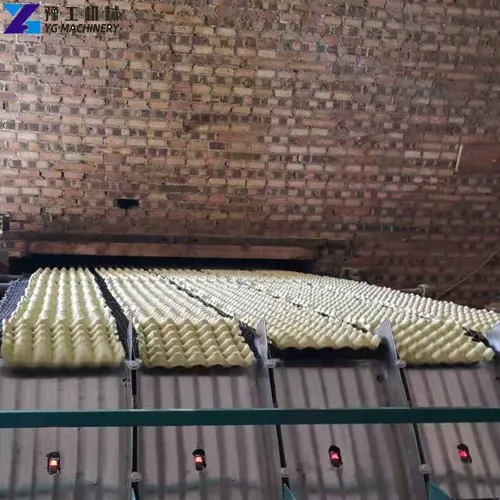
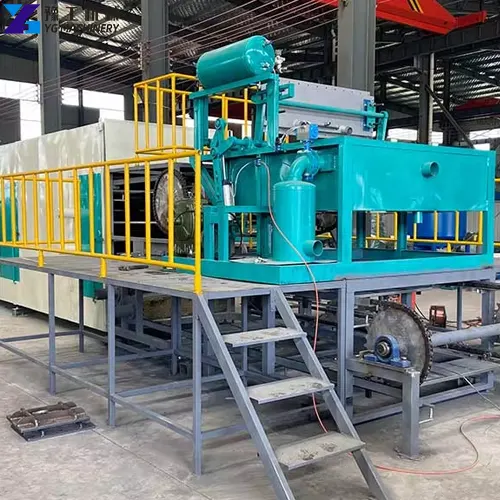
Regarding Egg Tray Drying Machines, What Are the Suitable Scenarios for Each of the Three Drying Methods?
Drying is one of the most crucial steps in egg tray production, and the choice of drying method directly impacts investment costs, product quality, and operating expenses.
Natural Air Drying (Sun Drying)
Natural air drying involves placing the formed, wet egg trays on racks and allowing them to dry using the sun and natural wind. It is the simplest and most cost-effective method.
- Advantages: Extremely low investment; no need to purchase additional drying equipment; zero fuel costs; lowest operating expenses; simple equipment configuration and easy maintenance.
- Disadvantages: Completely dependent on weather; production cannot proceed normally during rainy seasons or cloudy days; long drying cycle (4-6 hours or even 1-2 days); requires ample drying space; egg tray quality fluctuates greatly due to environmental factors.
- Suitable Regions: Tropical and subtropical dry regions, such as most of Africa, the Middle East, Southeast Asia during the dry season, and parts of Latin America. Requires many sunny days per year, low air humidity, and sufficient open-air space.
- Suitable Capacity: Small to medium capacity of 1000-2500 pcs/h.
Brick Kiln Drying Line
A brick kiln drying line uses refractory bricks to construct a drying tunnel with an internal conveyor belt. Wet egg trays are conveyed through the kiln and dried by hot air. The heat source can be coal, firewood, natural gas, diesel, etc.
- Advantages: Fast drying speed (20-30 minutes), unaffected by weather, stable production capacity, moderate equipment investment, flexible fuel selection, and high thermal efficiency.
- Disadvantages: Requires civil engineering construction, long installation period (approximately 30-45 days), large footprint, and requires 2-3 workers for operation and maintenance.
- Suitable Regions: Medium-scale production in regions with abundant and inexpensive coal or firewood resources, such as parts of South Asia, Africa, and Southeast Asia.
- Suitable Capacity: Medium-sized capacity of 2000-5000 pcs/h.
Metal Multi-Layer Drying Line
A metal multi-layer drying line is a fully automated drying system. It uses a multi-layer steel mesh belt design, with PLC controlling temperature and speed. Egg trays enter from one end and exit as dried finished products from the other.
- Advantages: Fastest drying speed (15-20 minutes), fully automated process requiring no manual labor, consistent product quality, small footprint (multi-layer structure saves space), clean and hygienic, meeting food hygiene standards.
- Disadvantages: Highest equipment investment, higher energy consumption, requires technical personnel for maintenance.
- Suitable Regions: Regions with large-scale production, high labor costs, and strict environmental requirements, such as high-end markets in Europe, North America, the Middle East, and Australia.
- Suitable Production Capacity: Large-scale production capacity of 5000-8000+ pieces/hour.
Comparison and Summary of 3 Drying Methods
| Comparison Dimensions | Natural air drying | Brick kiln drying | Metal multi-layer drying |
| Drying Time | 4-6 hours Extremely low | 20-30 minutes | 15-20 minutes |
| Investment Cost | Lowest | Medium | High |
| Operating Cost | Maximum | Medium | Higher |
| Land Area | Unstable | Large | Minimum |
| Product Quality | Completely dependent on | Relatively stable | Most stable |
| Weather Impact | Most | Unaffected | Unaffected |
| Labor Required | Shortest | Medium | Minimum |
| Installation Period | Natural air drying | Longest | Medium |
Want More Information on Egg Tray Production Lines? Click Here to Send an Inquiry
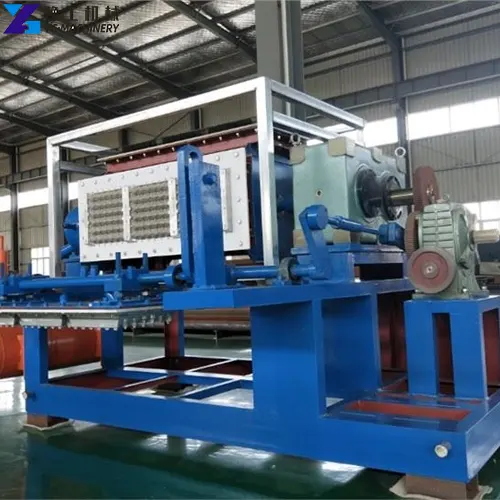
Frequently Asked Questions about Egg Tray Machine Production Lines
A1: The main raw material is waste paper, including waste cardboard boxes, old newspapers, and office waste paper. Each ton of waste paper can produce approximately 9,000-10,000 standard 30-pack egg trays. Raw material costs are extremely low, and no chemical agents are added throughout the process.
A2: A complete egg tray production line includes four main systems: a pulping system (pulper, mixing tank), a forming system (main machine, vacuum pump, air compressor, mold), a drying system (natural air drying/brick kiln/metal drying line), and a post-processing system (stacker, baler).
A3: There is no absolute better or worse; the choice depends on the specific circumstances. For tropical dry regions, small production capacity, and limited budgets, choose natural air drying; for medium to large production capacity, rainy regions, and consistent quality requirements, choose manual drying. YG engineers will provide professional advice based on the client’s local climate and budget. YG offers free ROI analysis.
A4: Small-scale machines (1000-1500 pcs/h) require 3-5 people, medium-scale lines (2000-4000 pcs/h) require 4-6 people, and fully automatic metal drying lines (5000 pcs/h and above) require only 3-4 people. Operation is not complicated; ordinary workers can be trained and start working in 1-2 days.
A5: No, the production water is recyclable; there is no wastewater or waste residue discharge; the product is completely biodegradable, meets environmental protection requirements, and the approval process is simple.