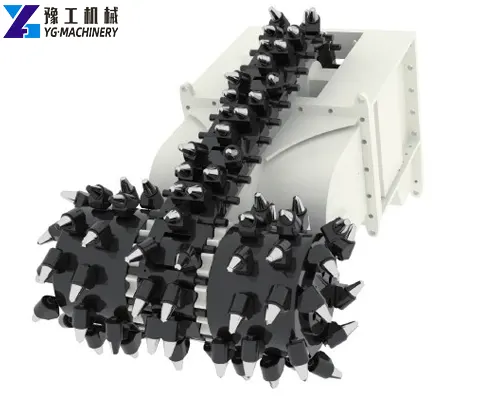
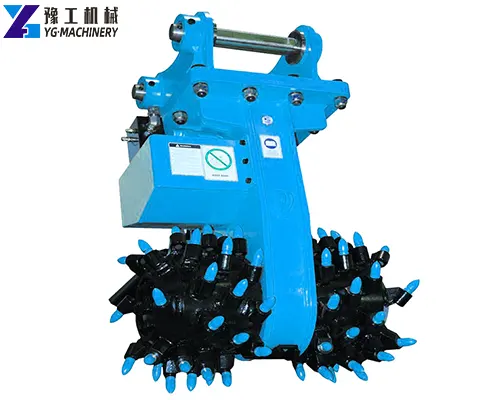
Traditional rock breakers suffer from high vibration and poor rock-cutting quality, and their buckets cannot penetrate medium-hard rock. Manual pneumatic drills are inefficient and pose high safety risks. Precise trenching, tunnel trimming, and smooth rock excavation have long been pain points in the engineering industry. A chain-type drum cutter, also known as a chain milling head, drum milling machine, excavator rock milling attachment, or cutting roller, is a hydraulically driven milling device mounted on the excavator boom. Its core function is to replace rock breakers and pneumatic drills in smooth milling operations on medium-hard rock, offering high precision and low vibration, making it suitable for precision engineering projects requiring specific excavation profiles.
YG, as a professional excavator attachment manufacturer, specializes in chain milling heads compatible with all tonnage sizes, while also covering similar functional attachments for transverse milling machines, rock breakers, and rippers. The optimal solution can be matched according to the working conditions. This excavator drum cutter is currently exported in bulk to countries with high demand for mining and infrastructure, such as Peru, South Africa, Australia, Brazil, Malaysia, and Kazakhstan, and is widely applicable to various construction scenarios, including tunnel engineering, mining, and municipal pipeline networks. If you are also interested, please contact us now for more information.
Click to Get More Detailed Information and Pricing for Drum Cutter Machines
YG New Type Excavator Chain-type Drum Cutter Technical Parameters
| Model | YG-700 | YG-1400 | YG-2200 |
| Max. Power(KW) | 70 | 140 | 220 |
| Max. Oil Flow(ml/r) | 240 | 450 | 600 |
| Motor Rated Pressure(Mpa) | 28 | 28 | 28 |
| Max. Output Torque(N.m) | 12000 | 33000 | 38000 |
| Work Oil Flow(L/min) | 180-240 | 290-330 | 480-540 |
| Wor Rotation(R/min) | 70 | 60 | 70 |
| Weight (Kg) | 3100 | 3300 | 3500 |
| Qty of Pick Teeth(pcs) | 107 | 107 | 107 |
| Spec. of Pick Teeth | 30 | 30 | 30 |
| Applied Excavator(T) | 18-23 | 35-45 | 45-70 |
| Dimension(mm) | 1780*750*2140mm | 1780*750*2140mm | 1780*750*2140mm |
Click to Get More Detailed Information and Pricing for Drum Cutter Machines
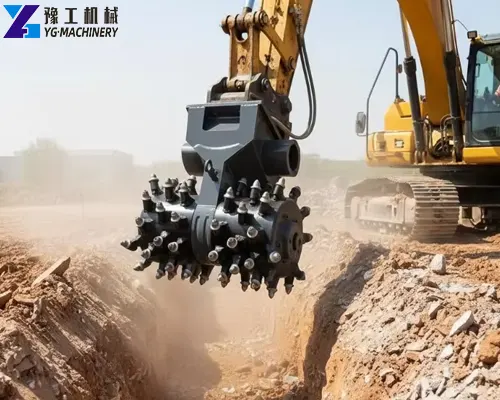

8 Features of Chain Type Drum Cutter Attached to Excavators
- Dual-drum + central chain composite cutting, one-time forming without ridges. This is the biggest technical advantage of chain milling machines. Ordinary dual-drum milling machines have a gap between the two drums, leaving a ridge in the middle after cutting. The operator must swing the excavator left and right to clear it, which is time-consuming, fuel-inefficient, and wears down the slewing mechanism. The central cutting chain completely eliminates this ridge, achieving a complete cross-section in one pass, increasing efficiency by over 50%.
- 40% energy saving and less excavator wear. Because there is no need to swing left and right to clear the ridge, the hydraulic energy consumption per cubic meter of cutting volume of the chain milling machine is about 40% lower than that of ordinary dual-drum milling machines. The lateral forces on the excavator’s slewing mechanism, boom, and stick are also significantly reduced, resulting in a longer equipment lifespan.
- Smooth trench walls and minimal over-excavation. The trench walls cut by the two side drums are vertical and smooth, resulting in high-quality forming and over-excavation controlled within 5%. Over-excavation with hydraulic breakers typically results in 30%-50% over-excavation, requiring substantial backfill material. Chain milling machines, with their precise shaping, significantly reduce backfilling costs.
- Capable of cutting 120MPa hard rock, with a wide range of applications. Flagship models can cut rocks with a uniaxial compressive strength of 120MPa, easily handling soft rock, medium-hard rock, concrete, asphalt, and frozen soil. Compared to circular saws that can only cut slits and hydraulic breakers with low efficiency, chain milling machines are true “all-rounders.”
- Direct operation up to 30 meters underwater without modification. The fully sealed gearbox and hydraulic system allow direct operation up to 30 meters underwater without any additional modifications. Suitable for underwater dredging, port and waterway improvement, and underwater foundation excavation.
- Uniform slag, directly usable. The cut material has a uniform particle size (mostly 20- 100 mm), allowing for direct loading and transportation or on-site backfilling as roadbed material without secondary crushing.
- Low vibration and low noise, ideal for urban construction. As it’s a continuous static cutting process, not impact crushing, the vibration intensity is typically less than 5mm/s, resulting in significantly lower noise. This makes it particularly advantageous in urban areas, near residential areas, and adjacent to existing buildings, fully meeting environmental protection requirements.
- Quick tooth replacement and convenient maintenance. All teeth use standardized tooth bases, allowing for individual tooth replacement when worn, eliminating the need to replace the entire row. The teeth are inexpensive, readily available, and can be replaced on-site with just a wrench, minimizing downtime.
Click to Get More Detailed Information and Pricing for Drum Cutter Machines


What Are the Suitable Applications for Chain Drum Cutter?
- Municipal pipeline trenching. Trenching in rock layers for water, gas, electricity, and communication pipelines is a specialty of chain milling machines. They achieve one-time trenching, smooth trench walls, and prevent over-excavation, making them several times more efficient than hydraulic breakers and avoiding vibration damage to existing pipelines.
- Mining and ore layer stripping. In medium-hard rock mines and quarries, chain milling machines can be used for ore layer stripping, bench mining, and road repair. They are an ideal alternative, especially in mining areas where blasting is prohibited (near residential areas with high environmental requirements).
- Tunnel engineering finishing and excavation. In tunnel construction, chain milling machines can be used for cross-section finishing, over-excavation backfilling, anchor bolt trench excavation, and drainage ditch milling. In soft rock tunnels, they can be used directly in conjunction with excavators for excavation, which is safer and more controllable than the drill-and-blast method.
- Road milling and maintenance: Milling and resurfacing of asphalt and concrete pavements, road widening and edge trimming, manhole cover trimming… Chain milling machines produce clean, controllable-depth cuts, offering greater flexibility than traditional milling machines, allowing for both forward and reverse movement, resulting in higher efficiency in small-scale operations.
- Underwater engineering and river regulation: Underwater excavation, waterway dredging, port expansion, and underwater foundation construction—chain milling machines can operate underwater without any modifications, reaching depths of up to 30 meters. Combined with long-arm excavators or ship-mounted excavators, underwater construction efficiency is significantly improved.
- Building demolition and concrete breaking: For demolishing buildings, bridges, and removing concrete foundations, chain milling machines can slice through concrete like cutting tofu, even cutting through reinforcing steel. Compared to the brute force of a hydraulic breaker, its cutting is more precise, with less vibration, and it won’t damage structures that need to be preserved.
- Slope trimming and foundation pit excavation: Chain milling machines can handle all aspects of construction, including highway and railway slope trimming, foundation pit sidewall trimming, and slope anchoring trench excavation. The resulting slope surfaces are smooth and aesthetically pleasing, facilitating subsequent shotcrete or shoring work and improving overall quality.
- Construction in permafrost zones and special geological conditions: In permafrost, mudstone, gypsum, and other special geological conditions, ordinary equipment is either inefficient or suffers rapid wear. The continuous cutting method of chain milling machines is particularly effective in permafrost, allowing for direct cutting rather than hammering, resulting in higher construction efficiency.
Click to Get More Detailed Information and Pricing for Drum Cutter Machines
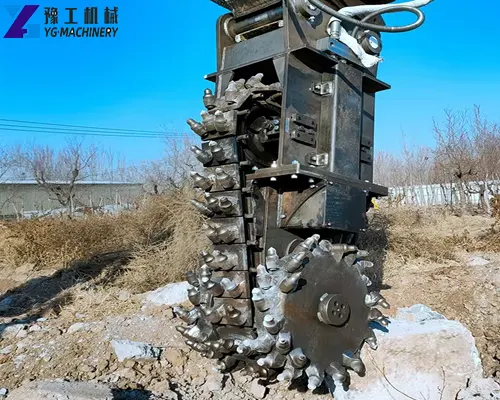

Chain Drum Cutter Machine Vs. Conventional Twin-Drum Cutter Machine Vs. Hydraulic Breaker: A Comprehensive Comparison
| Comparison Dimensions | Hydraulic breaker | Standard Twin-Drum Cutter Machine | Chain Drum Cutter Machine |
| Working Principle | Impact crushing | Rotary Milling (Twin-Drum) | Rotary Milling (Dual Drum + Central Chain) |
| Excavation Efficiency (Medium-Hard Rock) | ★★☆☆☆ | ★★★★☆ | ★★★★★ |
| Shaping Quality | ★☆☆☆☆ | ★★★☆☆ | ★★★★★ |
| Vibration Level | Very high | Low | Very Low |
| Noise Level | Very high | Medium | Low Medium |
| Over-excavation Amount | 30%-50% | 10%-15% | 3%-5% |
| Applicable Rock Hardness | Unlimited | ≤100MPa | ≤120MPa |
| Underwater Operation | Can be | Can (30m) | Can (30m) |
| Equipment Unit Price | Lower | Medium | High Medium |
| Cost Per Cubic Meter Excavation | Highest | Medium | Lowest |
| Operational Difficulty | Simple | Medium (Cutting Tooth Consumption) | Medium |
| Maintenance Cost | High (chisel rod easily breaks) | Large Area Milling, Dressing | Low Medium (Cutter Teeth + Chain) |
| Applicable Scenarios | Hard rock crushing, demolition | Standard Twin-Drum Milling Machine | Precision Grooving, Full-Face Excavation |
Selection Recommendations:
- For very hard rock (>120MPa) and large-block demolition → Choose a hydraulic breaker.
- For large-area road milling, slope trimming, and full-section tunnel excavation → A standard twin-drum milling machine offers better value.
- For trench excavation, precise shaping, and prioritizing efficiency and quality → A chain milling machine is the optimal solution.
Click to Get More Detailed Information and Pricing for Drum Cutter Machines
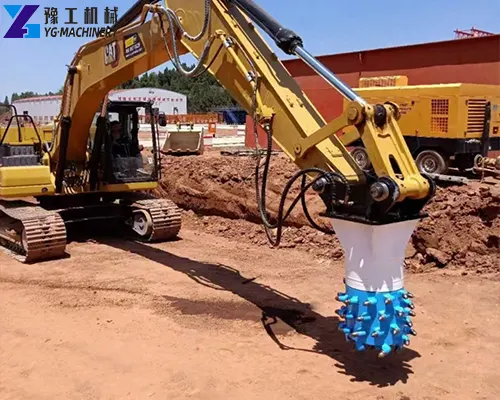

Frequently Asked Questions About YG Excavator Chain Drum Cutter Machines
The biggest difference is that the chain milling machine has an additional cutting chain between the two drums, allowing it to cut a complete cross-section in one pass without leaving any ridges. This increases efficiency by about 50%, saves 40% on energy, produces smoother trench walls, and reduces excavator wear. Chain milling machines are the preferred choice for trenching, but twin-drum machines can also be used for large-area milling.
Yes. Fully sealed chain milling machines require no modification and can operate directly underwater up to 30 meters. They can be used directly for underwater dredging, port and waterway improvement, and underwater foundation excavation, but regular inspection of the seals is necessary.
Generally, a ratio of 1/10 to 1/15 is used. For example, a 20-ton excavator is paired with a 1.2-2 ton milling machine, and a 30-ton excavator with a 2-3 ton machine. Too small a machine will be unstable, and too large a machine will be too heavy to operate.
It depends on the rock hardness. Replace them every 200- 300 m³ for soft rock, 100- 200 m³ for medium-hard rock, and 50- 100 m³ for hard rock. Cutting teeth are consumables, so timely replacement is crucial—severe wear will damage the tooth base, leading to higher maintenance costs.
No, it’s not difficult. Like installing a hydraulic breaker, it can be done in minutes using quick-connect couplings. The hydraulic lines simply connect to the excavator’s hammer lines; most excavators have spare lines. Installation and commissioning usually take 1-2 days.
Yes, the cutting teeth can cut reinforced concrete, but the feed speed should be reduced, and special alloy cutting teeth should be selected to avoid tooth damage. For thick reinforced concrete, it is recommended to crush it first before milling for higher efficiency and to save on cutting teeth.