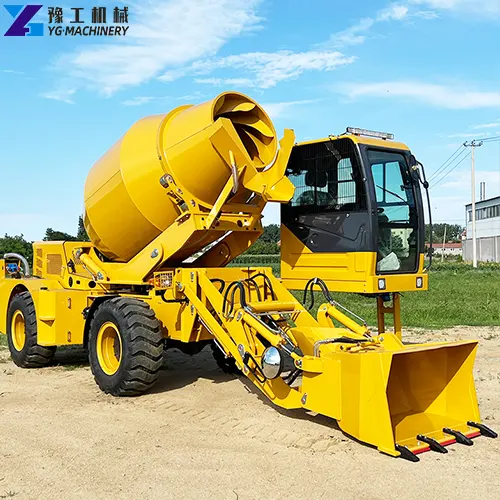
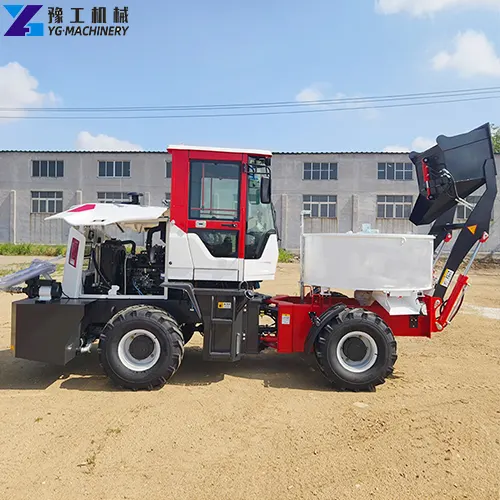
Concrete pouring for infrastructure projects in remote rural areas, small-scale municipal projects, and scattered construction sites commonly faces challenges such as high plant construction costs, long transport distances for concrete mixers, and significant waste from small-batch pouring. Traditional solutions require three machines: a loader, a mixing plant, and a transport truck, which is simply unaffordable for small projects. The self-loading concrete mixer truck is a mobile concrete production unit that integrates raw material loading, proportioning, mixing, and unloading. Its core function is to replace the traditional combination of a mixing plant, loader, and truck, producing concrete on-site, mixing as needed, and flexibly relocating the site, completely solving the cost problems associated with small-batch, long-distance pouring.
YG, as a professional engineering vehicle manufacturer, specializes in multi-capacity self-loading concrete mixer trucks. Its lightweight self-loader concrete mixer is suitable for ultra-small projects, with a full range covering capacities from 1.5 cubic meters to 4 cubic meters. Currently, it has been exported in batches to countries such as the Philippines, Kenya, Mexico, Nigeria, Vietnam, and Tanzania, and is widely applicable to rural infrastructure, remote construction sites, and small-scale municipal projects, especially suitable for construction areas with dispersed projects and inconvenient transportation.
Contact us now for more product information.
Click to Learn More About Self-Loading Concrete Mixer Trucks
YG Self-Loading Concrete Mixer Truck Technical Parameters
| Model | YG1.5 | YG2.6 | YG3.5 | YG4.0 |
| Output per Lot | 1.5 m³ | 2.6 m³ | 3.5 m³ | 4.0 m³ |
| Production Capacity | 8 m³/h | 11 m³/h | 15.5 m³/h | 18 m³/h |
| Engine Power | 55 KW | 78 KW | 85 KW | 91 KW |
| Climbing Capacity | 30° | 30° | 40° | 40° |
| Weight | 6300KG | 7000KG | 8250KG | 9000KG |
| Length/width/height | 6700*2340*2700mm | 6650*2700*3200mm | 7300*2750*3350mm | 7700*2950*3400mm |
| Wheelbase | 2500mm | 2770mm | 2750mm | 2950mm |
| Special Features | Optional Scales | Drum Lift & Rotation | AC, Enhanced Brakes | E-control, Water Meter |
| Drive System | Mechanical 4×2 | Mechanical 4×4 | Mechanical 4×4 | Full Hydraulic 4×4 |
| Max. Speed | 30 km/h | 35 km/h | 35 km/h | 45 km/h |
| Steering Type | Front Wheel | Articulated | Articulated | Rear Wheel |
| Hydraulic System | Open System | Open System | Rexroth Closed System | Open System |
Click to Learn More About Self-Loading Concrete Mixer Trucks

6 Key Features of YG Self-Loading Concrete Mixer Trucks
- Fully automatic loading and weighing system. The equipment comes equipped with a loading bucket and electronic weighing device. The amount of each material added—sand, cement, and water—is displayed in real-time on the cab screen with an accuracy of ±2%. The driver operates according to the formula, ensuring consistent concrete strength in each batch and eliminating the arbitrariness of manual batching.
- 270°/360° rotating unloading. The mixing drum can rotate 270° or even 360°, and with the retractable unloading chute, it can unload at multiple angles from the left, right, and rear sides of the vehicle. This allows for precise pouring without moving the truck in narrow construction sites or near irregularly shaped formwork, significantly improving site adaptability.
- Four-wheel drive off-road chassis. Equipped with 4×4 four-wheel drive and engineering tires, with a minimum ground clearance of 280- 330 mm and a maximum climbing angle of 30°, it can smoothly traverse mountain dirt roads, muddy construction sites, and gravel roads. It can go where ordinary concrete mixer trucks cannot.
- Integrated one-man operating system. All operations—bucket lifting, mixing drum rotation, water addition, and unloading—are completed from the cab via joysticks. One driver constitutes the entire production team, eliminating the need for multiple positions such as loader driver, mixer operator, and batching worker.
- Rapid and efficient mixing. From shoveling to discharge, a batch of concrete takes only 10-15 minutes. Taking the 3.5m³ model as an example, it can produce 3-4 batches per hour, with a daily output of approximately 80-120m³ (8-hour workday), 3-5 times faster than traditional manual mixing.
- Flexible mobility and quick relocation. The vehicle is 6-8 meters long, 2.5-3 meters wide, and has a minimum turning radius of 4-6.5 meters. It can navigate urban alleys and narrow rural roads. Multiple scattered construction sites can be rotated, eliminating the need for repeated station construction.
Click to Learn More About Self-Loading Concrete Mixer Trucks
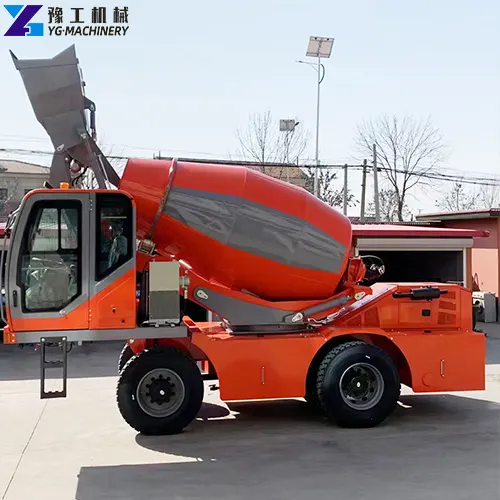

What Problems Can a Self-Loading Concrete Mixer Truck Solve for You?
- Save labor – One person does the work of an entire team. Traditional concrete production requires: 1 loader driver, 1-2 batching plant operators, and 1-2 material handlers, totaling 3-5 people. A self-loading mixer truck only requires one driver to handle everything. This can save $30,000-$50,000 in labor costs annually.
- Save on transportation costs – On-site mixing eliminates the need to travel. For construction sites more than 10 kilometers from the batching plant, commercial concrete transportation costs often account for more than 30% of the concrete cost. A self-loading mixer truck mixes directly on-site, saving on truck transportation costs and preventing the concrete from being wasted due to traffic jams.
- Save time – Mix as needed, no waiting. The biggest headache for small projects is waiting for commercial concrete: making phone calls, placing orders, and waiting for trucks can take half a day. A self-loading mixer truck can produce a batch in 10 minutes when needed, allowing you to completely control the pace.
- High adaptability – Goes almost anywhere. Road construction in mountainous areas, house building in rural areas, scenic area renovation, rooftop additions… these are areas inaccessible to large-scale concrete mixing plants and large concrete mixer trucks. Self-loading concrete mixer trucks, with their small size and strong off-road capabilities, can reach sites inaccessible to ordinary mixer trucks.
- Controllable quality – You Control the Formula. Different parts require different grades of concrete, and the formula can be adjusted at any time. C15 subbase, C20 foundation, C30 structural layer – one truck can handle it all. Electronic weighing ensures precise proportions and stable concrete quality.
Click to Learn More About Self-Loading Concrete Mixer Trucks

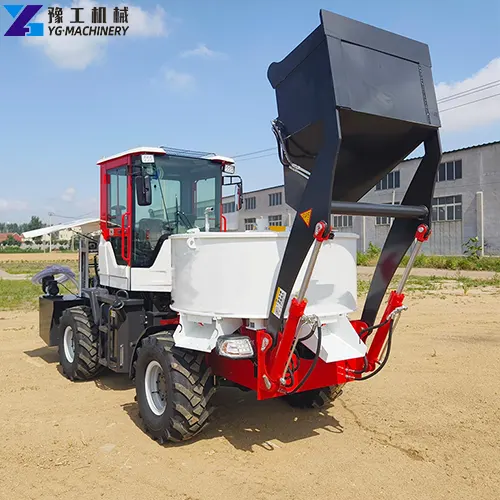
Where Can Self-Loading Concrete Mixer Trucks Be Used?
- Rural self-built houses and residential projects. Rural houses are often scattered and small-scale, making delivery from commercial concrete plants uneconomical. Self-loading mixer trucks can drive right to the doorstep, mixing concrete on-site, making them a standard piece of equipment for new rural construction.
- County and township roads and road maintenance. Projects like village road construction, road repair, and road widening have long operational lines and scattered work sites. Self-loading mixer trucks can work on the go, offering much more flexibility than fixed mixing plants.
- Water conservancy and mountain infrastructure. Reservoir dams, irrigation canals, and mountain drinking water projects are mostly located in remote areas with inconvenient transportation. The equipment can drive itself up to these sites and mix concrete on-site.
- Municipal maintenance and small-scale urban projects. Sidewalk renovation, manhole cover repair, and community road reconstruction—these are small-scale, numerous projects in cities. Self-loading mixer trucks are readily available, offering more economic and flexible options than commercial concrete trucks.
- Tunnel and bridge engineering. Tunnel interiors have limited space, preventing large equipment from entering. Small self-loading concrete mixer trucks can complete secondary lining and invert arch concrete pouring operations inside tunnels.
- Precast component plants and cement products. The production of precast components such as cement pipes, curb stones, and slope protection bricks requires frequent, small-batch production of different grades of concrete, which self-loading concrete mixer trucks can flexibly supply.
- Mining and plant infrastructure. For site hardening in mines, road construction in plants, and temporary facility construction, a single self-loading concrete mixer truck can be self-sufficient, eliminating reliance on external supplies.
- Leasing and equipment operation. Daily rental fees for self-loading concrete mixer trucks can reach $200-400, making them a popular category in the construction machinery rental market. With a quick return on investment, they are suitable for equipment leasing businesses.
Click to Learn More About Self-Loading Concrete Mixer Trucks

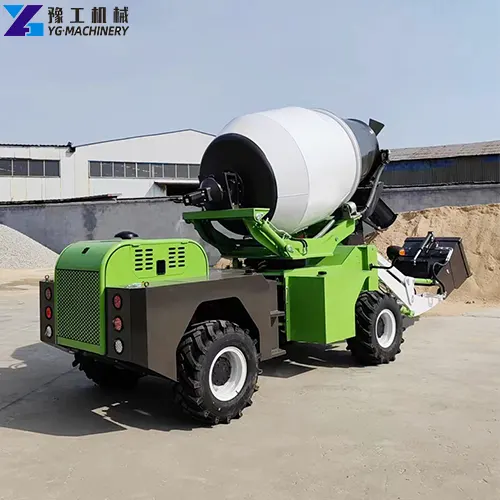
Case Studies of Customers in the Philippines and Kenya Using YG Self-Loading Concrete Mixer Trucks for Construction Projects
Case Study 1: Cebu Rural Road Project, Philippines
- Client Background: An infrastructure engineering company in Cebu, Philippines, undertook a rural road hardening project in mountainous areas. Construction sites were scattered across various villages, far from urban areas, with concrete mixing plant distances exceeding 50 kilometers, resulting in extremely high transportation costs and difficulties for concrete mixer trucks due to rugged mountain roads.
- Pain Points: Long and costly transportation of concrete, significant slump loss upon arrival at the site, and inconsistent quality; steep mountain roads preventing large concrete mixer trucks from traversing them; scattered construction sites making construction at a mixing plant uneconomical.
- Solution: Purchased two 3.5 cubic meter standard self-loading concrete mixer trucks for on-site mixing using locally sourced materials, suitable for the dispersed mountainous sites.
- Implementation Results: On-site use of aggregates eliminated the need for long-distance concrete transportation, reducing the cost per cubic meter of concrete by 40%; the four-wheel-drive chassis allowed for smooth operation on mountainous sites and even narrow roads; on-demand mixing prevented waste; flexible construction at scattered locations allowed for faster project completion.
- Project Completion Ahead of Schedule Customer Testimonial: “This self-loading concrete mixer perfectly solves the concrete problem in mountainous road construction. It’s flexible, cost-effective, and much more economical than commercial concrete. It’s an essential tool for construction sites in remote areas.”
Case Study 2: Nairobi, Kenya Residential Housing Project
- Client Background: A construction company in Nairobi, Kenya, undertakes suburban self-built housing and small factory projects. The projects are scattered, and previously, they used manual concrete mixing, which was inefficient, resulted in inconsistent strength, and increased labor costs.
- Pain Points: Manual mixing is inefficient and leads to long construction periods; mix proportions rely entirely on experience, resulting in inconsistent concrete strength and potential quality problems; projects are scattered, making it difficult to relocate fixed mixing plants.
- Solution: Purchase one 1.5 cubic meter lightweight self-loader concrete mixer, suitable for scattered residential housing projects.
- Implementation Results: One truck can operate across multiple construction sites, offering flexible relocation; eliminating the need for manual mixing, increasing efficiency by 5 times; electronic metering ensures stable mix proportions and guaranteed concrete strength, resulting in first-time acceptance; one driver can operate the machine, saving the cost of several workers; the equipment cost was recovered in less than a year.
- Customer Review: “The equipment is small and flexible, just the right size for residential projects. It saves labor, has stable quality, and is perfect for small projects. I plan to add another one to expand my business.”
Click to Learn More About Self-Loading Concrete Mixer Trucks
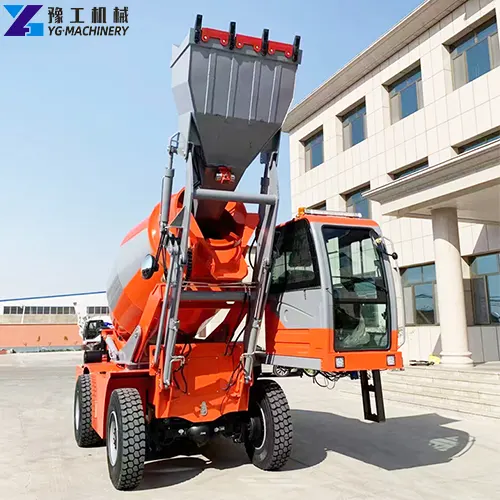
Frequently Asked Questions about YG Self-Feeding Concrete Mixer Trucks
A1: Regular mixer trucks can only transport concrete, not produce it. The self-loader model integrates loading, mixing, and transportation, allowing for independent concrete production without relying on a batching plant. It’s suitable for small, remote, and dispersed projects.
A2: Yes, the electronic metering system adjusts the ratio of sand, cement, and water, accurately producing grades from C15 to C30 to meet different construction needs, including flooring, foundations, and main structures.
A3: The four-wheel-drive off-road model features large-tread tires and a maximum climbing angle of 30°. It can travel normally on ordinary dirt roads, muddy mountain roads, and unpaved surfaces, adapting to complex field conditions.
A4: Under standard conditions, one person can complete all operations, including driving, loading, and mixing. For heavier workloads, one assistant can be added. No dedicated batching plant operator is required.
A5: Yes, the equipment comes with a large-capacity water tank, which can continuously operate multiple tanks once filled. An external water suction function is also optional, allowing water to be drawn directly from rivers, ditches, or reservoirs, making it suitable for remote construction sites without a water source.
A6: Yes, they are easy to replace. The blades are universal wear-resistant parts, bolted in place, and can be replaced without disassembling the tank. Compatible parts are generally available in local construction machinery markets, resulting in low maintenance costs.