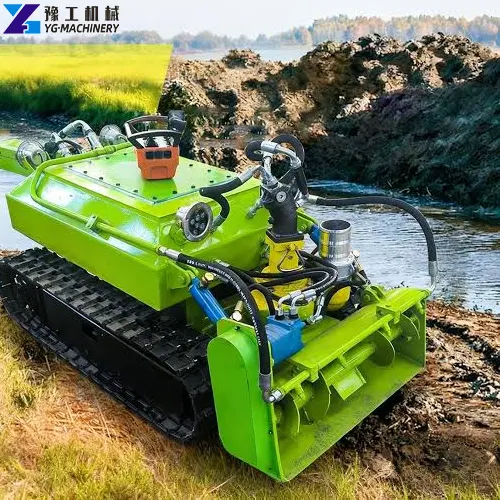

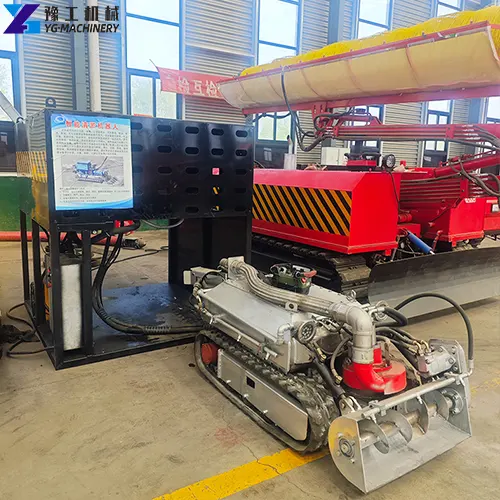
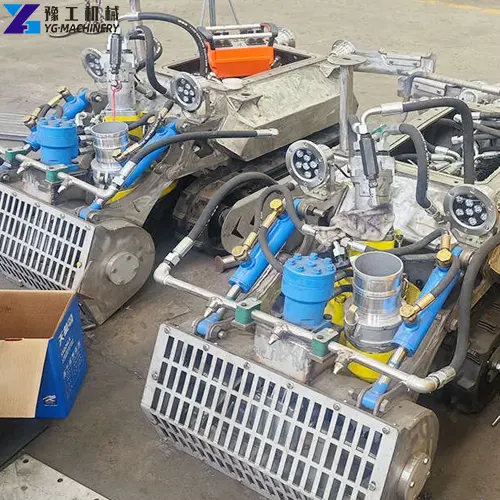
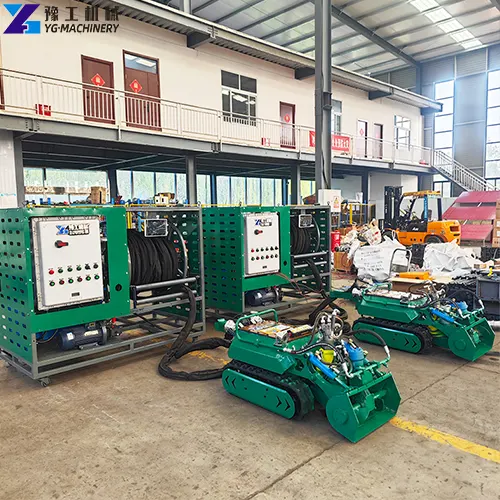
Traditional manual dredging, excavator dredging, and ordinary dredging vessels all suffer from drawbacks such as high risks to personnel entering the water, inability to access shallow water and pipe networks, low dredging concentration, and high subsequent treatment costs, which have long been construction challenges in the municipal and water conservancy industries. A dredging robot, also known as an underwater dredging robot, unmanned dredging machine, or intelligent dredging equipment, is a special engineering robot that can autonomously enter underwater and silty environments and be remotely controlled to complete the tasks of breaking up, extracting, and transporting silt. Its core function is to replace manual labor in dangerous waters, efficiently completing dredging operations while ensuring construction safety and significantly improving dredging efficiency.
YG, as a professional dredging equipment manufacturer, specializes in tracked unmanned dredging robots and also covers a full range of products, including pipe network-specific and deep-water models. These devices, also known as underwater dredging machines, intelligent dredging robots, and tracked dredging equipment, are currently exported in batches to countries with dense river networks and high infrastructure demand, such as Thailand, Bangladesh, Indonesia, the Philippines, Mexico, and South Africa, and are widely applicable to various dredging scenarios such as municipal rivers, drainage pipe networks, reservoirs, and lakes. If you are also interested, please contact us now for more product information.
Click Here Now for More Information About Dredging Robots
YG Hot-sale Remote Control Dredging Robot Technical Parameters
| Model | YG-500 | YG-600 | YG-700 | YG-800 | YG-900 | YG-1200 |
| Robot dimensions | 1500*500*650mm | 1500*600*650mm | 1600*700*650mm | 1600*850*700mm | 1650*960*750mm | 1900*1200*750mm |
| Dredging width | 500mm | 600mm | 700mm | 800mm | 900mm | 1200mm |
| Track travel speed | 3-15m/s | 3-15m/s | 3-15m/s | 3-15m/s | 3-15m/s | 3-15m/s |
| Robot weight | 320kg | 350kg | 380kg | 400kg | 420kg | 500kg |
| Pump output diameter | 3inch | 3inch | 4inch | 4inch | 4inch | 4inch |
| Pump flow rate(cubic meters/ hour) | 100 m³ | 100m³ | 200m³ | 200m³ | 200m³ | 200m³ |
| Hydraulic station dimensions(mm) | 2200*1200*1700 | 2200*1200*1700 | 2200*1200*1700 | 2200*1200*1700 | 2200*1200*1700 | 2120*1240*1200 |
| Main motor power | 22kw | 22kw | 30kw | 30kw | 30kw | 45kw |
| Hydraulic system pressure | 0-16Mpa | |||||
| Particle size | 15mm | 15mm | 38mm | 38mm | 38mm | 60mm |
| Reeling system speed | 0-10r/min | |||||
| Hydraulic hoses | 50m (Standard configuration) | |||||
| Control system | Wireless remote control | |||||
| Lighting system | Underwater LED lights *2 | |||||
Click Here Now for More Information About Dredging Robots
Where Are Dredging Robots Used?
- Municipal Drainage Networks: Underground stormwater pipes, sewage pipes, culverts, and inspection wells in cities—these spaces are often confined, contain many toxic and harmful gases, and manual entry is dangerous and inefficient. Dredging robots can be lowered into the well openings and clean along the pipes, making them standard equipment for municipal pipeline maintenance.
- Sewage Treatment Plant Sedimentation Tanks: Primary sedimentation tanks, secondary sedimentation tanks, and thickening tanks in sewage treatment plants require periodic cleaning of the bottom sludge. Previously, this required shutdown, pumping, and manual entry. Now, robots can directly dive in and clean, eliminating the need for shutdowns and pumping, making it safer and more efficient.
- Industrial Wastewater Pools and Sedimentation Tanks: Sedimentation tanks, equalization tanks, and tailings ponds in chemical plants, power plants, steel mills, and mines—the wastewater in these places is often corrosive and toxic, making it impossible for workers to enter. Dredging robots equipped with corrosion-resistant and explosion-proof modules can operate safely.
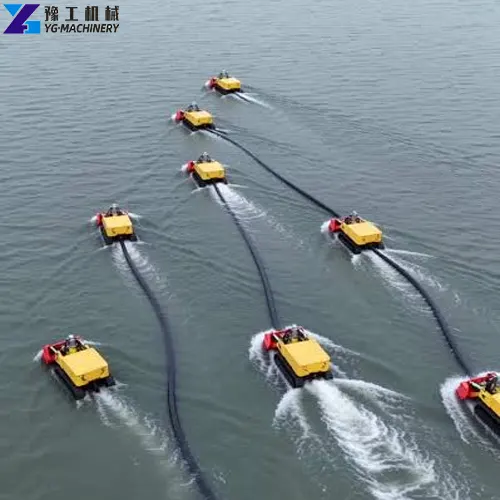
- Reservoir and Lake Dredging: Small reservoirs, landscape lakes, and artificial lakes can be dredged efficiently and flexibly using dredging robots. Without the need for dikes or pumping, the robots can directly submerge to the bottom, minimizing their impact on the aquatic environment.
- Rivers and Canals: For the dredging and maintenance of urban rivers, irrigation canals, and drainage ditches, dredging robots can enter from the bank and advance along the riverbank while dredging. This is more cost-effective and flexible than the traditional excavator + mud boat solution.
- Culverts and Tunnels: The removal of accumulated water and silt from highway culverts, railway culverts, and underground utility tunnels is ideal for dredging robots, especially in confined spaces where large equipment cannot enter, and manual labor is dangerous.
- Power Plant Cooling Towers and Ash Pools: Cooling tower pools and fly ash sedimentation tanks in power plants accumulate silt quickly and require frequent cleaning. Regular maintenance using dredging robots ensures cooling efficiency and safe production.
- Emergency Rescue and Disaster Relief: In emergencies such as urban flooding, pipe blockages, and water tank leaks, dredging robots can be quickly deployed to clear drainage channels and remove accumulated water, much faster than manual labor.
Hot Selling Markets and Suitable Regions
YG dredging robots have been sold to over 100 countries worldwide. Major hot selling markets include:
- Southeast Asia: Indonesia, Philippines, Vietnam, Thailand – Long rainy season, high drainage pressure, strong demand for pipeline maintenance.
- Middle East: Saudi Arabia, UAE, Qatar – Rapid infrastructure development, high demand for industrial and municipal dredging.
- Africa: Nigeria, Kenya, South Africa – Peak infrastructure construction period, drainage systems gradually improving.
- Latin America: Brazil, Colombia, Mexico – Rapid urban expansion, high demand for upgrading aging pipelines.
- Europe: Poland, Spain, France – Strict environmental regulations, high demand for safe and efficient dredging equipment.
Characteristics of suitable regions for using dredging robots: Areas with dense urban drainage networks, numerous sewage treatment plants, concentrated industrial enterprises, severe river and reservoir siltation, and frequent flooding during the rainy season.
Click Here Now for More Information About Dredging Robots

Dredging Robot Selection Guide: How to Choose for Pipelines, Pools, and Rivers
Different work scenarios require completely different dredging robot models. Choosing a robot that’s too large won’t allow it to enter the pipe, while choosing one that’s too small will result in low efficiency. Below is a selection guide categorized by scenario.
Municipal Pipeline Dredging
- Key Indicator: Pipeline Inner Diameter. The robot width must be smaller than the pipe diameter, allowing at least 100mm of margin.
- DN500-600 Pipelines → Select YG500 or YG600
- DN700-800 Pipelines → Select YG700 or YG800
- DN900 and above Pipelines or Box Culverts → Select YG900 or YG1200
- Additional Consideration: How many bends are in the pipeline? For small turning radii, choose a short-body model.
Sedimentation/Regulating Tank Dredging
- Key Indicators: Tank size and depth
- Small tanks (under 100㎡) → YG600 or YG700 sufficient
- Medium tanks (100-500㎡) → YG800 or YG900
- Large tanks (over 500㎡) → YG1200, or multiple units working together
- Additional Considerations: For water depths exceeding 15 meters, choose a deep-water model; for corrosive environments, choose a corrosion-resistant model.
River/Reservoir Dredging
- Key Indicators: Dredging area, silt thickness, working environment
- Small rivers, landscape lakes → YG900 offers high cost-effectiveness
- Large rivers, reservoirs → YG1200 offers high efficiency
- Additional Considerations: Water flow speed? High flow rates require counterweights or anchoring devices; turbid water necessitates sonar.
Special Industrial Environments
- Chemical and Pharmaceutical Plants → Corrosion-resistant models (316L stainless steel + anti-corrosion coating) are mandatory.
- Coal Mines and Petrochemical Plants → Explosion-proof models (explosion-proof certification) are mandatory.
- High-Temperature Water Tanks → Confirm the equipment’s high-temperature resistance range; custom high-temperature seals may be necessary.
Still unsure? Tell YG’s sales engineers about your operating conditions, and they will help you select the most suitable model.
Click Here Now for More Information About Dredging Robots
Frequently Asked Questions about Dredging Robots
A1: The standard YG dredging robot is IP68 waterproof, with a maximum working depth of 15-30 meters. Custom-designed deep-water models can reach 50 meters. It covers most scenarios, including municipal pipelines, sedimentation tanks, reservoirs, and rivers.
A2: Efficiency varies depending on the model: YG500/600 approximately 100 m³/h, YG700/800 approximately 160 m³/h, YG900 approximately 200 m³/h, and YG1200 up to 250 m³/h. Actual efficiency may vary slightly depending on silt concentration and particle size.
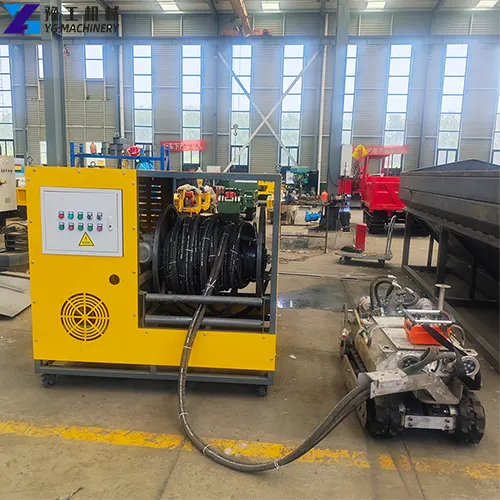
A3: Absolutely not. Operators control the robot from the shore via remote control and real-time video monitoring. Workers are kept away from confined spaces with toxic or hazardous substances, fundamentally eliminating the safety hazards of manual dredging.
A4: The YG dredging robot can handle particles with a maximum diameter of 15- 50 mm (depending on the model), effectively sucking up small stones, gravel, and debris. For oversized objects, the robot’s built-in suction head can break them up before suction.
A5: It uses a tracked chassis with a maximum climbing angle of 30°, allowing it to move stably on complex terrains such as silt, gravel, and steps. It can overcome obstacles up to 130mm high, adapting to scenarios with varying pipe joint heights and uneven pool bottoms.