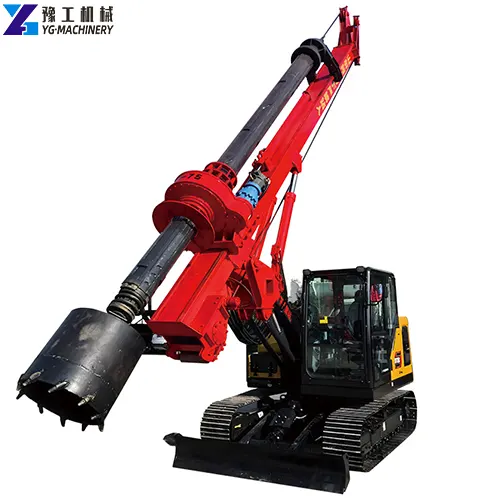
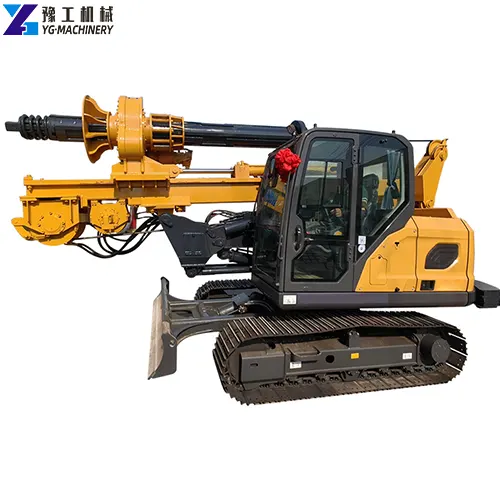
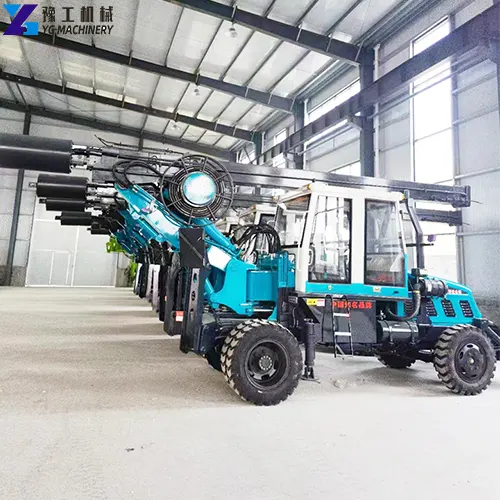
When building skyscrapers, bridges, or factories, the first step isn’t laying bricks, but driving piles into the ground. And the first step in pile driving is drilling a sufficiently deep and straight hole in the ground. The machine used for this work is called a pile foundation drilling machine, often referred to as a rotary drill rig. Tracked models are called crawler rotary drilling rigs, and they can replace solar pile drivers and excavator pile drivers to complete complex pile foundation operations. This machine rotates its drill bit to drill through soil and rock, remove debris, and maintain hole stability using mud or casing methods. If your project also needs a rotary drilling rig to improve efficiency, please contact us now for more product information.
Get Factory Direct Pricing Today
YG Pile Foundation Drilling Machine Technical Parameter
| Dimensions (mm) | 7900*2260*3100 |
| Vehicle mass (kg) | 8000 |
| Wheelbase (mm) | 3150 |
| Wheelbase (mm) | Front 1400 After 1060 |
| Drilling depth (m) | 13 |
| Drilling diameter (mm) | 600-1600 |
| Rotation angle | 180 degree |
| Walking speed (km/h) | 50 |
| Gear pump model | CBJT2080 |
| Hydraulic system working pressure (Mpa) | 20-25 |
| Hydraulic system displacement (ml/r) | 80 |
| engine model | 4108 |
| Engine power (kW) | Hydraulic system working pressure (MPa) |
Get Factory Direct Pricing Today
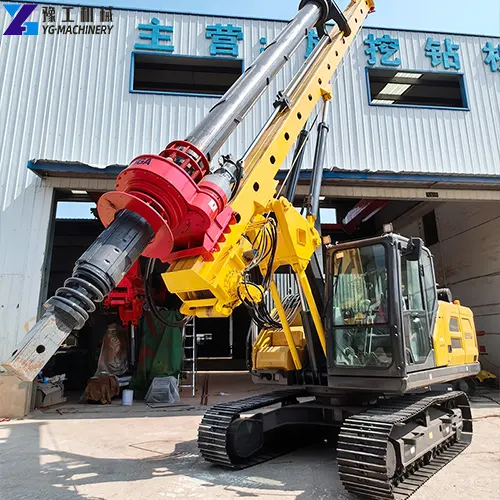
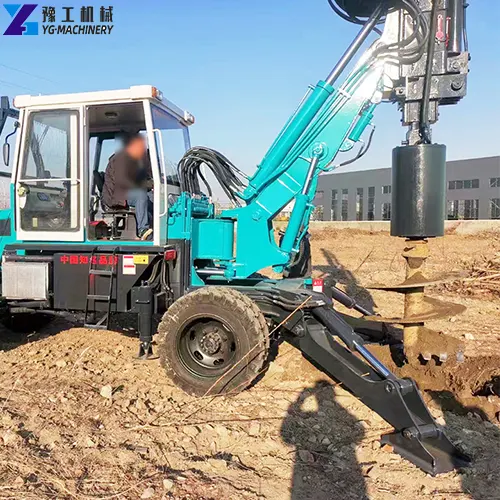
How Does a Pile Foundation Drilling Machine Work? Understanding the Rotary Drilling Process
- Positioning and Setup. The operator drives the crawler rotary drilling rig to the designated pile location. Outriggers extend to level the machine. The electronic verticality system calibrates automatically.
- Drill String Assembly. The operator connects the appropriate drill bit to the Kelly bar. For deep holes, multiple Kelly bar sections extend to reach the target depth.
- Rotation and Penetration. The power head rotates the drill string at 10-40 RPM while hydraulic cylinders apply downward pressure (WOB – Weight on Bit). The drill bit teeth cut into soil or rock.
- Soil Removal. The drill bit design carries cut material into its chamber. When full, the operator lifts the string out of the hole. The bucket opens to discharge debris.
- Cycle Repetition. This cycle repeats until the borehole reaches design depth. The entire process for a 20-meter pile in ordinary soil typically takes 2-4 hours.
- Cleaning and Inspection. Final cleaning removes loose sediment from the hole bottom. The operator verifies depth and verticality before placing the reinforcement cage.
- Concrete Placement. Workers lower the reinforcement cage, then the tremie pipe pours concrete from the bottom up, displacing drilling slurry.
Get Factory Direct Pricing Today
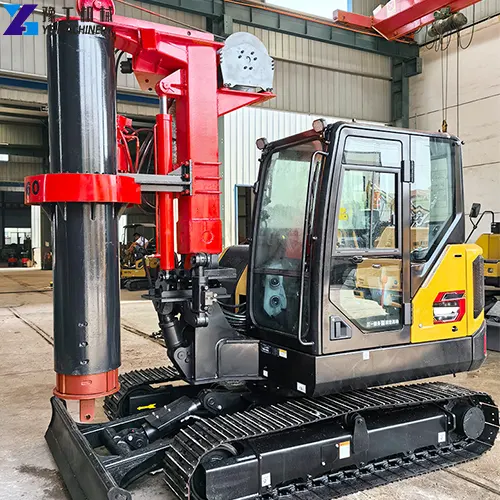
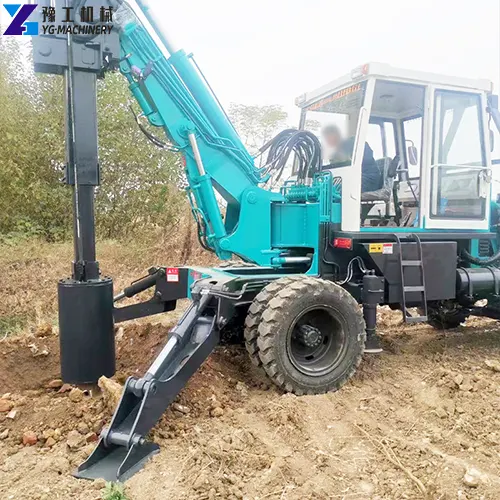
6 Key Features That Make Modern Pile Foundation Drilling Machines Superior
Feature 1: Powerful Hydraulic Torque System
The heart of any rotary drill rig lies in its torque output. YG machines deliver 36-450 kN·m of rotational force, enabling efficient drilling through:
- Soft clay and silt.
- Dense sand and gravel.
- Partially weathered rock.
- Hard rock (with appropriate bits).
Variable torque settings allow operators to match power to soil conditions, reducing energy waste and tool wear.
Feature 2: Intelligent Verticality Control
Advanced pile foundation drilling machines incorporate:
- Dual-axis tilt sensors (±0.1° accuracy).
- Real-time digital displays.
- Automatic correction alerts.
- Data logging for quality records.
This technology ensures verticality errors below 1%, meeting stringent foundation specifications for tall structures.
Feature 3: Telescopic Kelly Bar System
The Kelly bar (also called telescopic drill pipe) provides remarkable drilling depth without excessive machine height:
- 3-6 sections nest inside each other during transport.
- The extended length reaches 60-80 meters.
- Friction-type bars for soil; interlocking-type for rock.
- Quick-couple connectors speed up handling.
Feature 4: Versatile Drill Bit Options
Different geological conditions demand different tools. Quality drilling rigs accept multiple drill bit types:
- Short auger/Soil bucket: Ideal for clay, silt, and sand.
- Rock bucket: Reinforced teeth for gravel and weathered rock.
- Barrel core barrel: Extracts rock cores for geological analysis.
- Tricone bit: Crushers for hard limestone and sandstone.
- CFA (Continuous Flight Auger): Hollow-stem auger for concrete placement.
Feature 5: Crawler Mobility System
The crawler rotary drilling rig chassis offers unmatched site mobility:
- 400-500mm wide tracks reduce ground pressure.
- Self-propelled movement eliminates towing.
- 30° gradeability handles slopes.
- 360° rotation enables positioning flexibility.
- Variable track width (expandable undercarriage) stabilizes on uneven ground.
Feature 6: Operator-Focused Control Cab
Modern pile driver equipment prioritizes operator comfort and safety:
- Climate-controlled enclosed cab (air conditioning/heating).
- Low-noise design (under 85 dB inside).
- Ergonomic seat with joystick controls.
- Multi-language display screens.
- Rear-view cameras for site safety.
- Emergency stop buttons within reach.
Get Factory Direct Pricing Today
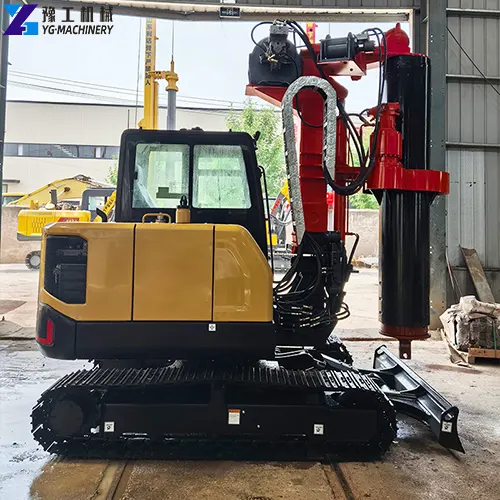
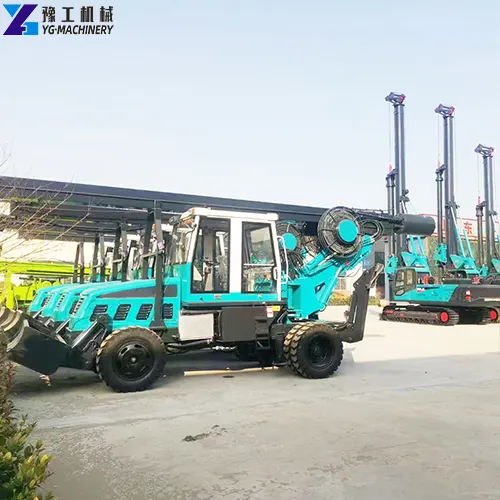
10 Critical Application Areas for Pile Foundation Drilling Machines
- High-Rise Building Foundations. Urban high-rises demand deep, high-capacity piles to transfer building loads to stable strata. Rotary drill rigs create large-diameter bored piles (1.0-2.5m) reaching 40-80m depth, providing bearing capacities of 3,000-8,000 kN per pile.
- Highway and Railway Bridge Piles. Bridge foundations must resist both vertical loads and lateral forces from traffic. Crawler rotary drilling rigs work in riverbeds and marshy areas, drilling piles that anchor structures to bedrock or dense sand layers.
- Elevated Highway and Railway Viaducts. Urban transit infrastructure requires hundreds of identical piles through soft urban soils. Rotary drilling rigs deliver consistent quality and production rates that traditional methods cannot match.
- Commercial and Industrial Building Foundations. Warehouses, factories, and data centers require expansive foundation systems. Medium-sized rotary drilling rigs (torque 150-250 kN·m) provide ideal capacity for these projects.
- Seaport and Harbor Structures. Marine foundations face aggressive environments with water ingress and soft seabed soils. Rotary drilling rigs equipped for offshore conditions create piles that anchor quay walls and cargo handling equipment.
- Solar and Wind Farm Foundations. The renewable energy sector creates a massive demand for efficient foundation solutions. Solar pile drivers specialize in driving ground screws and pipe piles for photovoltaic panel arrays. YG’s solar pile driver achieves 300+ pile installations per day with GPS-guided precision.
- Retaining Walls and Diaphragm Walls. Diaphragm wall construction uses modified rotary drilling rigs to create structural walls below ground level. These walls support deep excavations for basements, subway stations, and flood control structures.
- Foundation Reinforcement and Underpinning. Existing structures requiring additional support benefit from drilled micropiles. Compact rotary drilling rigs work in confined spaces where larger equipment cannot operate.
- Slope Stabilization and Landslide Prevention. Mountainous construction requires anchoring unstable slopes. Anchor drilling rigs mounted on rotary platforms create tensioned rock bolts and grouted piles that stabilize slopes.
- Industrial Equipment Foundations. Heavy machinery foundations for turbines, generators, and presses demand precise, high-capacity pile groups. Rotary drilling rigs provide the accuracy and capacity these installations require.
Get Factory Direct Pricing Today
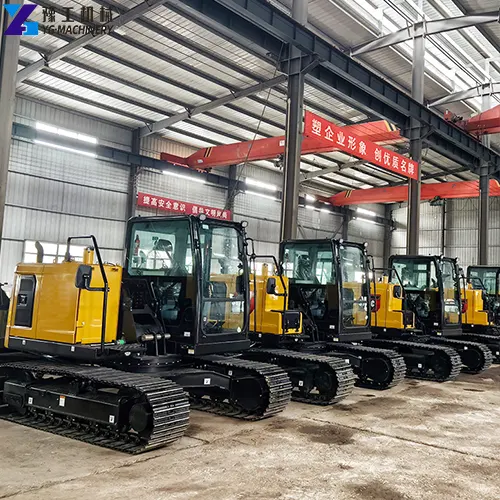
Frequently Asked Questions about Pile Drilling Rigs
A1: For narrow sites and flat terrain, choose a wheeled model—it’s cheaper and easier to move around. For rugged, muddy, or deep pile/hard rock sites, choose a tracked model—it has better stability and higher load-bearing capacity.
A2: Yes. Use a sand scoop (straight cylinder with teeth) for clay layers, a spiral drill bit (blades with teeth) for sand layers, and a cutting die (rotary cone or cutting teeth) for hard rock layers. YG provides all three types of drill bits for quick on-site switching.
A3: Excavator pile drivers are a very economical and efficient option, especially suitable for small to medium-sized projects with limited space or budgets. As long as the hydraulic system is properly matched, its operating performance is very reliable.
A4: Routine maintenance includes checking fluid levels (engine oil, hydraulic oil, coolant), inspecting tracks and chassis, lubricating pivot points, and checking drill bits. It is recommended to allow 15-20 minutes before and after each shift for routine checks.
A5: Rotary drilling encounters difficulties in the following situations:
1. Areas with boulders exceeding 1 meter in diameter.
2. Loose sand layers requiring continuous casing.
3. Strongly acidic or chemical environments affect the equipment.
4. Site conditions with underground obstacles (old foundations, utilities).
5. Please review the geotechnical report before selecting equipment.
A6: Operation is simple, with an intelligent panel and handle control; 1-2 days of training is sufficient to learn how to operate it; the manufacturer provides free operation manuals, videos, and remote guidance.