What Is a Pass Through Shot Blasting Machine?
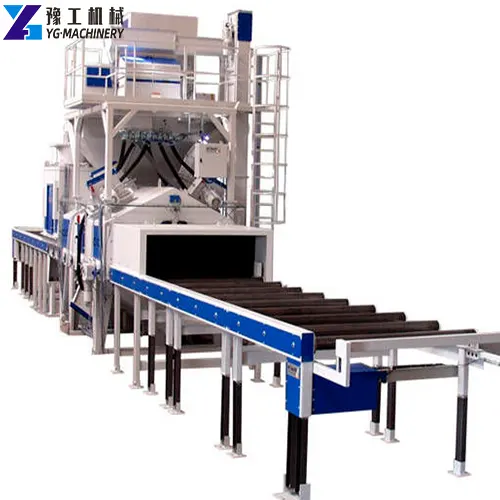
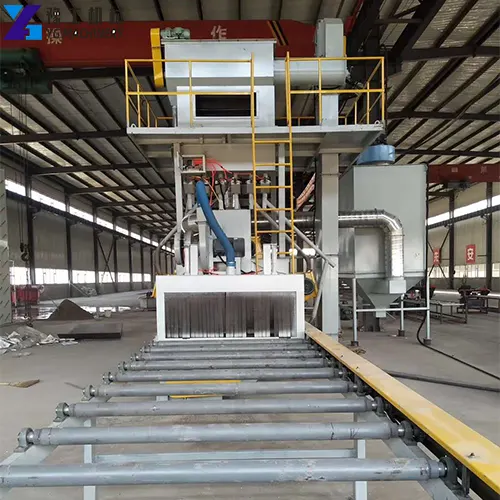
A pass through shot blasting machine is a continuous surface treatment system for metal workpieces that can travel through a blast chamber. It is also commonly called a roller conveyor shot blasting machine, steel plate shot blasting machine, or steel structure blasting machine.
Instead of loading one part into a cabinet or manually blasting each surface, operators place the workpiece on an infeed roller conveyor. The conveyor carries it through a sealed blast chamber. Blast wheels throw steel shot or steel grit toward the workpiece from selected angles. After blasting, the workpiece exits through the outfeed roller conveyor for inspection, painting, coating, fabrication, or storage.
This type of shot blast cleaning machine is commonly used in steel fabrication lines where material flow, cleaning consistency, and production continuity matter.
Typical applications include:
- Steel plate and sheet preparation before painting or cutting
- H-beams, I-beams, channels, angles, and structural profiles
- Steel pipes, tubes, and fabricated pipe sections
- Bridge components and heavy steel structures
- Pressure vessel parts and large welded assemblies
- Castings, forgings, and fabricated metal components
- Shipbuilding steel sections and marine fabrication materials
- Pre-treatment for an automatic shot blasting line and coating line
Would you like more information about the products? Contact us.
Find the Right Pass-Through Machine for Your Workpieces (H-Beam, Plate, Pipe)
YG Hot-sale Pass-Through Shot Blasting Machine Technical Parameters
| Parameter | YG-698 | YG-6912 | YG-6915 | YG-6920 | YG-6925 | YG-6930 | YG-6940 |
| The effective cleaningwidth(mm) | 800 | 1200 | 1500 | 2000 | 2500 | 3000 | 4000 |
| The room feed-insize(mm) | 1000*400 | 1400*400 | 1700*400 | 2200*400 | 2700*800 | 3200*800 | 4200*400 |
| The length of the workpiece (mm) | 1200-12000 | 1200-1600 | 1200-12000 | 1200-12000 | 3000-12000 | 2400-12000 | 4500-18000 |
| The speed of the conveyor(m/min) | 0.5-4 | 0.5-4 | 0.5-4 | 0.5-4 | 0.5-4 | 0.5-4 | 0.5-4 |
| The thickness of the cleaning steel sheet(mm) | 3-60 | 3-60 | 1.5-60 | 3-60 | 3-60 | 3-110 | 4.5-100 |
| The section steelspecification(mm) | 800*300 | 1000*300 | 1500*300 | 2000*300 | 2500*700 | 3000*700 | 4000*300 |
| The quantity of shotblasting(kg/min) | 4*180 | 4*250 | 4*250 | 6*250 | 6*250 | 6*360 | 8*360 |
| The first enclosedquantity(kg) | 4000 | 4000 | 4000 | 4500 | 4500 | 8000 | 11000 |
| Roll brush adjustingheight(mm) | 200 | 200 | 350 | 450 | 600 | 850 | 900 |
| Total power (kW) | 90 | 78.3 | 113.5 | 156.6 | 204.8 | 224.55 | 293.6 |
| Airness size(m3/h) | 22000 | 17560 | 19000 | 19550 | 27758 | 28050 | 38000 |
Contact Engineer for Pit & Layout Requirements


How Does the Roller Conveyor System Work?
A roller conveyor shot blasting machine creates a continuous workflow from loading to surface preparation and unloading.
1. Infeed Roller Conveyor
The infeed conveyor brings steel plates, profiles, pipes, or structures into the blast chamber. It reduces repeated manual lifting and helps maintain a consistent production sequence.
For the customer, this means less material handling between processes and a more organized fabrication line.
2. Blast Chamber and Blast Wheels
Inside the blast chamber, multiple blast wheels project steel shot or steel grit toward the moving workpiece. The number, power, angle, and placement of blast wheels are selected according to the workpiece geometry and expected cleaning result.
For example, flat plates need different coverage from H-beams, pipes, or complex welded structures. A proper wheel layout helps reach more surfaces and reduces the risk of untreated shadow areas.
3. Abrasive Recovery and Recycling System
After impact, the abrasive falls into the recovery system. A typical configuration may include a screw conveyor, bucket elevator, abrasive separator, storage hopper, and abrasive delivery system.
This system separates reusable abrasive from dust, broken particles, scale, and contaminants. Recovered abrasive can return to the blast wheels for further use.
For the customer, efficient abrasive recycling can reduce unnecessary media consumption and support stable cleaning performance over longer operating periods.
4. Dust Collection System
Shot blasting produces dust from rust, mill scale, coatings, abrasive fines, and surface contaminants. A dust collector helps capture airborne dust and improve the working environment around the production line.
The dust collection system should be considered according to local environmental requirements, workpiece condition, production volume, and plant ventilation design.
5. Sealing Curtains and Wear-Resistant Protection
Sealing curtains help limit abrasive escape at the machine entry and exit. Wear-resistant liners and protective plates help protect high-impact areas inside the blast chamber.
These components do not eliminate maintenance, but a suitable wear-protection design can reduce premature chamber damage and help limit unplanned downtime.
Can It Achieve Sa 2.5 Surface Preparation?
Many steel fabrication projects require a specified surface cleanliness grade before coating, such as Sa 2, Sa 2.5, or another project-defined standard. Sa 2.5 is commonly referred to as near-white metal blast cleaning and is widely used as an acceptance level for industrial coating preparation.
A properly configured pass through shot blasting machine can be designed to support a target such as Sa 2.5 for suitable workpieces and process conditions. However, YG should confirm the requirement based on your actual steel condition, material geometry, coating specification, abrasive media, line speed, and cleaning test requirements.
If your project has a coating specification, please send it with your inquiry. This helps us evaluate whether the machine configuration, abrasive type, blast wheel layout, and conveyor speed are appropriate.
Get a Factory-Direct Quote on Pass-Through Machines


How to Select the Right Machine for Your Line
Before asking for a quotation, prepare the information that determines whether a roller conveyor system fits your production line.
1. Workpiece dimensions
Provide the maximum:
- Width
- Height
- Length
- Weight
- Wall thickness, where relevant
- Quantity processed per hour or per day
The machine opening must provide adequate clearance for the largest workpiece. The roller conveyor must also support the maximum load safely.
2. Steel type and starting condition
Tell us whether you process:
- New hot-rolled steel with mill scale
- Lightly rusted steel plate
- Heavily corroded structures
- Welded components with spatter or scale
- Used steel requiring coating removal
- Pipes, profiles, beams, or mixed workpieces
Different starting conditions may require different blasting intensity, abrasive selection, and conveyor speed.
3. Target cleaning level and profile
Specify the required surface standard, coating manufacturer recommendation, roughness requirement, and whether the steel will move directly to painting, galvanizing, welding, or storage after blasting.
4. Required capacity
A good machine is not simply the largest machine. It should match your real output target.
Tell YG:
- Required tons per hour, pieces per hour, or square meters per hour
- Daily production hours and number of shifts
- Batch production or continuous production needs
- Whether workpieces have different sizes
- Whether the equipment must connect with an existing production line
5. Factory layout and utilities
Please provide your available workshop dimensions, power supply, floor plan, crane capacity, loading direction, dust-control requirements, and desired loading/unloading method.
This allows YG to propose a more practical automatic shot blasting line configuration rather than a generic machine quotation.
Match Throughput to Your Production Capacity – Calculate Now

Pass-Through Shot Blasting Machine vs. Other Cleaning Equipment
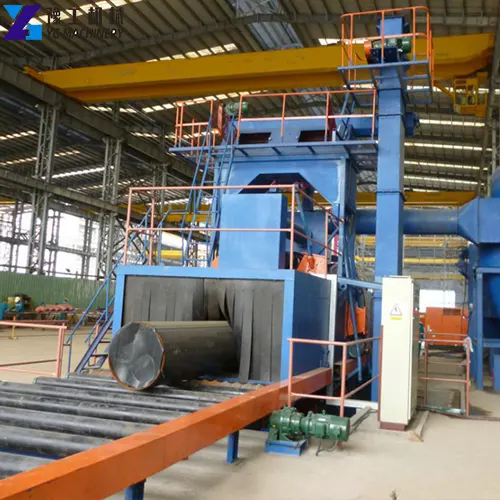
YG provides several types of surface preparation equipment because different jobs require different processes. Choosing the correct equipment can improve efficiency and avoid unnecessary investment.
| Equipment | Best Suited For | Not the Best Choice When |
| Pass-through shot blasting machine | Continuous treatment of plates, beams, pipes, profiles, and repeatable large workpieces | The workpiece is oversized, highly irregular, or cannot travel on a roller conveyor |
| Sandblasting room/blast room | Large, irregular, heavy, or complex workpieces that need manual or semi-automatic blasting | You need a high-volume continuous production line for uniform workpieces |
| Industrial shot blasting machine | Castings, forgings, wheels, hooks, tumbling parts, or specific production processes | A standard machine type does not match your workpiece handling method |
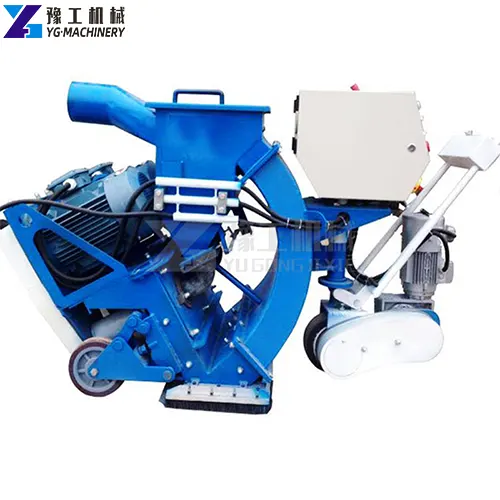
| Road surface shot blasting machine | Concrete or asphalt surface preparation, coating removal, bridge deck treatment, and road maintenance | You need to clean steel plates, beams, or fabricated metal parts in a factory |
| Portable sandblasting machine | Local repair, small-batch work, field maintenance, and flexible spot treatment | You need automated, high-throughput, repeatable processing |
| Dry ice blasting machine | Non-abrasive cleaning where residue control is important, such as molds, equipment maintenance, electrical-sensitive areas, or certain cleaning tasks | You need aggressive rust removal, mill-scale removal, or a defined steel surface profile |
Why Choose YG Machinery?
YG Machinery supports overseas customers looking for industrial surface treatment equipment that fits their actual production requirements.
1. Project-based equipment selection
We do not recommend a conveyor opening or blast wheel arrangement based only on a keyword inquiry. Our team can evaluate your workpiece drawing, maximum dimensions, steel condition, production target, and factory layout before suggesting a configuration.
2. More than one surface treatment option
YG can support customers with a wider product range, including:
- Pass-through shot blasting machines
- Roller conveyor shot blasting machines
- Sandblasting rooms and blast rooms
- Industrial shot blasting machines
- Road surface shot blasting machines
- Portable sandblasting machines
- Dry ice blasting machines
This helps customers compare equipment based on their workpiece, process, dust-control needs, and investment plan.
3. Support for export projects
For international buyers, equipment selection is only one part of the project. You may also need to consider export packing, container loading, installation planning, electrical requirements, spare parts, operator training, and remote technical communication.
YG can discuss these points before shipment so your project team can prepare for installation and commissioning.
4. Parts and maintenance planning
Shot blasting equipment contains wear parts that require planned inspection and replacement. Common maintenance areas may include blast wheel parts, liners, sealing components, abrasive recycling components, conveyor rollers, and dust collector consumables.
A reasonable spare-parts plan can help reduce avoidable downtime after the machine enters production.