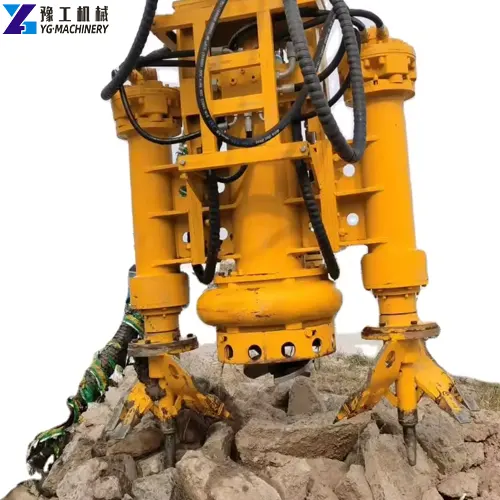

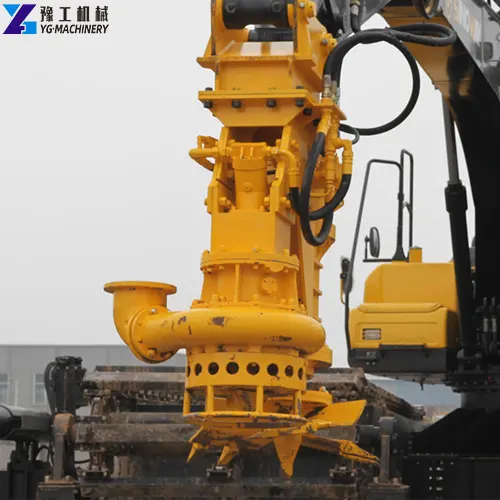
In river dredging, sand extraction, and tailings treatment projects, traditional stationary sand pumps and dredging vessels generally suffer from drawbacks such as difficulty in relocation, high investment costs, and inability to operate in shallow waters, resulting in extremely low return on investment for small projects. Excavator dredge pumps, also known as excavator dredging pumps, hydraulic sand pumps, submersible sand dredging attachments, or excavator mud pumps, are hydraulically driven underwater pumping devices mounted on the boom of an excavator. Their core function is to convert excavators into mobile sand dredging platforms, completing silt extraction and dredging operations in rivers, reservoirs, and tailings ponds without the need to purchase separate dredging vessels or fixed pumping stations, significantly reducing equipment investment.
YG, as a professional excavator attachment manufacturer, specializes in hydraulic sand pump attachments suitable for all tonnage sizes, also known as excavator dredge pump attachments. They also offer a full range of excavator attachments, including hydraulic breakers, log grapples, and breaker buckets, providing a one-stop solution to meet the diverse construction needs of engineering teams. Our products are currently exported in bulk to countries with dense river networks and abundant sand and gravel resources, such as Indonesia, Bangladesh, Nigeria, Brazil, Peru, and Vietnam. They are suitable for various construction scenarios, including river dredging, sand mining, and tailings treatment. If you are interested, please contact us now for more product information.
Click Here to Send an Inquiry and Get More Detailed Information About Excavator Dredge Pump
YG Hot-sale Excavator Dredge Pump Technical Parameters
| Model | Flow(m³/h) | Lift(m) | Matching Agitator | Stirrer Torque(N·m) | Excavator Tonnage |
| YG200-15 | 200 | 15 | 5.5kW | 1556 | 10-20T |
| YG150-30 | 150 | 30 | 5.5kW | 1556 | 10-20T |
| YG300-20 | 300 | 20 | 5.5kW | 1556 | 10-20T |
| YG400-10 | 400 | 10 | 7.5kW | 1946 | 20-30T |
| YG500-15 | 500 | 15 | 7.5kW | 1946 | 20-30T |
| YG250-35 | 250 | 35 | 7.5kW | 1946 | 20-30T |
| YG300-30 | 300 | 30 | 15kW | 2433 | 30-40T |
| YG400-30 | 400 | 30 | 15kW | 2433 | 30-40T |
| YG400-40 | 400 | 40 | 15kW | 2433 | 30-40T |
Model naming convention: YG + Flow Rate – Head. For example, YG400-30 represents a flow rate of 400 m³/h and a head of 30 meters.
You can choose between a “high flow rate, low head” or “low flow rate, high head” model based on your project needs. For example, select YG500-15 (high flow rate) for large-area river dredging, and YG400-40 (high head) for long-distance pipeline transportation.
Click Here to Send an Inquiry and Get More Detailed Information About Excavator Dredge Pump
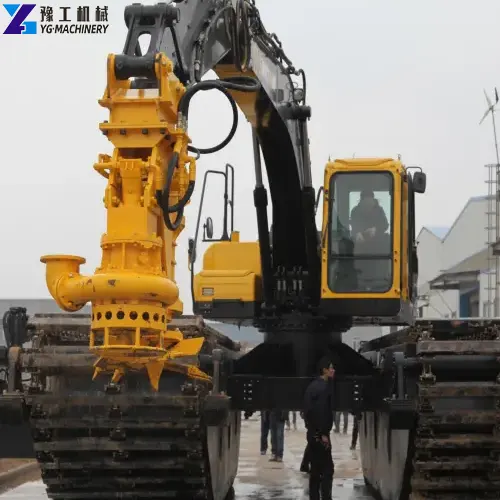
8 Application Areas of Excavator-Powered Sand Dredging Pumps
- River Dredging and Silt Removal – Removing silt from urban, rural, and scenic waterways to restore flood control and self-purification capabilities. This is the most common application scenario for excavator-powered sand dredging pumps.
- Port and Wharf Dredging – Maintaining waterway depth in ports, wharves, and locks, removing silt and sediment to ensure navigable water depth.
- Reservoir and Lake Dredging – Restoring reservoir capacity and ecological dredging of lakes, removing years of accumulated silt and pollutants.
- Sand Dredging and Mining Projects – River sand extraction, reservoir sand dredging, and land reclamation using sand, replacing traditional sand dredgers with flexibility and efficiency.
- Tailings Treatment and Mining – Tailings slurry transportation in mineral processing plants, tailings dam cleaning, mine drainage and sludge removal, and sedimentation tank dredging, etc.
- Fishpond and Aquaculture Farm Dredging — Removing silt from the bottom of fishponds and shrimp ponds to improve water quality and increase aquaculture density and yield.
- Municipal Engineering and Environmental Protection — Dredging of sedimentation tanks in sewage treatment plants, cleaning of regulating reservoirs, and removal of silt from stormwater and sewage separation projects.
- Flood Control and Emergency Response — Emergency operations such as clearing river channels before the flood season, soil extraction for dike reinforcement, and drainage of stagnant water pits.
YG’s hydraulic sand pump for excavators has been sold to more than 100 countries and regions worldwide. Popular markets include Indonesia, the Philippines, Vietnam, Thailand (Southeast Asia), Nigeria, Kenya, Ghana (Africa), Saudi Arabia, the UAE, Oman (Middle East), Brazil, Peru, Chile (Latin America), as well as Australia and the United States. River dredging in Southeast Asia, sand mining projects in Africa, port maintenance in the Middle East, and mine tailings treatment in Latin America are all high-frequency application scenarios.
Click Here to Send an Inquiry and Get More Detailed Information About Excavator Dredge Pump
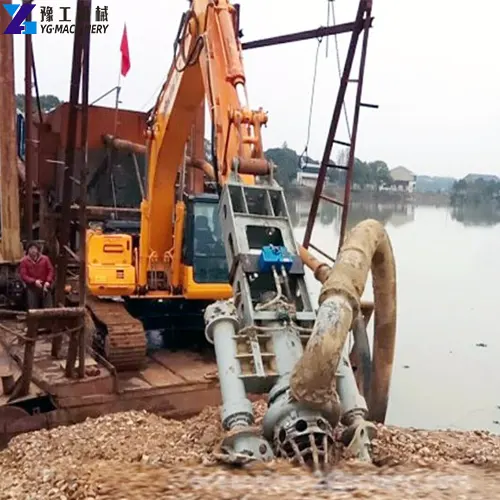

Case Studies and Results of Customers in Indonesia and Dubai Using YG Excavator Attachments and Sand Pumps
Case Study 1: Jakarta River Dredging Project, Indonesia
Client Background: A municipal engineering company in Jakarta, Indonesia, primarily undertakes urban river dredging and flood control projects. Jakarta frequently experiences flooding during the rainy season, and the municipal government allocates an annual budget for river dredging.
Problems Encountered: Previously, the traditional method of manually dredging the river and transporting the dredged material by small boats was extremely inefficient, taking three months to dredge a 2-kilometer stretch of water. Furthermore, worker safety was not guaranteed, and work was impossible during the rainy season.
Solution: In 2024, two YG500-15 excavator dredge pump attachments were purchased from YG, paired with the client’s existing 25-ton excavator. The equipment is mounted on the excavator’s boom, and with the extended boom, it can reach deep into the middle of the river for dredging.
Results:
- Each pump can actually remove approximately 250-300 cubic meters of silt per hour (with a sand concentration of approximately 50%).
- The dredging period for a 2-kilometer river channel has been reduced from 3 months to 20 days.
- The number of construction workers has been reduced from 20 to 4 (1 excavator operator + 1 assistant + 2 pipeline maintenance personnel).
- Overall costs have been reduced by approximately 60%.
Customer Testimonial: “Previously, we couldn’t finish dredging the river before the rainy season, but now it’s easily done. The equipment is very easy to operate; our excavator operator learned it in just one day. We’ve already purchased a third unit and plan to use it for projects in other cities.” —Project Manager Pak Budi
Case Study 2: Dubai Port Maintenance Project, UAE
Client Background: A port services company in Dubai responsible for the daily maintenance of several small ports and marinas around Dubai. Dubai’s desert region experiences strong winds and sandstorms, resulting in rapid siltation in the ports, necessitating regular dredging to maintain water depth.
Problems Encountered: Previously, large dredging vessels were rented, charged by the hour, which was very expensive, and the large vessels could not enter the small harbor basins and marinas. Each dredging operation required waiting for ship schedules, which was very troublesome to coordinate.
Solution: In 2025, a YG400-40 high-lift excavator-driven sand pump was purchased, paired with a 36-ton excavator. A high-lift model was chosen because it was necessary to transport silt to a silt treatment plant 800 meters away, a vertical height of approximately 15 meters; the horizontal distance plus pipe resistance required a high lift.
Results:
- The 40-meter lift fully meets the 800-meter long-distance transport requirement.
- Daily sand dredging capacity is approximately 1500-2000 cubic meters; dredging of small harbor basins can be completed within a week.
- The equipment is readily available, eliminating waiting times for ships and making maintenance more flexible.
- Compared to renting dredgers, the cost per dredging operation is reduced by more than 70%.
Customer Testimonial: “This pump solved our biggest pain point—small boats couldn’t get in, and large boats were too expensive. Now we can maintain the water depth of all docks ourselves, and the response time is much faster. YG’s after-sales service is also excellent; we can contact them anytime if there are any problems.” —Ahmed, Operations Manager
Click Here to Send an Inquiry and Get More Detailed Information About Excavator Dredge Pump
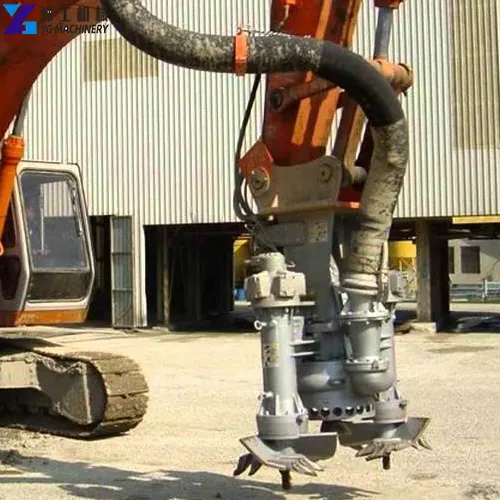

How to Calculate Pump Selection? Matching Flow Rate and Head to Project Requirements
Many users choose pumps based on intuition, resulting in either insufficient capacity or an oversized pump being wasted. Actually, there’s a basic calculation method for pump selection; calculating correctly before buying will ensure a smooth purchase.
Five Steps for Pump Selection:
Step 1: Calculate the Required Flow Rate.
Calculate the required flow rate per hour based on the total project volume and construction period.
Formula: Flow Rate (m³/h) = Total Project Volume (m³) ÷ Construction Period (days) ÷ Daily Working Hours
Example: 5000 cubic meters of sludge, completed in 10 days, working 8 hours per day → 5000 ÷ 10 ÷ 8 = 62.5 m³/h
This is the actual sand output. Considering concentration decay (estimated at 50% concentration, multiplied by a factor of 1.5-2) → Select a pump with a flow rate of 100-150 m³/h or higher.
Step 2: Calculate the Required Head.
Total Head = Vertical Height + Pipeline Resistance Loss + Outlet Pressure Margin
- Vertical Height: The distance the outlet is above the water surface is the head in meters.
- Pipeline Resistance: Approximately 0.5-1 meter of head is lost for every 10 meters of horizontal pipe, and approximately 0.5-1 meter for each bend.
- Margin: Add a 10%-20% safety margin.
Example: 10 meters vertical height + 50 meters horizontal pipe (approximately 3 meters loss) + 3 bends (approximately 2 meters loss) = 15 meters
Add 20% margin → 15 × 1.2 = 18 meters. A pump with a 20-meter head is sufficient.
Step 3: Confirm the excavator tonnage.
Choose a model within the corresponding tonnage range based on the tonnage of your existing excavator. Forcing a small excavator to power a large pump will be ineffective and damage the hydraulic system.
Step 4: Determine the type of silt/sand.
For fine sand and silt, a regular impeller is sufficient; for coarse sand and gravel, choose an open impeller and high-chromium material; for corrosive wastewater, choose stainless steel or polyurethane lining.
Step 5: Consider future expansion.
If you might take on larger projects in the future, you can choose a slightly larger model to allow for upgrades. However, don’t go too far over the top; using a large pump with low throttle will result in lower efficiency and faster wear.
Click Here to Send an Inquiry and Get More Detailed Information About Excavator Dredge Pump


Frequently Asked Questions about Excavator Attachment Sand Pumps
A1: The YG series excavator sand dredging pump has a flow rate range of 150-500 m³/h (clean water). The actual sand output depends on the sand concentration. When the concentration is 40%-50%, the actual sand output is approximately 50%-60% of the nominal flow rate. For example, the YG500-15 model has a clean water flow rate of 500 m³/h, and the actual sand output is approximately 250-300 m³/h.
A2: The YG excavator sand dredging pump has a head range of 10-40 meters, with the YG400-40 model reaching a maximum head of 40 meters, suitable for long-distance pipeline transportation or high-drop discharge scenarios. When selecting a model, estimate the required head based on “vertical height + pipeline losses + margin”.
A3: The YG sand dredging pump is compatible with excavators ranging from 10 to 40 tons. Small models (YG200 series) are paired with 10-20 ton excavators, medium models (YG400/500 series) with 20-30 ton excavators, and large models (YG300-30/400-30/400-40) with 30-40 ton excavators. The specific lifespan depends on the excavator’s spare hydraulic flow rate and pressure.
A4: High-chromium alloy (Cr26) impellers have a lifespan of approximately 2000-3000 hours under normal river sand conditions; approximately 800-1500 hours under conditions containing strong abrasive particles such as quartz sand and tailings; and up to 3000-5000 hours under pure silt and fine sand conditions. It is recommended to check the impeller condition every 500 hours.
A5: No, no modifications to the main excavator structure are required. Simply connect the hydraulic lines using the excavator’s spare hydraulic interface (hydraulic breaker circuit). Installation is done via standard pins and quick-connect couplings, and disassembly and assembly can be completed in 30 minutes without affecting the excavator’s digging function.
A6: The YG sand pump can handle particles up to approximately 30- 80 mm (depending on the model; larger models have larger channels). Larger particles may clog the impeller; it is recommended to install a screen filter at the suction inlet.