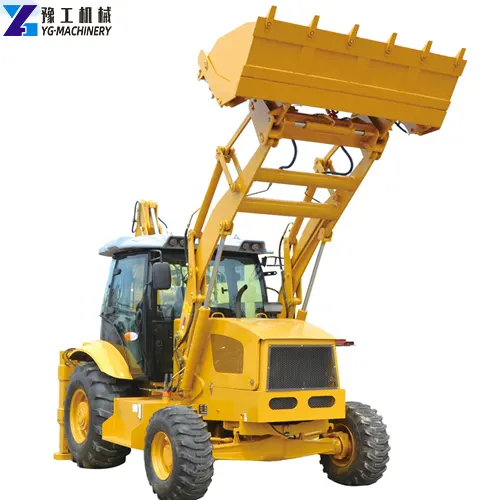
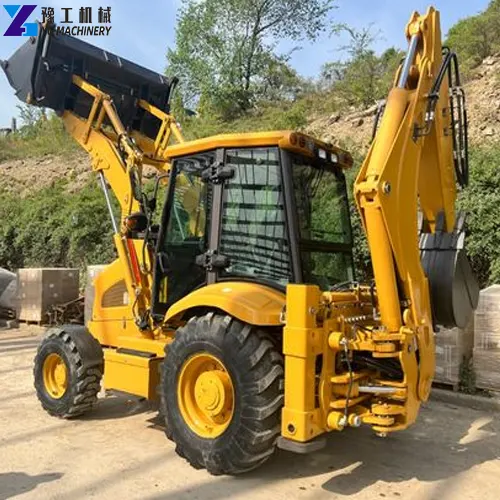
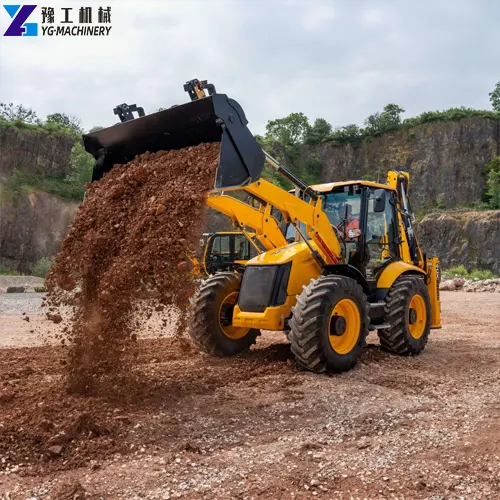
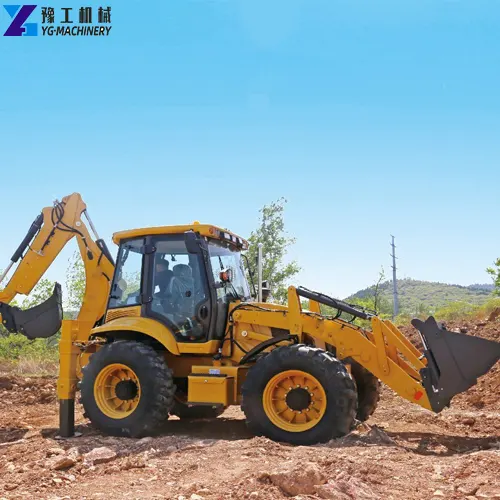
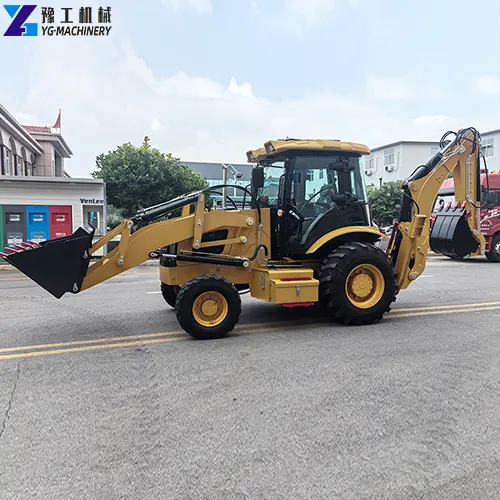
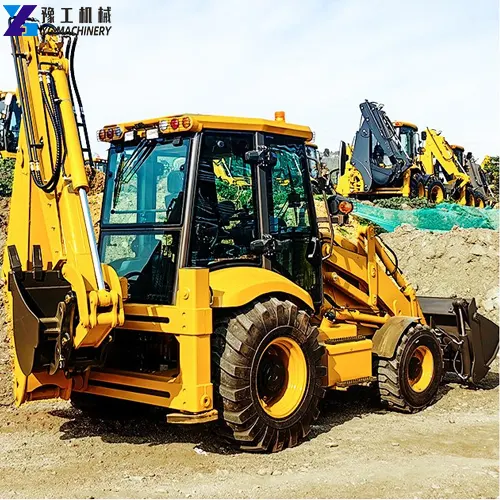
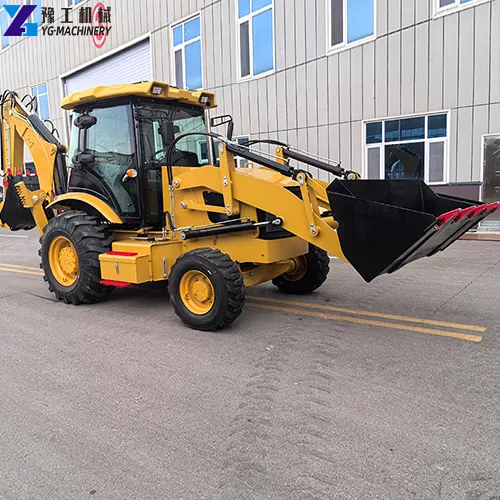
A compact tractor loader backhoe combines three working functions in one machine:
- Tractor for travel and, where offered, PTO-driven farm tasks
- Front loader for loading, moving, leveling, and material handling
- Rear backhoe for trenching, digging, drainage, foundation holes, and light excavation
This machine is a good fit for buyers who need more versatility than a mini excavator or a compact tractor alone, but do not need a full-size construction backhoe loader. YG builds compact tractors with a front loader and rear backhoe for mixed farm, landscaping, municipal, rental, and light construction work.
If you are considering whether a compact tractor loader backhoe (TLB) is suitable for your project, please take a close look at this article; naturally, you are also welcome to contact us for further product information and professional advice.
One Machine, Three Functions – Explore Tractor, Loader & Backhoe
YG Backhoe Excavator Loader Technical Parameters: One Machine, Three Functions
| Item | YG-920 | YG-926 | YG-928 | YG-930 | YG-940 | YG-946 | YG-949 |
| Drive Mode | Manual Transmission | Continuously Variable Transmission | Continuously Variable Transmission | Continuously Variable Transmission | Continuously Variable Transmission | Continuously Variable Transmission | Continuously Variable Transmission |
| Discharge Height | 3.2 | 3.2 | 3.2 | 3.2 | 3.5 | 3.5 | 3.5 |
| Standard Bucket | 1.8 m | 1.8 m | 1.8 m | 1.8 m | 2 m | 2 m | 2 m / 2.2 m |
| Gearbox | High-Low Speed | 265 Single High-Low Speed | 265 Dual High-Low Speed | 265 Dual High-Low Speed | 265 Dual High-Low Speed | 280 Dual High-Low Speed | 300 Split-Type Dual High-Low Speed |
| Drive Axle | Isuzu Axle | Isuzu Axle | Small Hub Reduction Axle | Small Hub Reduction Axle | Large Hub Reduction Axle | Large Hub Reduction Axle | Large Hub Reduction Axle |
| Engine | Weifang 490 | Weifang 490 | Weifang 490 | Weifang 4102 Turbocharged | Weifang 4102 Turbocharged | Weifang 4102 Turbocharged | Weifang 4108 Turbocharged |
| Tire Size | 20.5-16 | 20.5-16 | 20.5-16 | 20.5-16 | 1670-20 | 1670-20 | 1670-24 |
| Control Lever | Single Lever Control | Single Lever Control | Single Lever Control | Single Lever Control | Single Lever Control | Single Lever Control | Single Lever Control |
| Braking System | Hydraulic Brake | Hydraulic Brake | Air Brake | Air Brake | Air Brake | Air Brake | Air Brake |
| Articulation Angle | 25° | 25° | 25° | 25° | 30° | 45° | 45° |
All-in-One Workhorse for Your Jobsite – View Models
6 Key Benefits of a Compact Tractor Loader Backhoe
- One machine for mixed-task work: A single unit handles soil loading, trenching, backfilling, material transport, and routine property maintenance, reducing the need to own, transport, and maintain multiple dedicated machines for small operations.
- Maneuverable in tight spaces: Compact frame dimensions help operators work around farm buildings, orchards, gardens, yards, narrow access roads, and small construction sites where larger backhoe loaders cannot fit.
- 4WD traction for uneven terrain: 4WD compact tractor backhoe models deliver reliable grip and torque on uneven ground, loose soil, sloped terrain, and rural job sites with poor access roads.
- Lower operating cost than full-size equipment: A small tractor backhoe loader uses less fuel, costs less to transport, and requires lower upfront investment than a full-size backhoe loader, making it practical for small businesses and owner-operators.
- Expandable with attachments: Optional work tools increase seasonal use cases and improve overall fleet utilization, so the machine stays productive across more types of work throughout the year.
- PTO and hitch capability for farm use: For farm operators, a farm tractor with a front loader and backhoe can also pull and power standard implements, adding utility beyond loading and digging tasks.
Actual performance depends on machine configuration, operator skill, soil condition, bucket size, attachment type, terrain, and local operating practices.
8 Applications of YG Backhoe and Wheel Loader
For each application, note what the front loader does and what the rear backhoe does.
- Farm and livestock operations — loader moves feed, compost, and manure; backhoe digs stock-watering trenches and small drainage lines.
- Orchard and vineyard work — loader handles mulch and soil in compact rows; backhoe digs irrigation and planting trenches.
- Landscaping and property maintenance — loader grades, moves soil, and levels; backhoe digs planting holes and small drainage channels.
- Drainage, irrigation, and trenching — both ends work together on narrow trench runs and backfilling.
- Small building and foundation preparation — backhoe digs footings and utility trenches; loader spreads and backfills.
- Roadside, park, and municipal maintenance — loader handles loose material; backhoe repairs drainage and small crossings.
- Utility and cable trench preparation — narrow backhoe bucket cuts clean trench lines.
- Equipment rental fleets — a versatile one-machine platform suits mixed short-term jobs.
Find Your Application – Landscaping, Construction, Agriculture
How to Choose the Right Tractor Loader Backhoe
Use the buyer questions below to match the machine to your work.
What digging depth do you need?
Drainage trenches, cable trenches, irrigation work, and foundation repairs can require different digging depths. Provide your target depth rather than only asking for the smallest price. Rated depth must be confirmed by model.
What materials will the front loader handle?
Soil, gravel, sand, mulch, compost, feed, manure, pallets, and light construction materials are typical loads. Dense wet soil and stone require more lift capacity than loose mulch, so match the bucket and lift rating to the heaviest material.
Is your site mainly a farm, landscaped property, rental fleet, or construction site?
Tyre type, transmission, loader and backhoe buckets, cab option, and attachments may change with the site. A turf tyre on a landscaped yard is not the same setup as an industrial tyre on a construction site.
Do you need PTO and a three-point hitch?
Farm users may need to run implements such as rotary mowers, tillers, post-hole diggers, trailers, seeders, or spreaders. Only choose compatible attachment categories where technically applicable to the actual model.
How will the machine be transported?
Check machine weight, overall width, loading ramp capacity, container loading plan, local road rules, and trailer capacity before purchase.
Do you need an operator cab?
Decide between open station, ROPS canopy, and enclosed cab options based on climate, dust, rain, heat, and expected work hours.
Callout — Send YG These Details for a Correct Model Recommendation
- Country and destination port
- Intended application
- Required digging depth
- Materials to load or move
- Soil or ground condition
- Preferred engine power range
- Required attachments
- Whether 4WD is required
- Cab or open-station preference
- Quantity and expected purchase date
Find Your Application – Landscaping, Construction, Agriculture
Front Loader and Backhoe Functions
| Task | Best Working End | Typical Attachment or Bucket | Buyer Consideration |
| Loading soil or gravel | Front loader | General-purpose bucket | Lift capacity and bucket size |
| Moving pallets | Front loader | Pallet forks | Load centre and visibility |
| Grading and leveling | Front loader | 4-in-1 bucket or standard bucket | Ground condition and operator skill |
| Digging utility trenches | Rear backhoe | Narrow trench bucket | Target depth and bucket width |
| Drainage ditch repair | Rear backhoe | Trench or ditch bucket | Soil condition and slope |
| Post and tree-hole preparation | Rear backhoe or compatible auger | Auger or narrow bucket | Hole diameter and soil type |
| Backfilling | Front loader or rear backhoe | Standard bucket | Space around the trench |
Optional Attachments
YG optional attachments are available subject to model compatibility and quotation. Each attachment should be chosen for the job it solves; do not assume every attachment fits every small tractor backhoe loader.
- General-purpose loader bucket — everyday loading of soil and loose material
- 4-in-1 bucket — grab, scrape, grade, and carry in one unit
- Pallet forks — moving pallets and framed loads
- Grapple bucket — handling logs, brush, and irregular material
- Rear backhoe buckets in different widths — matching trench width to the job
- Trench bucket — narrow, clean trench lines
- Ditch-cleaning bucket — clearing and shaping drainage channels
- Hydraulic breaker — only where hydraulic capacity and mounting compatibility are confirmed
- Auger — where compatible, for post and tree holes
- Rotary mower — mowing and vegetation control (needs PTO if applicable)
- Tiller — soil preparation where compatible
- Trailer — towing light loads where rated
- Snow blade or snow pusher — for suitable markets
- Quick hitch / quick-attach system — faster attachment changes where available
Get a Factory-Direct Quote on TLB Packages
Frequently Asked Questions About Backhoe Loaders
A1: It combines a tractor, front loader, and rear backhoe for mixed farm, landscaping, drainage, rental, and light construction tasks — from loading soil and moving material to digging trenches and small foundation holes. It suits buyers who need more versatility than a mini excavator or compact tractor alone.
A2: A compact TLB is a tractor with a front loader and rear backhoe, able also to travel and, where offered, run PTO implements. A mini excavator is a dedicated digging machine with a rotating arm and no loading bucket or PTO. Choose a TLB when you need loading, transport, and implements; choose a mini excavator for continuous digging.
A3: Typical maximum digging depth is approximately 1.8–3.1 m, depending on the model. The exact rated depth must be confirmed from the final model datasheet, and actual depth depends on soil conditions, operator skill, and site access.
A4: Typical lift capacity at the pivot pin is approximately 300–1,000 kg depending on model. Confirm the rated capacity from the model specification, and remember that dense, wet soil and stone place more demand on the lift than loose mulch.
A5: Where the actual model offers a three-point hitch and PTO, compatible implements such as rotary mowers, tillers, trailers, seeders, or spreaders may be used. Compatibility depends on the model’s PTO and hydraulic ratings, so confirm before purchase.
A6: Send your application and materials, required digging depth, front loader lifting requirement, need for PTO or farm implements, required attachments, 4WD/cab/tyre preference, country and destination port, quantity, and target purchase date. With these details, YG can recommend a matched model and prepare a quotation.