For the First-Time Buyer: What Does This Machine Actually Do?
Shotcrete is concrete that is sprayed onto a surface, usually in a tunnel, mine, or slope.
There are two kinds:
- Dry shotcrete — water is added at the nozzle, at the point of spraying.
- Wet shotcrete — the concrete is fully mixed before it is pumped and sprayed.
This page is about wet shotcrete. It is generally preferred in tunnel lining and support work because it can give better bonding, lower dust, and less rebound, though the final method must be confirmed against the design and the approved process.
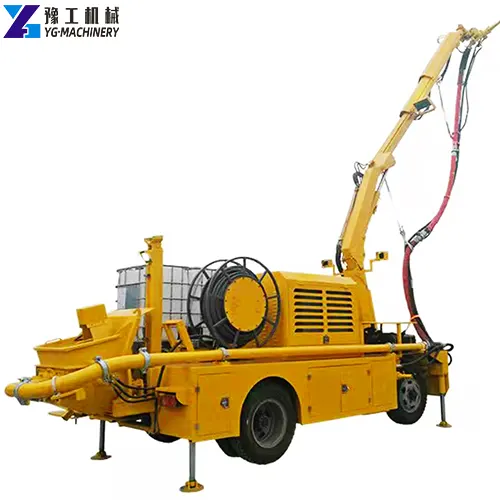
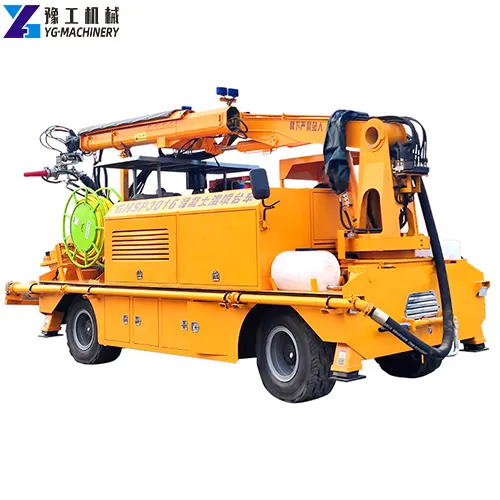
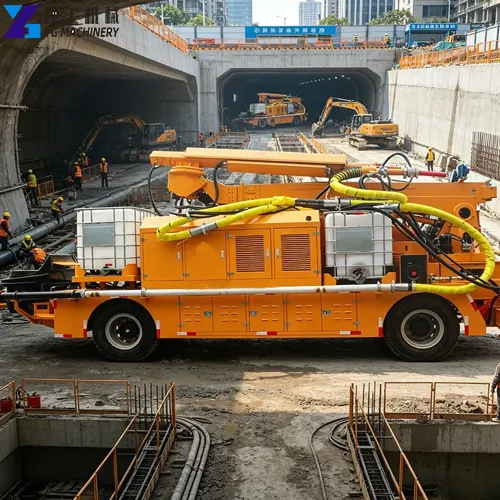
The shotcrete machine robot for tunnels is a truck-mounted wet shotcrete machine. It mixes, pumps, and sprays from the same vehicle, and uses a powered spraying arm instead of a hand-held nozzle. This matters because with a hand gun, the operator stands close to the spraying face; with the truck, the arm does the reaching, and the operator controls it from the cabin or with a remote, so the nozzle work is farther from the operator.
- Pumping — moving the wet concrete from the mixer through a hose up to the nozzle.
- Accelerator — a chemical added at the nozzle that makes the concrete stick and set faster on the surface.
- Boom/spraying manipulator — the powered arm that holds and moves the nozzle to different points.
On this truck, mixing, pumping, and spraying, plus the accelerator dosing, all sit on one chassis. They are designed to work together as a system. But the truck is only one part of the system — you also need the concrete supply, compressed air, accelerator, and cleaning water lined up on site.
Contact us now to learn more about hydraulic wet-mix shotcrete machines.
Get Your Free Quote in 12 Hours
Technical Specifications for the Concrete Spraying Robot for Tunnels
| Model | YG-3016 | YG-4016 |
| Overall length | 7770mm | 7880mm |
| Overall width | 2460mm | 2460mm |
| Overall height | 3180mm | 3380mm |
| Rated weight | 14T | 15T |
| Minimum turning radius | 10.8M | 11.5M |
| Maximum gradeability | ≥40° | ≥40° |
| Engine power | 85KW | 103KW |
| Wheelbase | 3900mm | 4100mm |
| Front axle track | 1870mm | 1870mm |
| Rear axle track | 1870mm | 1870mm |
| Boom and Outrigger Parameters | ||
| Spraying height | 16m | 16m |
| Spraying width | 25m | 25m |
| Main boom luffing angle | 0°~65° | 0°~65° |
| Secondary boom luffing angle | -110°~90° | -110°~90° |
| Boom slewing angle | 310° | 310° |
| Nozzle axial rotation angle | 360° | 360° |
| Nozzle vertical oscillation angle | 240° | 240° |
| Nozzle sweeping angle | 360° | 360° |
| Front outrigger ground contact center distance | 2480mm | 2480mm |
| Rear outrigger ground contact center distance | 2480mm | 2480mm |
| Front-to-rear outrigger center distance | 5850mm | 5850mm |
| Pumping System Parameters | ||
| Concrete output | 30m³/h | 40m³/h |
| Hopper capacity | 0.4m³ | 0.4m³ |
| Concrete discharge pressure | 7.5Mpa | 7.5Mpa |
| Accelerator pump maximum discharge pressure | 1.8Mpa | 1.8Mpa |
| Concrete pipe diameter | Φ90mm | Φ90mm |
| Nozzle outlet diameter | Φ50mm | Φ50mm |
| Main oil cylinder | Φ100mm*Φ70*1000 | Φ100mm*Φ70*1000 |
| Conveying cylinder | Φ180mm*1000 | Φ180mm*1000 |
| Electric motor | 55KW | 75KW |
Reference specifications from the YG public page; final configuration and suitability depend on the selected model, tunnel section, concrete mix, pump setup, and site conditions.
Explore Tunnel Support & Slope Stabilization Solutions – Learn More
6 Key Features of the YG Robotic Shotcrete Spraying System
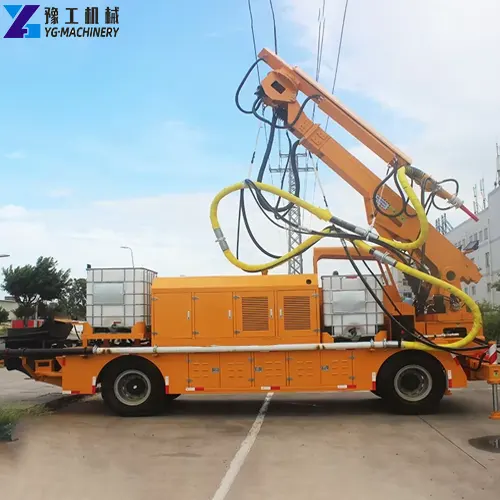
- Integrated wet shotcrete system. All key parts: concrete pumping unit, accelerator dosing, compressed air interface, robotic shotcrete arm, and mobile truck chassis are assembled on one wet shotcrete truck. No need to assemble separate large pumps on site.
- Hydraulic robotic arm control. Hydraulic wet shotcrete robot delivers stable, smooth nozzle movement. Remote operation lets operators stand outside the high-risk spray face. Arm positioning covers tunnel crown, side walls, and invert when matched to your tunnel size.
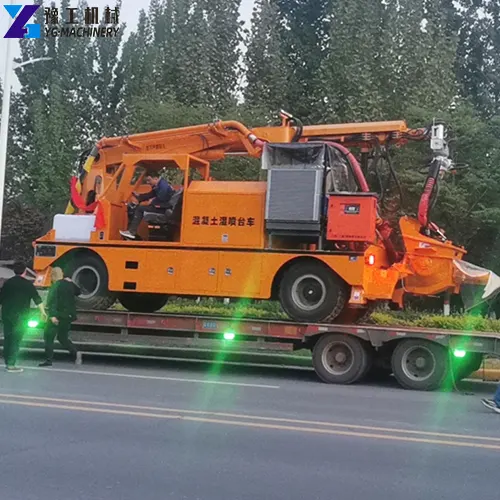
- Rugged off-road chassis for underground sites. YG-3016 and YG-4016 chassis support steep climbing ≥40°. The truck body is compact for tunnel travel.
- Controllable accelerator dosing. Adjustable accelerator flow matches your concrete mix and rock conditions, helping reduce rebound and improve lining quality.
- Easy site transfer and cleaning design. The whole unit drives between tunnel faces. After each shift, the pipeline and nozzle need full cleaning to prevent concrete blockages inside hoses.
- Safety-focused layout. Operator separation from the spray zone cuts dust and impact exposure. This machine still requires site ventilation, escape routes, and trained staff; remote control is not unmanned operation.
Where This Shotcrete Machine Robot Is Used (Applications)
This shotcrete machine robot for tunnels is built for permanent and temporary tunnel support projects.
- Highway & railway tunnel primary lining, tunnel crown and side wall shotcrete support
- Metro/subway underground tunnel rock stabilization
- Hydraulic tunnels, water diversion caverns
- Underground mine drift and stope rock reinforcement
- Slope stabilization, rock cut protection for open sites
- Small underground cavern and utility tunnel shotcrete works
Best fit: Medium to large tunnel sections with continuous shotcrete tasks. For very small cross-sections or short tunnels, YG can review whether split, smaller handheld wet shotcrete equipment is a better option.
Compare Prices Across All Models – See Pricing

How the Tunnel Concrete Spraying Robot Works (Working Principle)
The working process can be understood in six steps.
1. Prepare the Surface
Before spraying, the surface should be inspected and prepared.
Loose rock, dust, water, and unstable material should be addressed according to the project requirements. Steel arches, rock bolts, mesh, and other support elements should also be checked.
Surface condition affects adhesion and rebound. A clean, stable surface helps the sprayed concrete bond better.
2. Mix the Concrete
Wet shotcrete uses concrete that has already been mixed with water.
The concrete mix must suit the project specification, pump, delivery distance, and spraying method. Aggregate size, workability, and consistency affect pumping and spraying.
The concrete should be delivered in a sequence that matches the spraying schedule.
3. Pump Concrete to the Nozzle
The pump moves wet concrete through delivery lines toward the nozzle.
Pumping distance, hose condition, line routing, and concrete workability all affect operation. A longer or more complex route may require additional planning.
Blockages can interrupt work. Proper mix design, clean lines, correct hose arrangement, and planned cleaning help reduce avoidable interruptions.
4. Add Accelerator at the Nozzle
Accelerator is added near the nozzle, not into the entire concrete batch.
It helps the sprayed concrete adhere to the surface and begin setting faster. The correct accelerator setting depends on the concrete mix, spraying distance, layer thickness, and project requirements.
Accelerator should be handled according to the manufacturer’s instructions and the approved safety procedure.
5. Spray Through the Robotic Arm
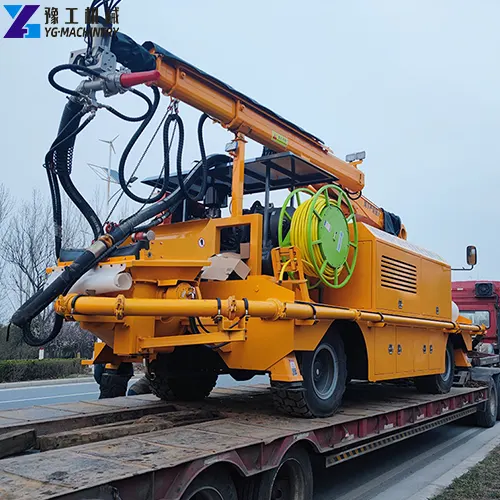
The hydraulic arm positions the nozzle against the tunnel crown, sidewall, or other support surface.
Compressed air helps shape the concrete stream as it leaves the nozzle. The operator controls the spraying process from the cabin or remote-control position, subject to the selected configuration.
Nozzle distance, angle, layer thickness, and movement pattern affect adhesion and rebound.
6. Clean and Inspect
After spraying, the system should be cleaned according to the operating procedure.
Delivery lines, pump components, nozzle parts, and accelerator equipment may require cleaning. Inspection should also cover the sprayed surface, equipment condition, hoses, and control system.
Cleaning is part of maintaining reliable operation. It should be planned into the work schedule, not treated as an optional task.
Get 12-Month Warranty & Lifetime Support – Learn More

Frequently Asked Questions About Tunnel Shotcrete Trucks
A1: A mobile machine that carries, pumps, and sprays wet concrete onto a tunnel surface using an arm-mounted nozzle.
A2: Check the tunnel net width, net height, cross-section shape, access route, turning space, and floor condition. Provide the tunnel drawing to YG for review.
A3: Boom coverage depends on the model and the tunnel section. Confirm with YG for the selected model.
A4: The pump, delivery pipe, compressed air, accelerator, and wash water must be planned together. Confirm the setup with YG for your tunnel and concrete mix.
A5: Rebound and blockage depend on the mix, the accelerator, the spraying distance and angle, the layer thickness and the operator technique.
A6: Training covers the machine, the concrete mix, the spraying technique, ventilation, communication, escape routes, and emergency procedures.
Send Your Tunnel Cross-Section, Concrete Mix and Site Layout
We will review your tunnel net width, net height, cross-section drawing, tunnel length, slope, support design, concrete mix, pumping distance, accelerator, power supply, destination port, and purchase schedule, then recommend a suitable shotcrete machine robot for the tunnel configuration and provide a technical proposal.