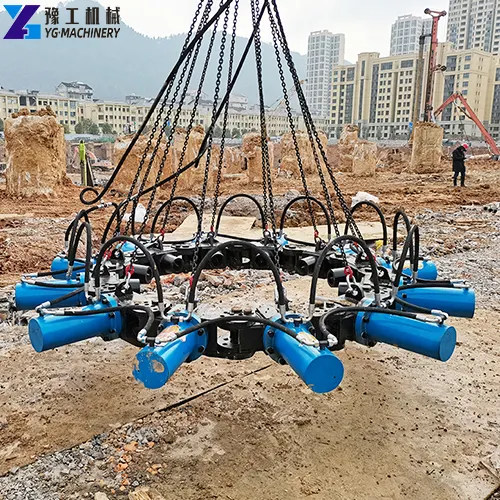
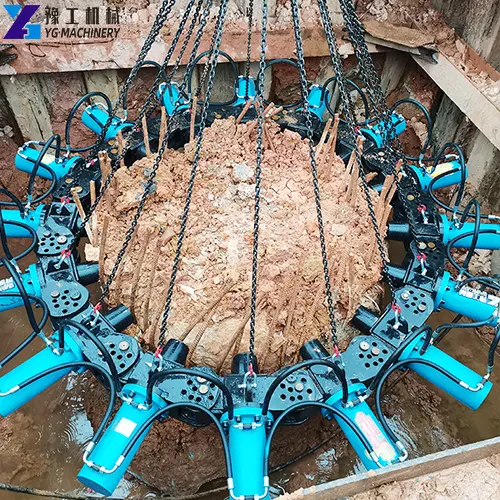
For foundation contractors and pile construction teams, selecting the right hydraulic pile breaker directly controls project speed, safety, and the quality of pile head removal. Also known as a concrete pile breaker, square pile breaker, or round pile breaker, this hydraulic crushing tool splits concrete pile heads while preserving main reinforcement bars. This buying guide walks you through a structured selection workflow: pile type → dimensions → rebar & site constraints → power & lifting → final equipment recommendation.
Step 1: Identify Pile Type and Core Dimensions
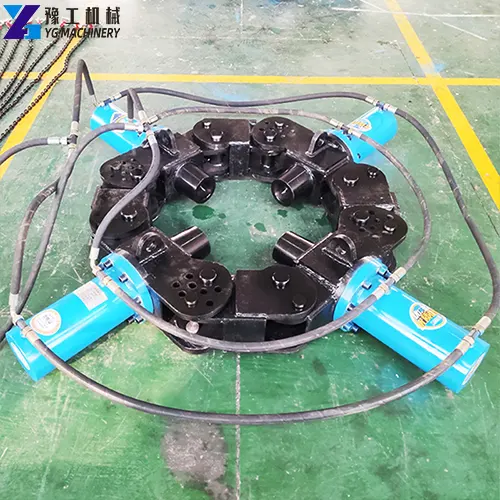
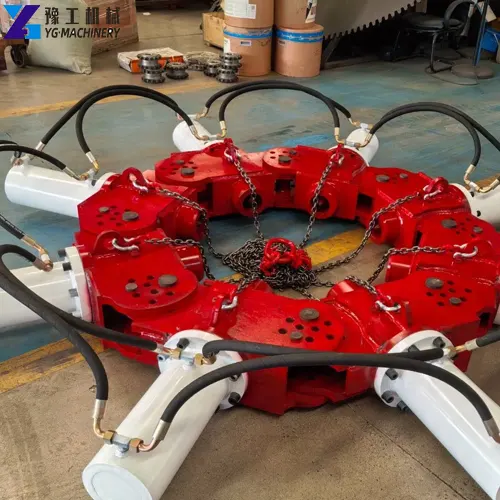
The first rule for selection: square piles and round piles cannot share identical module assemblies. For square pile breaker: evaluate by side length, cross-section geometry, and rebar layout. Do NOT treat square side length as equivalent to round pile diameter. Square pile modules are built to fit rectangular profiles, with crushing cylinders arranged to target flat concrete faces. For round pile breaker: sizing is based on pile diameter and circular rebar arrangement. Circular modules wrap around the cylindrical pile surface.
Even when two piles have similar cross-sectional area, the difference in shape changes cylinder spacing, opening range, and crushing force distribution. A module set made for a 400 mm square pile will not reliably work on a 400 mm diameter round pile.
Step 2: Check Reinforcement, Concrete Strength and Site Boundary Conditions
After confirming pile geometry, collect these critical site parameters:
- Concrete compressive strength of pile head
- Number, diameter and spacing of vertical rebar
- Height of concrete to be removed
- Clearance around each pile, pile spacing, pit edge boundaries and lifting access
Many buyers assume that if the breaker can physically sleeve over the pile head, the machine will work. This is a common mistake. Fitting over the pile ≠ workable on site. You must verify pile spacing, foundation pit boundaries, equipment outer envelope, and lifting path. Even if the breaker fits the pile, tight adjacent piles or limited overhead space can block rotation, installation, and debris removal.
A second key point: breaking concrete does not automatically pass inspection. Successful pile head removal requires precise cut elevation, undamaged reserved rebar, intact lower pile body, and finishing trimming. YG hydraulic pile breakers reduce rebar damage risk but cannot guarantee zero damage under all site conditions. Site operators still need to follow approved construction procedures and conduct post-cut inspection.
Special note for solid, hollow, and pre-stressed piles: these pile categories require separate assessment. Do not apply one standard breaker solution to all three. We must review construction drawings and approved work method statements before recommending any model.
Request a Budgetary Quote for Your Project – Fast Response
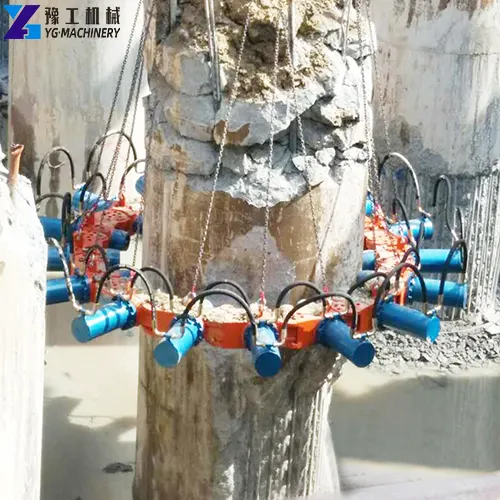
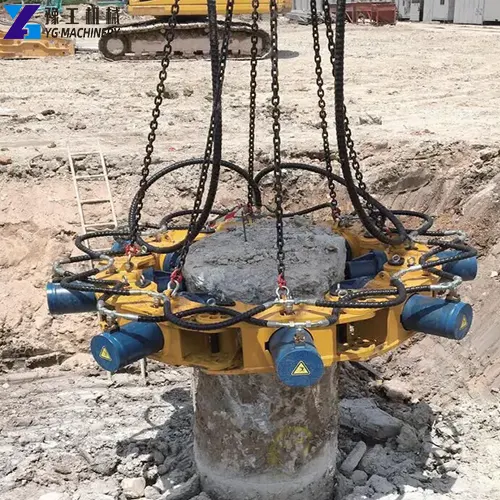
Step 3: Power Source Selection — Excavator Hydraulic vs Independent Hydraulic Power Pack
Two power options are available for the YG hydraulic pile breaker:
- Excavator-assisted hydraulic supply: The most common setup. The breaker connects to the excavator’s existing hydraulic circuit. The excavator also handles lifting, positioning, and moving the pile breaker between piles.
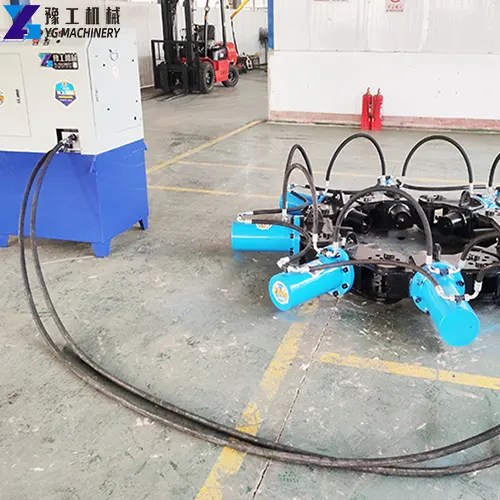
- Pile breaker with hydraulic power pack: For sites without available excavators.
Important distinction: A crane used for hoisting does not provide hydraulic power. If you use a crane plus a standalone hydraulic power pack, you must separately solve lifting, positioning, support, breaker handling, and broken concrete fragment removal.
When choosing a standalone hydraulic power pack, the pressure, flow rate, engine or electric power configuration, hoses, and couplings must be confirmed for your exact project. These components are not universal for every breaker size.
Step 4: Why Small Diameter Piles Are Not Solved Simply by Shrinking Modules
A frequent misconception: smaller pile sizes only need smaller crushing modules. This is incorrect. For small pile diameter or small square pile projects, YG supports custom hydraulic pile breaker manufacturing. However, customisation requires matching multiple factors together: module outer dimension, working opening range, cylinder stroke, total equipment weight, and clear gap between steel rebars. Reducing module size alone cannot guarantee smooth operation.
To request a custom small pile breaker, submit the actual pile diameter or side length, pile head photos, reinforcement drawings, concrete strength, cutting height, and surrounding clearance. Without these site documents, YG cannot confirm minimum working dimensions or guarantee model suitability.
In-Stock Pile Breakers Ready to Ship – See What‘s Available
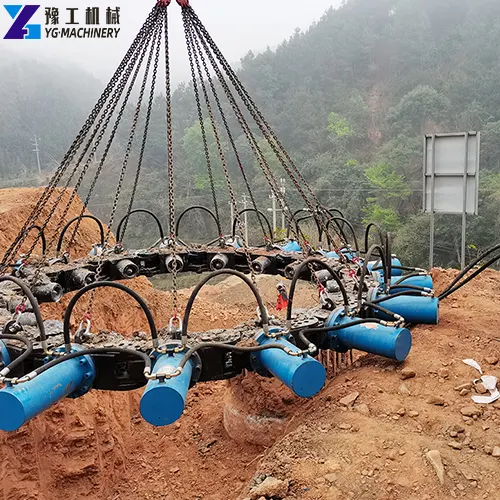
Step 5: Calculate Total Cost and Output for Sites Without Excavators
When there is no excavator on site, buyers must compare full project costs instead of only checking the pile breaker host price. Total expenses include:
- Hydraulic power pack unit
- Crane or other lifting rental
- Fuel or electricity consumption
- On-site positioning and labour
- Broken concrete fragment handling and transport
- Machine mobilisation and demobilisation
Daily output per shift is not a fixed number. It depends on pile type, concrete strength, the height of material to remove, lifting speed, and debris clearing efficiency. YG will not quote fixed production rates without full site data.
Select Your YG Hydraulic Pile Breaker — Final Recommendation Logic
- Confirm if piles are round or square; separate model ranges apply.
- Record pile diameter (round) or side length (square).
- Collect rebar layout, concrete strength and cutting height.
- Measure pit clearance, pile spacing, and lifting routes.
- Choose power source: excavator hydraulic or standalone hydraulic power pack.
- For small piles: submit drawings and photos for custom evaluation.
YG machinery supplies standard and custom hydraulic pile breakers for pile head removal. Our technical team reviews your pile drawings and site layout to filter unsuitable models before quoting.
Customize Your Pile Breaker for Free – Start Now
Explore Frequently Asked Questions about YG Pile Breakers
A1: Match the breaker module shape to your pile cross-section. Never use square pile modules for round piles or vice versa. Provide pile dimensions and cross-section drawings for accurate model selection.
A2: Yes, custom small pile breakers are available. We need pile size, rebar drawing, concrete strength, removal height, and site clearance. We cannot confirm fit without these documents.
A3: Yes, by using a pile breaker with a hydraulic power pack. You will need separate crane lifting, positioning, and concrete fragment removal. Cranes supply lifting force only, not hydraulic power.
A4: No. Pressure, flow, hoses, and couplings must be matched to your breaker model. Power pack configuration is project-specific and must be verified before site delivery.
A5: It greatly reduces rebar damage risk when operated correctly. But zero damage cannot be guaranteed. Operators must follow approved construction methods and inspect rebar after cutting.
A6: Pile dimension data, reinforcement drawings, site layout, concrete strength, required cutting height, and power source plan.