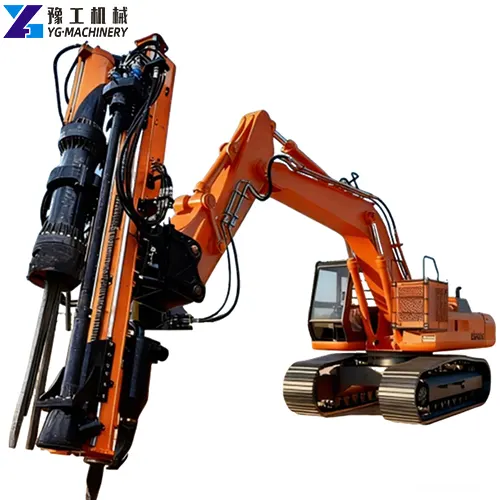
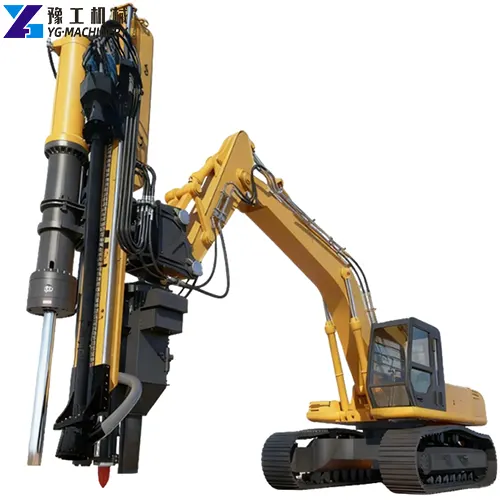
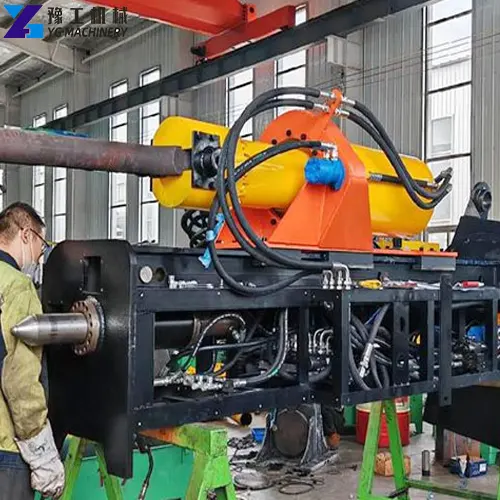
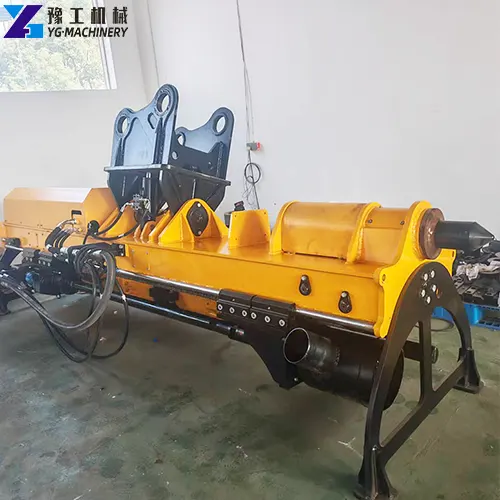
An excavator drilling and splitting machine is an integrated excavator attachment, also known as a drill-split all-in-one unit. It combines down-the-hole rock drilling and hydraulic rock splitting in one piece of equipment, designed to fit excavators ranging from 20 tons to 65 tons for non-explosive rock breaking. At YG Machinery, we export this heavy-duty mining attachment to quarry and mining contractors globally. For this Chile project, our team held multiple rounds of technical communication with the client to review their site challenges and machine conditions. After repeated evaluation, the customer chose YG for their hard rock breaking job. This case is written from our first‑person perspective as a project recap: how we clarified client requirements, ran through our technical verification checklist, selected the suitable attachment configuration, and arranged export delivery.
See Factory-Direct Pricing on Integrated Units – Request Quote
YG 20-65T Excavator Integrated Drilling and Splitting Machine Technical Parameters
| Model | YG-130 | YG-152 | YG-210 |
| Suitable Excavator | 20T-36T Excavator | 36T-48T Excavator | 48T-65T Excavator |
| Maximum Horizontal Splitting Height | 9475mm | 9985mm | 10680mm |
| Maximum Vertical Splitting Height | 6715mm | 6905mm | 6770mm |
| Maximum Splitting Depth | 6705mm | 7025mm | 8050mm |
| Maximum Splitting Distance | 10225mm | 10875mm | 11640mm |
| Pilling Beam Length | 3875mm | 4850mm | 5525mm |
| Drilling Advance Stroke | 2000mm | 2600mm | 3500mm |
| Maximum Drilling Thrust Force | 50KN | 50KN | 50KN |
| Maximum Drilling Pull Force | 32KN | 32KN | 32KN |
| Piling Advance Stroke | 1500mm | 1800mm | 2300mm |
| Maximum Piling Thrust Force | 160KN | 160KN | 160KN |
| Maximum Piling Full Force | 100KN | 100KN | 100KN |
| Hydraulic Pressure | Max. 35Mpa | Max. 35Mpa | Max. 35Mpa |
| Hydraulic Flow | Min. 240L/min | Min. 240L/min | Min. 240L/min |
| Weight | 4200kg | 6200kg | 8300kg |
| Dimensions | 4210*1400*1785mm | 5270*1485*1840mm | 5810*1485*1840mm |
| Operation Mode | Remote Control | Remote Control | Remote Control |
Match Drill & Splitter to Your Excavator (20T–65T Options) – Start Now
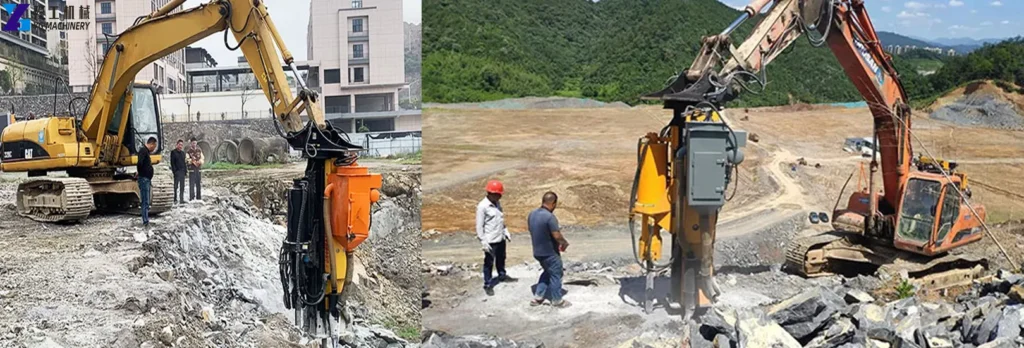
Customer Background
Our Chilean customer is an open‑pit mining and aggregate contractor focused on hard rock breaking works. Their core requirement was to break rock safely without explosives. They operate an excavator within the 36–48 ton class as their primary working carrier on the bench.
What we knew before selection:
- Destination country: Chile
- Excavator class: 36–48 t
- Application: mining rock breaking
- Core requirement: drill and split rock without explosives
Previously, the team used hydraulic hammers for secondary rock breaking. While hammers worked for fractured rock zones, they showed clear limits on dense, intact rock: slow breaking cycles, high fuel consumption, strong vibration to the host machine, and poorly controlled rock fragment sizes. Irregular rock blocks slowed downstream loading and crushing workflows. The customer reached out to us to source one integrated excavator attachment to finish both drilling and splitting, to cut down hammer usage and stabilise rock-breaking results.
Our Selection Process: Matching Attachment Based on Verified Technical Data
We never recommend a drilling and splitter attachment based only on excavator tonnage. We go through systematic technical confirmation together with the customer before locking the model.
What we confirmed during the selection process:
- Excavator auxiliary hydraulic flow and pressure
- Hydraulic return line conditions and backpressure limits
- Boom mounting dimensions and pin size
- Attachment operating weight against the excavator’s safe lifting capacity
- Target drilling stroke, working reach and splitting range for their rock breaking pattern
- Rock condition data shared by the customer, including rock hardness, fracture development and free‑face layout
After cross‑checking all above parameters, we selected the YG‑152 model for this Chile project. It is designed to suit 36–48 ton excavators and aligns perfectly with the customer’s carrier range and non‑explosive rock‑breaking targets. All hydraulic parameters and mounting interfaces were double‑checked before order confirmation.
Note: YG‑152 requires a minimum hydraulic flow of 240 L/min and maximum working hydraulic pressure of 35 MPa. We verified that the customer’s excavator auxiliary circuit can meet this flow requirement before order confirmation.
Read the Full Chile Granite Case Study
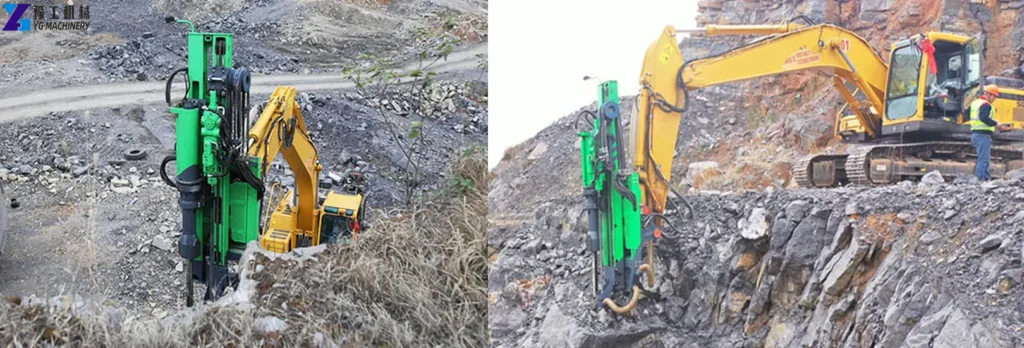
What Remains To Be Confirmed After Equipment Arrival
Our model recommendation was built on the rock information and site data provided by the customer in the inquiry stage. Actual on‑site performance still depends on real working conditions, so these items will be verified during commissioning and early operation:
- Actual rock type and rock integrity on the working face
- Real on‑site production rate
- Operator feedback on operation efficiency and control
- Long‑term wear performance of drill bits and splitting wedges
We do not guarantee fixed output or zero wear. Field data collected after arrival will help us refine operation guidance and spare‑part planning for this site.
Working Principle: Drill First, Then Split
The YG‑152 follows a clear, sequential working cycle, operated by remote control:
- Position the excavator accurately at the rock face.
- Drill the designed hole using the down‑the‑hole drilling assembly. The YG‑152 provides a 2600 mm drilling advance stroke, with max drilling thrust force of 50 KN and max drilling pull force of 32 KN.
- Rotate and switch the working head to the hydraulic splitter.
- Insert the splitting wedge assembly into the pre‑drilled hole and apply high hydraulic splitting force to split the rock along controlled fracture planes. The splitter delivers up to 160 KN splitting thrust force and 100 KN splitting pull force, with a splitting advance stroke of 1800 mm.
- Clear broken rock and reposition for the next cycle.
One excavator completes both drilling and splitting with this attachment. Compared with impact hammers, hydraulic splitting generates quieter, vibration‑controlled rock breakage, which fits the customer’s non‑explosive mining plan. Fragment size is easier to manage when the hole grid and free face are arranged properly.
Check Stock & After-Sales Support – Learn More
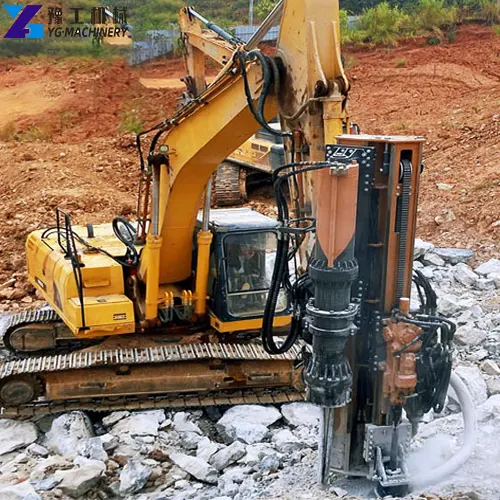
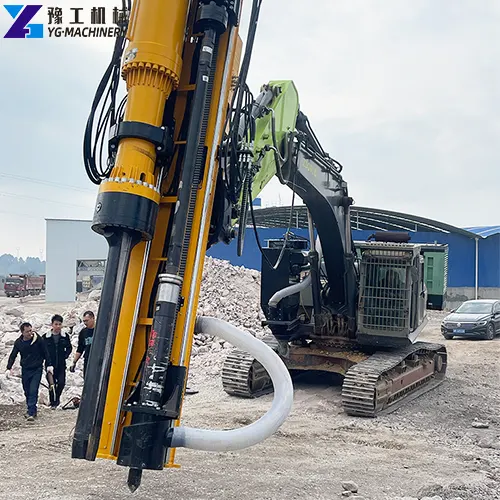
Why Configuration Directly Affects Quotation & Service Life
We specialise in mining and quarry excavator attachments, and our drilling & splitting series covers carriers from 20 tonnes up to 65 tonnes. Our priority is correct matching rather than simple price comparison. Three key factors decide configuration and final cost:
- Splitting wedge material and heat treatment: The wedge core components use Angang steel. Raw material quality, heat treatment process, and precision machining jointly determine wear resistance. For hard intact rock in mining scenarios, stable wedge quality reduces frequent replacement downtime.
- Hydraulic system and working stroke design: All three models share the same peak drilling thrust / pull force and splitting force rating, but differ greatly in working stroke, operating reach, and overall size. Larger models support longer drilling and splitting strokes, extended working height and reach, which are essential for high‑bench mining. Every model has a consistent max hydraulic pressure of 35 MPa; the minimum required hydraulic flow is 240 L/min for the whole series.
- Middle articulated structure: The central hinge design distributes splitting load and improves posture control during operation. Even so, we always cross‑check attachment weight against the excavator’s lifting capacity. Tonnage range is only a reference; safe loading must be confirmed case by case.
Delivery & Support
We verified the full YG‑152 configuration against the packing list and completed factory testing before shipment. Our standard scope includes factory inspection, seaworthy export packaging, full export documentation, and remote after‑sales technical guidance. The cargo was shipped to Chile via ocean freight. We also supplied a matched set of wearing spare parts together with the machine. Our technical team stays available for remote commissioning guidance and operational training after arrival.
Talk to an Engineer Now – Free Consultation
Frequently Asked Questions About Integrated Drilling and Splitting Attachments for Excavators
A1: Tonnage range alone cannot confirm compatibility. We need your excavator model, auxiliary hydraulic flow and pressure, return‑line condition, and pin mounting sizes. The whole series requires a minimum 240 L/min auxiliary hydraulic flow. For 20–25t excavators, hydraulic modification is usually needed. We will check lifting capacity and interface before giving formal advice.
A2: YG‑152 comes with a 2600 mm drilling advance stroke. Its max horizontal working height is 9985 mm, max vertical working height is 6905 mm, max splitting operating depth is 7025 mm, and max working reach is 10875 mm. Final usable drilling depth is also affected by drill rod selection.
A3: Production output is not fixed. Real output varies heavily with rock properties, hole layout, and site mucking speed, and is not guaranteed. The working cycle is built around the equipment’s drilling and splitting stroke and force parameters listed above.
A4: While the hydraulic thrust and pull force ratings are consistent, price differences come from longer working strokes, extended working reach, heavier structural frames, larger splitter beam, and different overall dimensions. Larger models are built for bigger bench sizes and deeper splitting work.
A5: Please share your excavator model and hydraulic specs, site photos, rock condition description, target working depth/reach, destination port, and your expected purchase timeline. Our engineers will evaluate and send a matched solution and quotation.