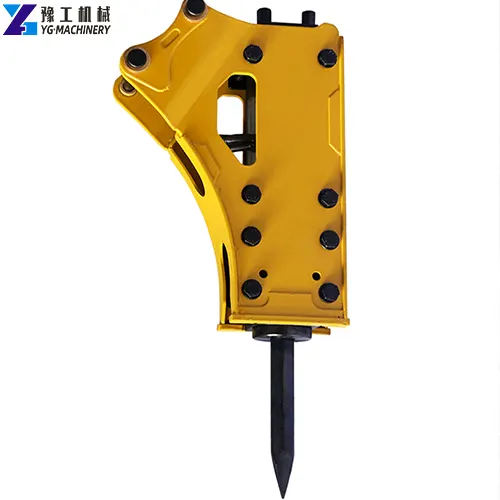
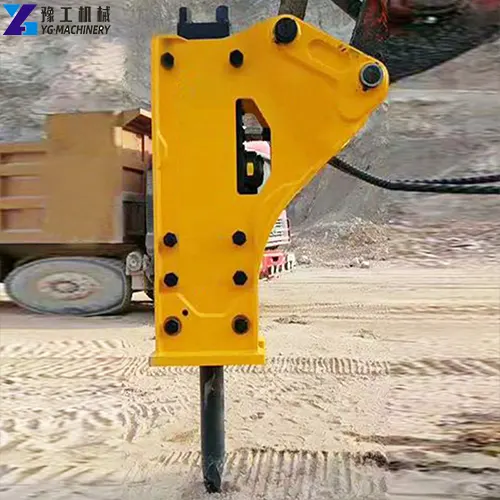
An excavator concrete breaker is a hydraulic impact attachment mounted on an excavator, specifically designed for breaking hard materials such as concrete, rock, asphalt pavement, and frozen soil. It uses the excavator’s hydraulic system to drive an internal piston that reciprocates at high speed, impacting a chisel rod and delivering tremendous striking energy, significantly improving the efficiency of demolition, mining, and municipal engineering operations. Compared to manual pneumatic picks or traditional blasting, breakers offer core advantages such as high efficiency, low cost, and controllable safety, making them an indispensable tool in modern construction. If you are interested, please contact us now for more information.
Get Factory Direct Pricing Today
YG Hot-sale Excavator Hydraulic Concrete Breaker Technical Parameters
| Model | Chisel Diameter | Suitable Carrier Weight | Main body Weight | Operating Pressure | HydraulicOil Flow | Blow Frequency | Hose Diameter |
| mm | Ton | kg | Kg/cm 2 | I/min | bpm | inch | |
| YG350 | 35 | 0.5-1 | 40 | 90-120 | 15-25 | 800-1300 | 1/2 |
| YG400 | 40 | 1-3 | 53 | 90-120 | 15-25 | 800-1300 | 1/2 |
| YG450 | 45 | 1.2-3.0 | 67 | 90-120 | 20-30 | 700-1200 | 1/2 |
| YG530 | 53 | 2.5-4.5 | 85 | 90-120 | 25-50 | 600-1100 | 1/2 |
| YG600 | 60 | 2-5 | 140 | 90-120 | 25-50 | 600-1100 | 1/2 |
| YG680 | 68 | 4-7 | 152 | 110-140 | 40-70 | 500-900 | 1/2 |
| YG750 | 75 | 6-9 | 210 | 120-150 | 50-90 | 400-800 | 1/2 |
| YG850 | 85 | 7-14 | 278 | 130-160 | 60-100 | 400-800 | 3/4 |
| YG100 | 100 | 10-15 | 475 | 150-170 | 80-110 | 350-700 | 3/4 |
| YG1250 | 125 | 15-18 | 616 | 150-170 | 80-110 | 350-700 | 3/4 |
| YG1350 | 135 | 16-26 | 846 | 160-180 | 130-150 | 400-800 | 1 |
| YG1400 | 140 | 18-26 | 916 | 160-180 | 120-180 | 350-500 | 1 |
| YG1400A | 140 | 18-26 | 952 | 160-180 | 120-180 | 350-500 | 1 |
| YG1500 | 150 | 27-35 | 1088 | 160-180 | 150-190 | 350-700 | 1 |
| YG1550 | 155 | 28-36 | 1309 | 180-200 | 200-260 | 250-400 | 1-1/4 |
| YG1650 | 165 | 30-40 | 1438 | 180-200 | 200-260 | 250-400 | 1-1/4 |
| YG1650P | 165 | 30-40 | 1586 | 180-200 | 200-260 | 250-380 | 1-1/4 |
| YG1750 | 175 | 35-40 | 1929 | 180-200 | 210-290 | 200-350 | 1-1/4 |
| YG1850 | 185 | 35-45 | 2411 | 190-220 | 220-270 | 200-250 | 1-1/4 |
| YG1990 | 190 | 40-55 | 2626 | 190-220 | 220-290 | 180-200 | 1-1/4 |
| YG2100 | 210 | 60-80 | 3396 | 200-240 | 290-350 | 150-200 | 1-1/4 |
Get a Quote for Your Specifications Now
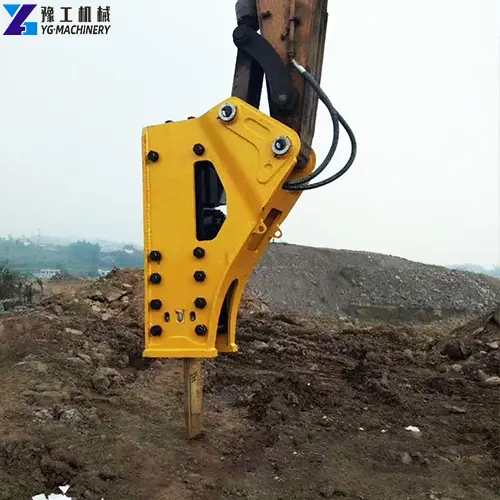
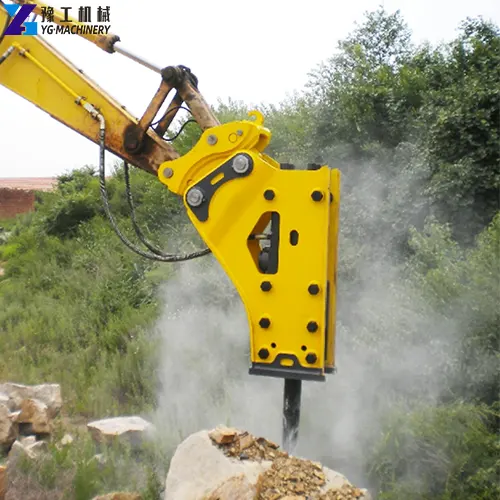
Where Are Excavator Breakers Suitable for Use?
- Building Demolition and Urban Renewal
- Building demolition, factory demolition, and old building renovation projects.
- Breaking concrete beams, columns, floor slabs, and foundations.
- Urban demolition operations, using breakers in conjunction with excavators, are the most efficient.
- Safer than blasting, much more efficient than manual labor.
- Road and Bridge Engineering
- Cement pavement breaking and renovation.
- Bridge demolition and repair.
- Highway widening and renovation.
- Airport runway maintenance.
- Municipal pipeline construction, road surface trenching, and breaking.
- Mines and Quarries
- Secondary ore crushing.
- Large rock crushing.
- Stone extraction in quarries.
- Open-pit mine stripping operations.
- Tunnel excavation and mine roadway widening.
- Foundation and Substructure Construction
- Rock foundation breaking and excavation.
- Foundation pit rock breaking.
- Pile head breaking (a dedicated pile cutter can also be used).
- Underground pipeline construction encountered rock breaking.
- Mountain road construction is encountering rock breaking.
- Metallurgical and Industrial Demolition
- Steel Plant Furnace Lining Demolition.
- Cement Plant Kiln Demolition.
- Industrial Equipment Foundation Demolition.
- Smelting Slag Crushing.
- Underwater Engineering
- Underwater Reef Crushing and Removal.
- Underwater Crushing for Port and Wharf Construction.
- River Dredging and Rock Crushing.
- Breaking Rocks Encountered.
- Breaking hammers can operate directly underwater without special modifications.
- Emergency Rescue and Disaster Relief
- Post-Earthquake Building Debris Clearance.
- Landslide Road Clearance.
- Mine Accident Rescue.
- Rapid Obstacle Removal.
Get a Quote for Your Specifications Now
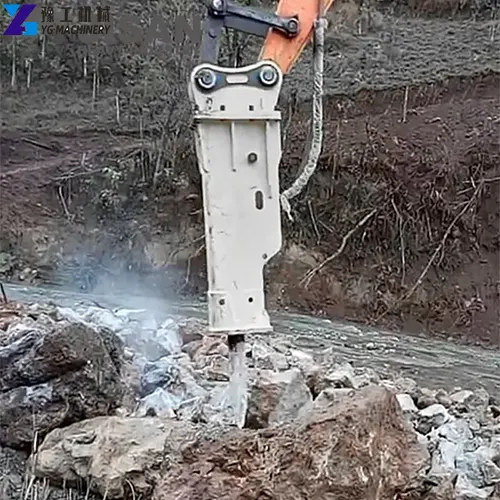
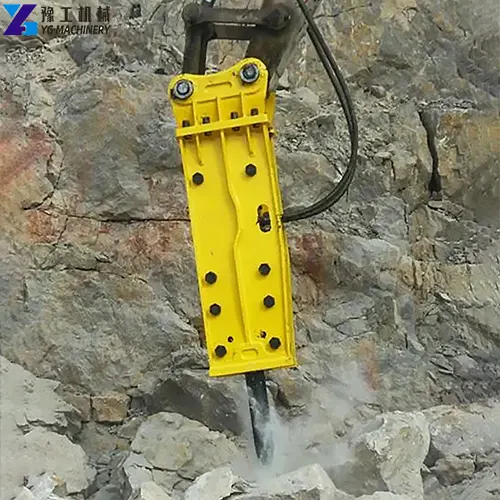
How Does an Excavator Breaker Work?
- Simple Explanation of Working Principle
- The excavator’s hydraulic system provides high-pressure hydraulic oil.
- The hydraulic oil enters the breaker’s cylinder, pushing the piston in a reciprocating motion.
- The piston moves at high speed, striking the tail of the chisel.
- The chisel transmits the impact force to the concrete or rock.
- Under the high-frequency impact, the concrete or rock is shattered.
- The nitrogen chamber acts as an energy storage and buffer, improving striking efficiency.
- Operating Procedures
- Start the excavator and let it idle for a few minutes until the hydraulic oil temperature reaches normal operating temperature.
- Aim the breaker’s chisel vertically at the object to be broken and gently apply downward pressure.
- Depress the foot pedal or press the operating button; the breaker will begin striking.
- Maintain appropriate downward pressure during the breaking process; do not apply excessive force or strike while the object is suspended in the air.
- After breaking one point, move to the next point to continue breaking.
- After breaking, lift the breaker and release the foot pedal.
- When not in use for an extended period, lay the breaker flat and retract the chisel into the cylinder.
- Common operational errors to avoid:
- Do not strike without contact with the object (strike before the chisel touches it), as this will damage the hydraulic breaker.
- Do not use the hydraulic breaker as a pry bar, as this will break the chisel.
- Do not strike the same spot continuously for an extended period; if the material is not broken after 30 seconds, move to a different location.
- Do not work underwater for extended periods; each underwater operation should not exceed 30 minutes.
- Do not exceed 80 degrees Celsius in hydraulic oil temperature; excessive heat will damage the seals.
Get Factory Direct Pricing Today
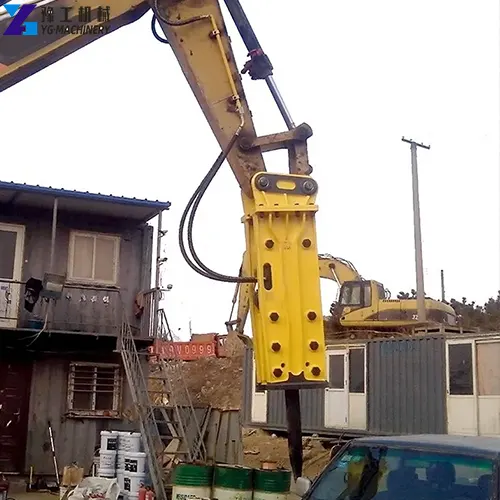
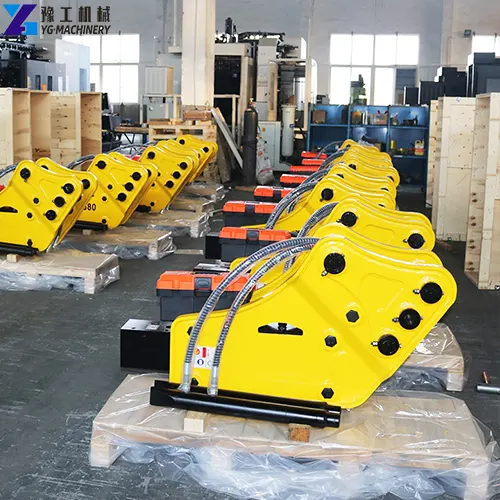
How to Choose the Right Hydraulic Breaker?
Step 1: Determine the Compatible Excavator Tonnage
- This is the most crucial step: what size excavator requires what size hydraulic breaker?
- Manufacturers usually provide recommended tonnage ranges.
- Do not exceed the tonnage limit, as this will damage the excavator’s boom and hydraulic system.
- Don’t choose one that’s too small either, as it will be inefficient and not cost-effective.
- Generally, choose a model slightly above the middle of the compatible range for maximum efficiency.
Step 2: Choose Based on the Type of Work
- For concrete demolition and municipal engineering, a medium-sized breaker is sufficient.
- For mining and hard rock breaking, choose a model with greater impact force.
- For frequent urban operations, choose a quiet model with a soundproof cover.
- For harsh working environments, choose a reliable brand.
- Also consider the type of chisel; pointed tips are suitable for breaking, while flat tips are suitable for compaction.
Step 3: Focus on the Quality of Core Components
- The cylinder and piston are the heart of the hydraulic breaker; ensure they are made of high-quality materials.
- Check if they are forged and examine the heat treatment process.
- Consider the seals. Always use imported brands; otherwise, oil leaks are likely.
- The material of the chisel is crucial; a good chisel can last up to half as long.
- The accumulator is very important; accumulators provide greater striking force and less impact on the excavator.
Step 4: Consider after-sales service and spare parts supply.
- Breaking hammers are wear-prone equipment; problems are normal. The key is whether they can be resolved promptly.
- Choose a manufacturer with excellent after-sales service; YG offers 24-hour online support.
- Small parts supply should be timely and reasonably priced. YG provides guaranteed after-sales service and spare parts supply.
Step 5: Don’t just look at the price; consider the cost-effectiveness.
- Cheap breakers may break down frequently, resulting in high repair costs.
- The losses from delayed construction can exceed the cost of the equipment itself.
- More expensive brands offer better quality, fewer malfunctions, and lower actual operating costs.
- Consider the overall cost, not just the purchase price.
- YG breakers offer excellent value for money, with quality approaching imported brands, but at half the price.