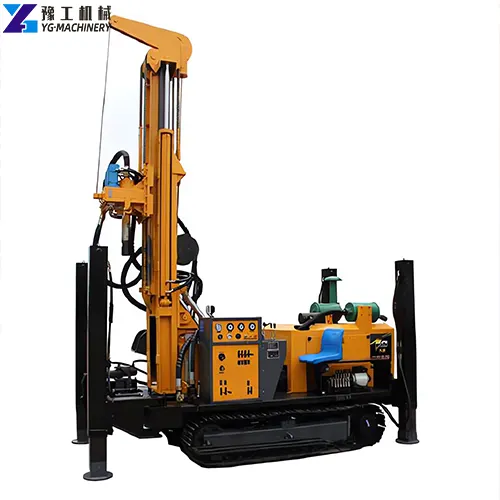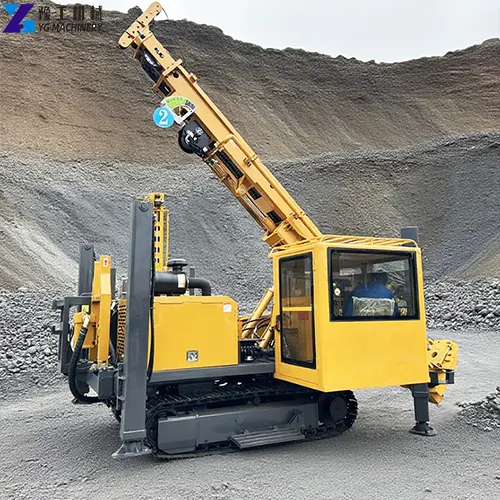
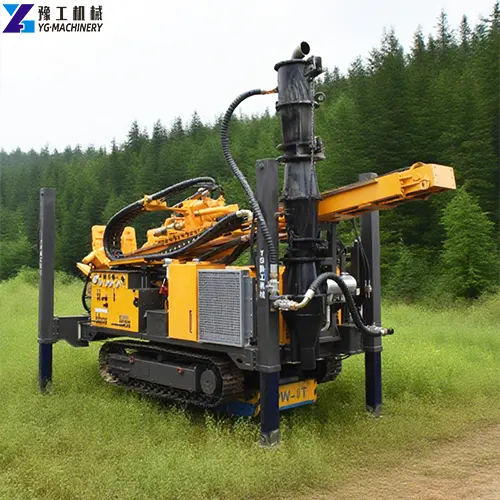
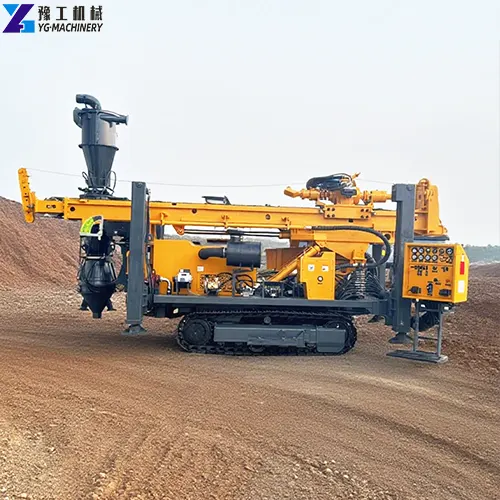
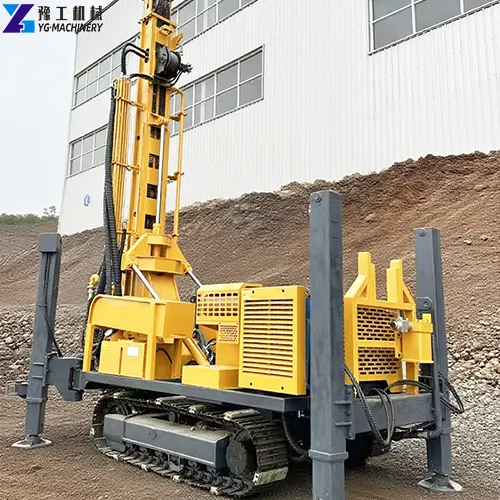
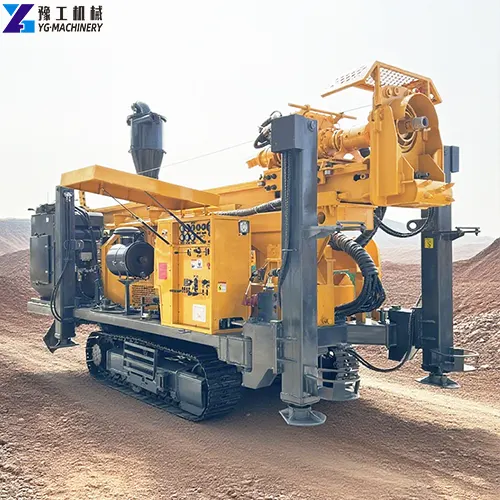
RC drilling rigs are commonly known as reverse circulation drilling rigs, air reverse circulation drilling rigs, or RC exploration drilling rigs, and are often simply referred to as RC drills in the industry. Their core function is to utilize the reverse circulation principle, employing high-pressure airflow or fluid to drive the drill bit to break up rock formations, while simultaneously transporting rock cuttings samples quickly to the surface. This achieves efficient drilling and precise sampling, and is widely used in mineral exploration, foundation engineering, geological hazard surveys, and other applications. Compared to traditional forward circulation drilling rigs, this equipment offers higher sample recovery rates and faster drilling speeds, effectively adapting to unstable rock formations and large-diameter boreholes, providing accurate geological data support for projects. As a professional manufacturer of reverse circulation drilling equipment, YG has served numerous drilling projects worldwide with its reliable quality and customized services. If you are interested, please do not hesitate to contact us for more product information.
Get Factory Direct Pricing Today
Reverse Circulation Drill Rig Parameter
| Model | YG150RC | |
| Drill rig weight(crawler mounted) | kg | 9000 |
| Engine Power | kW | 125 |
| Length × Width × Height (normal) | mm | 6750x2200x2950 |
| Ambient Temperature Range | °C | -10~38 |
| Drill Ability | ||
| Nominal Drill Depth | m | 150 |
| End-hole Diameter | mm | 110-250 |
| Drill angle | ° | -10-90 |
| Horizontal hole height | m | 1.85-2.8 |
| Drill head output | ||
| Max Output Torque | N.m | 8000 |
| Output Rotation Speed(continuity) | rpm | 30 / 60, 54/108rpm |
| Output Rotation Speed(interval) | rpm | 62 / 124105/210rpm |
| Feeding | mm | 3500 |
| Thrust Force | kN | 45 |
| Lifting Capacity | kN | 65 |
| Pipe-puller Device Output | ||
| Output Rotation Speed | rpm | 40 |
| Max Output Torque | N.m | 30000 |
| Hole-through Diameter | mm | 370 |
| Auxiliary Winch | ||
| Pull Force of the First Layer | kN | 11 |
| Rope Diameter | mm | 14 |
| Rope Capacity | m | 60 |
| Engine(Cummins) | 6BTA5.9-C125 | |
| Power | kW | 125 |
| Rotary Speed (Max.) | rpm | 2200 |
| Track Chassis Base | ||
| Walk Speed | Km/h | 1.2 |
| Unit Pressure | MPa | <0.05 |
| Climb Ability | ° | Drill rig weight(crawler-mounted) |
Get Factory Direct Pricing Today
Working Principle of the YG RC Drilling Rig
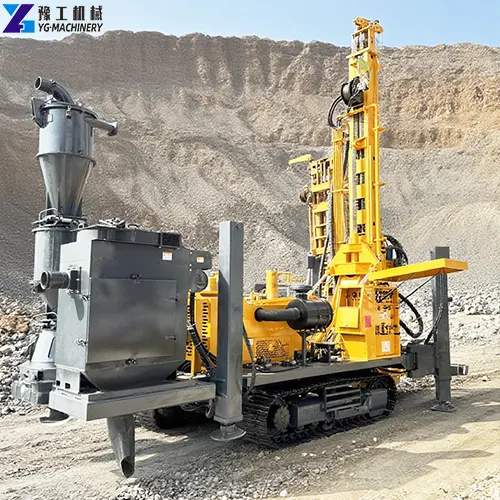
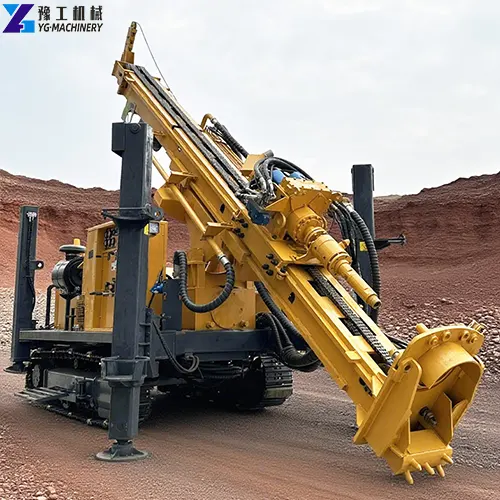
The working principle of the YG RC drilling rig is based on reverse circulation airflow drive and centrifugal separation technology. The core principle is the reverse transmission of airflow and rock cuttings through a double-walled drill pipe. The overall process is simple and efficient, and can be summarized as follows:
- Equipment Preparation: Move the RC drilling rig to the work site, level and secure the crawler chassis to ensure the machine’s stability; connect the double-walled drill pipe to the down-the-hole hammer, connect the high-pressure air and hydraulic lines, and check the sealing performance of all connections to prevent air and hydraulic oil leaks.
- Parameter Setting: Based on geological conditions (rock hardness and stability), set parameters such as drilling speed (30-210 rpm), thrust, and airflow pressure through the control panel, and start the engine to preheat the equipment.
- Drilling and Crushing: Start the fully hydraulic system to drive the drill pipe and down-the-hole hammer to rotate. Simultaneously, high-pressure airflow is rapidly transported to the down-the-hole hammer through the outer annulus of the double-walled drill pipe. The airflow drives the down-the-hole hammer to impact the rock layer at high frequency, crushing the rock into cuttings.
- Reverse Circulation Sampling: The crushed rock cuttings mix with the high-pressure airflow and, under the suction of the airflow, are rapidly transported upwards to the surface through the inner channel of the double-walled drill pipe; the airflow carrying the rock cuttings enters a cyclone separator, where centrifugal force separates the rock cuttings from the airflow. The rock cuttings fall into a collection device, and the airflow is discharged.
- Work Completion: After drilling to the preset depth, stop drilling and airflow transmission, disassemble the drill pipe and down-the-hole hammer, and clean any remaining rock cuttings from the equipment; organize and analyze the collected rock cuttings samples, and check the wear of equipment components, replenish hydraulic oil and lubricating oil, and perform routine maintenance.
Get Factory Direct Pricing Today
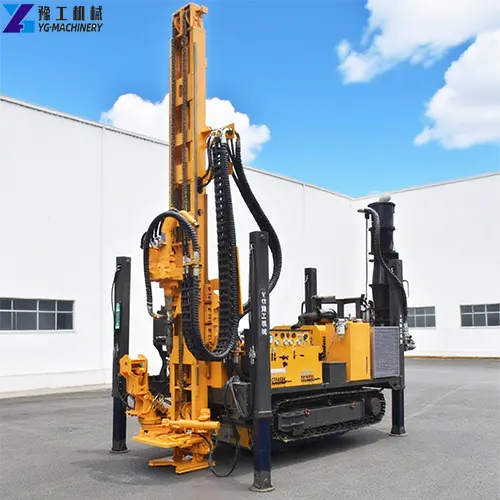
8 Major Application Areas of the YG RC Drilling Rig
- Mineral Exploration: Used for underground exploration of metallic and non-metallic minerals. High-recovery sampling allows for accurate determination of ore body boundaries and grades, providing data support for mineral development planning.
- Infrastructure Foundation Engineering: Suitable for foundation drilling of large-scale infrastructure projects such as high-rise buildings and cross-sea bridges, detecting the stability of foundation rock layers, and providing a basis for foundation design and construction.
- Hydropower and Water Conservancy Engineering: Used for dam foundation treatment and reservoir geological surveys, assessing the impermeability and stability of rock layers to ensure the safety of hydropower projects.
- Geological Disaster Investigation: In the investigation of geological disaster-prone areas such as landslides and mudslides, rapid drilling obtains rock layer data, providing support for disaster early warning and management.
- Energy Exploration: Applicable to preliminary drilling for geothermal wells and oil and gas exploration, efficient hole formation and precise sampling help improve the efficiency of energy resource exploration.
- Urban Rail Transit Engineering: Used for geological surveys of subway and light rail projects, detecting underground rock layers and pipeline distribution to avoid construction conflicts and safety hazards.
- Environmental Monitoring and Investigation: In soil pollution and groundwater monitoring projects, drilling obtains underground samples, providing accurate data for ecological assessment and management.
- Road and Bridge Engineering: Used for foundation drilling of highways and railway bridges, assessing foundation bearing capacity to ensure the quality and service life of road and bridge projects.
In addition, the YG RC drilling rig can work in conjunction with a full hydraulic core drilling rig to achieve integrated sampling and core extraction, adapting to the diverse needs of high-precision exploration scenarios.
Get Factory Direct Pricing Today
Frequently Asked Questions about YG RC Drilling Rigs
A: It is suitable for various geological conditions, including granite, soft rock formations, and permafrost, with a drilling angle of -10° to 90°. The standard model can drill up to 150 meters deep, and with specialized drilling tools, it can meet the needs of deeper exploration, suitable for most small and medium-sized projects.
A: The sample recovery rate is ≥95%. With a cyclone separator, it can separate pure rock cuttings, ensuring no secondary contamination of the sample, accurately reflecting the rock formation conditions, and providing precise data for geological analysis, superior to traditional drilling rig sampling.
A: The main influencing factors include: maximum drilling depth (which determines the size and power of the drilling rig), whether a vehicle-mounted air compressor is included, the choice of crawler or vehicle-mounted chassis, and additional automation or safety configurations. Choosing the right configuration is key to achieving optimal cost-effectiveness.
A: The former focuses on efficient sampling and drilling, suitable for large-scale exploration; the latter focuses on core extraction with higher precision. The two can work together to achieve integrated sampling and core analysis, meeting diverse needs.
A: The crawler design provides excellent mobility and stability. It can move freely in rugged, muddy, or steep mining areas without the need for additional towing equipment, greatly improving the flexibility and safety of on-site deployment.
A: No professional personnel are required. The manufacturer provides free on-site training, covering operation, parameter adjustment, and maintenance. With the operation manual and video guidance, ordinary personnel can master the operation after 1-2 days of training.