
This project sits in a western Nepali mountain valley for a medium-sized hydropower station. Works include thick mass concrete footings, intake abutments, and retaining bases. Narrow temporary roads and steep terrain make large stationary vibration rigs impossible to transport onsite.
The contractor specializes in hydropower foundation and bridge substructure construction. Before using the excavator-mounted concrete vibrator, all concrete consolidation relied on handheld vibrators. Crews had to stand on fresh concrete to insert probes. Wide pours required 4–6 workers at the same time, creating safety risks, slow pour cycles, and inconsistent vibration. Dense rebar cages slowed probe insertion and risked shifting steel reinforcement.
The project team wanted to move vibration control to the excavator operator, reduce ground crew exposure, and speed up large pours. They contacted YG for a hydraulic concrete vibrator excavator attachment. The client’s first choice was an 8-head unit, assuming more rods automatically deliver faster work. YG engineers explained that rod count is only one factor; hydraulic flow, lifting capacity, rebar spacing, and working radius determine real performance.
Original Construction Pain Points
Handheld vibrators created four key site challenges.
- High labor dependency. Large pours required multiple skilled workers. Labor shortages and fatigue caused uneven vibration, leading to honeycombing or concrete segregation.
- Safety hazards. Crew members worked on uncured fresh concrete near deep foundation trenches, with slip and fall risks.
- Limited coverage. Handheld units struggled to cover 3.2m-wide continuous foundation sections. Concrete delivery scheduling had to slow, raising cold joint risks.
- Rebar interference. The 150mm rebar grid trapped handheld probes, wasting time and displacing reinforcement.
After researching multi-head concrete vibrator attachments, the contractor reached out to YG for technical review and quotation.
Get Your Free Quote in 12 Hours


Concrete Vibrator Attachment for Excavators (Nepal) Client Data & YG Model Selection Review
Client submitted full site drawings and excavator specs:
- Excavator: CAT 320GC | Operating weight: 20 ton
- Hydraulic flow: 80–110 L/min | Working pressure: 210 bar
- Allowable back pressure: ≤25 bar | Pin: 80mm, ear spacing:320mm
- 6-head attachment weight: 680kg | Max working radius:6.2m
- Project: Hydropower mass concrete foundation
- Rebar spacing:150mm | Pour lift:500mm
YG compared three standard options:
- 8-head: 3.6m coverage, weight 860kg, min 110L/min flow. At 6.2m radius, CAT320GC hits safe lifting limits. Rod spacing conflicts with 150mm rebar grid. Ruled out.
- 6-head: 2.4m coverage, 680kg, 75–100L/min flow. Matches CAT320GC hydraulics. Custom 150mm rod spacing fits the rebar grid for smooth rod penetration. Recommended.
- 4-head: 1.6 m coverage, 520kg, 55–80L/min flow. Lighter for narrow sections, but more travel passes needed for wide pours. Suitable for future small footings.
Important note: rod count controls horizontal coverage width; rod length controls vibration depth. The client chose 700mm rods for their 500mm pour depth.
Custom Configuration Decisions
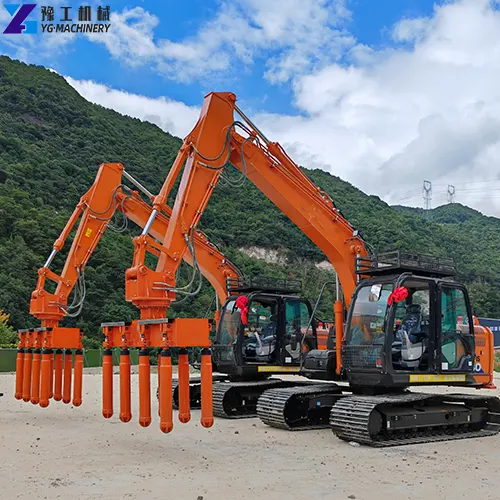
The client ordered the custom 6-head excavator-mounted concrete vibrator. YG set rod spacing to 150mm to align with the rebar mesh. Each vibrator rod has an independent hydraulic motor; operators can shut off individual rods in partially blocked zones.
Key takeaways:
- Multi-head rods pass through rebar only when spacing matches rebar openings. Tight rebar may require fewer rods.
- Always follow excavator load charts at max working radius. Overreaching creates tipping risk.
- Insufficient hydraulic flow reduces vibration frequency and hurts consolidation quality.
- Wide multi-head attachments cannot reach corners and formwork edges. Handheld vibrators are required for supplementary vibration.
- Match vibrator operation rhythm to concrete delivery speed; avoid vibrating partially set concrete.
- More rods do not guarantee higher productivity. Wider units increase hydraulic and lifting load and reduce flexibility.
This excavator concrete vibrator attachment works only for fresh concrete consolidation. It is not for soil compaction, pile driving, or breaking hardened concrete.
Boost Construction Progress by 30% – See Case Study Data


Pre-Shipment Inspection & On-Site Prep
Before shipment, YG completed full factory hydraulic testing for all 6 vibrator motors. We inspected welds, hoses, and seals. English operation manuals, hydraulic connection guides, and safety videos were provided.
The unit was packed in steel frames for sea freight to Kolkata, then overland trucking to western Nepal. YG shared a pre-installation checklist for the site team to verify auxiliary hydraulics, pressure settings, and pin fitment.
Site preparation steps:
- Mark excavator travel paths on the foundation
- Keep handheld vibrators ready for edge work
- Train excavator operator on cabin controls
- Schedule trial pour with stable concrete supply
Site Trial & Project Outcomes
The trial pour was performed on a 2.4 m-wide foundation section. The CAT320GC operator controlled lifting, tilting, and rod insertion from the cabin. The multi-head unit lowered through the rebar grid into fresh concrete, held for proper vibration time, and moved to the next position.
Each pass covered a 2.4m concrete strip. The excavator-mounted unit handled main area consolidation, while two ground crew used handheld vibrators along formwork and corners. Fewer workers stood on fresh concrete.
YG reminded the team that no vibrator can eliminate honeycombing entirely. Final concrete quality depends on mix design, pouring sequence, layer thickness, and approved construction methods.
After a successful trial, the contractor approved the unit for full foundation works. They reserved the 4-head model for smaller footings in later project phases.
Other YG Excavator Attachments for Nepal Projects
YG supplies a full range of excavator attachments for Nepal hydropower, bridge, and road projects:
- Hydraulic breaker: Rock breaking & demolition
- Crusher bucket: On-site rock and concrete crushing
- Grapple: Timber, steel, and waste handling
- Quick hitch: Fast switching between attachments
Each attachment serves separate tasks. The excavator-mounted concrete vibrator is exclusively for fresh concrete consolidation.
Lock In Today‘s Factory Price – Request Quote Now


Frequently Asked Questions About Excavator-Mounted Hydraulic Concrete Vibrator
A1: Evaluate excavator hydraulic output, lifting capacity at working radius, rebar spacing, and pour width. 4-head for narrow pours and low-flow excavators. 6-head balances performance for most mass concrete works like this Nepal hydropower case. 8-head delivers the widest coverage but requires higher hydraulic flow and lifting capacity. More rods do not equal faster work.
A2: Yes, available by custom order. We need full project and excavator data for technical review. Lead time and cost differ from standard 4/6/8-head models, commonly used for small strip footings.
A3: Send us the excavator model, hydraulic flow, pressure, backpressure limit, pin dimensions, and lifting capacity at target radius. Our engineers will complete a compatibility review, just like the CAT320GC Nepal project.
A4: Yes. Rod length matches pour depth; rod spacing adjusts to fit your rebar layout. Rod count and rod length are independent parameters. We set 150mm spacing for this Nepal project.
A5: Run a small trial pour under real site conditions. Test rod penetration through rebar, hydraulic stability, and concrete finish. Always follow your approved concrete construction procedure.
A6: Sea freight to Kolkata, then inland truck delivery to Nepal. YG provides digital manuals and maintenance video guides. Wear parts can ship together or separately. On-site training can be arranged based on mutual schedules.
Send Your Excavator Specifications and Concrete Pouring Layout
Fill in our inquiry form with: project location, concrete pouring drawings, rebar spacing, preferred vibrator head count, excavator hydraulic data, maximum working radius, delivery destination, and expected purchase timeline. Our engineering team will review your information and provide a customized technical proposal for your excavator-mounted concrete vibrator.