Define the Sampling Objective Before You Name a Rig
Start with what the hole must deliver. The sampling objective splits three ways, and each route changes the tooling package:
- Continuous diamond core for mineral exploration, ore-grade estimation, and rock description.
- Larger-diameter core (HQ or PQ) where you need more sample volume, higher recovery per run, or engineering-geology logging for dams, tunnels, and foundations.
- Standard penetration test (SPT) data in overburden and soil horizons, where you need blow-count values and soil parameters rather than rock core.
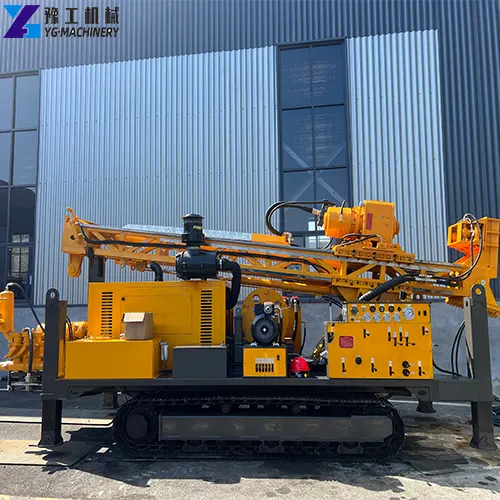
These outcomes are not interchangeable, and they are not “small, medium and large” versions of the same job. SPT is a soil test method; NQ, HQ, and PQ are coring system sizes; each needs its own tools. For this reason, YG’s full hydraulic core drilling rig proposal starts from the detection purpose and required core size before any depth is quoted — the largest model is not the default answer. If the upper part of the hole is soil and the lower part is rock, the rig should be able to run SPT sampling tools in one section and a coring assembly in the next, within a single programme.
Lock In Today‘s Factory Price – Request Quote Now
Match the Drill-Tool System Before You Match the Depth
Core size is a system decision, not a label on the specification sheet. NQ, HQ, and PQ describe the coring system: the drill rods, the core-barrel inner tube, and the casing dimensions that go together. NTW is a thin-wall wireline coring system with its own rod, barrel and overshot dimensions. SPT is a soil sampling test method, not a coring size. If these are treated as the same “drilling method”, the tooling list and the quotation will both be wrong. Two questions usually decide the conversation:
Why the same 600 m costs differently for NQ and PQ
A rig can list the same depth for both, but a PQ hole carries a heavier drill string, larger casing, higher hydraulic flow, and more mud-pump capacity. Reaching 600 m and recovering useful PQ core are different workloads, so YG prices the complete system — rods, core barrels, diamond bits, overshot, clamps and casing — rather than quoting depth alone.
Whether existing NTW tooling can be reused
NTW rods, thin-wall barrels, overshots and the drill head’s clamping and rod-handling capacity must be verified as a complete, compatible set. YG does not assume NTW and NQ interchange. If you plan to run your own NTW string, send rod outside diameter, box dimensions, and barrel length so compatibility is checked before the quote.
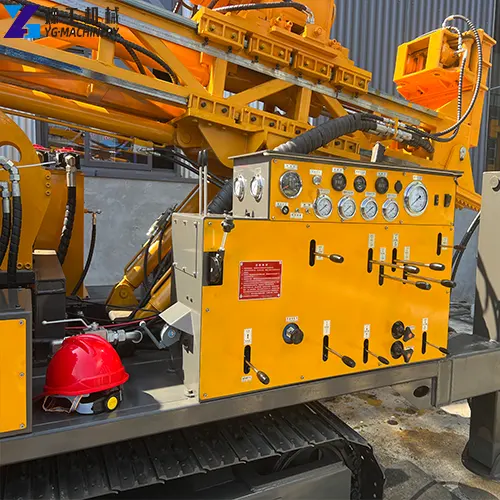
Support is not standard equipment. For the configuration you want, confirm drill rods, core barrels, diamond bits, overshot, rod clamps and, where soil is involved, the SPT hammer and sampler. YG evaluates the configuration on request and confirms exactly what is included in the quotation.
Get 12-Month Warranty & Lifetime Support – Learn More

Set the Target Hole Depth — Reference Values, Reviewed for Your Project
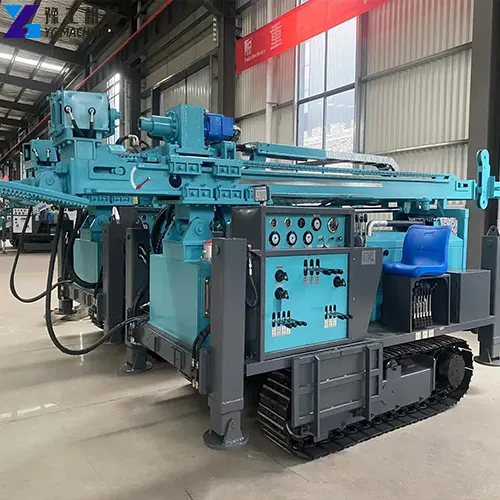
Each YGX model lists reference drilling depth, and each list shows several figures. That is deliberate: achievable depth depends on the coring system, hole diameter, formation, hole angle, and operating practice. A smaller core size will generally reach deeper than a larger one on the same rig class, and a steeply inclined hole or heavy casing reduces what is practical.
| Specification | YGX-400 | YGX-600 | YGX-800 | YGX-1000 |
| Reference drilling depth | 180 / 400 / 500 m | 200 / 600 / 650 m | 400 / 800 / 1,000 m | 500 / 1,000 / 1,100 m |
| Rated hydraulic pressure | 21 MPa | 21 MPa | 25 MPa | 28 MPa |
| Rated hydraulic flow | 168 L/min | 192 L/min | 260 L/min | 300 L/min |
| Cooling mode | Air + water | Air + water | Air + water | Air + water |
| Engine | Yuchai, 78 kW / 2,400 rpm | Yuchai, 92 kW / 2,400 rpm | Yuchai, 92 kW / 2,400 rpm | Cummins, 154 kW / 2,400 rpm |
| Drilling angle | 0–90° | 45–90° | 45–90° | 45–90° |
| Lifting force | 12 t | 16 t | 24 t | 30 t |
| Feed force | 6 t | 8 t | 12 t | 15 t |
| Mud-pump flow | 30–90 L/min | 30–90 L/min | 90–180 L/min | 90–180 L/min |
| Mud-pump pressure | 4–7 MPa | 4–7 MPa | 4–7 MPa | 4–7 MPa |
| Approx. dimensions | 4,000 × 1,900 × 1,800 mm | 4,000 × 2,000 × 1,800 mm | 5,500 × 2,100 × 2,000 mm | 6,000 × 2,200 × 2,400 mm |
All drilling-depth figures are reference values. They must be reviewed together with your core size, drill-string system, ground conditions, borehole design, drilling angle, casing program and project support plan. This page does not assign each depth figure to a specific NQ, HQ or PQ specification — that mapping is a project decision confirmed in YG’s technical proposal. When you send a depth target, include the coring specification you expect to carry, so the recommendation matches a real hole rather than an advertised figure.
Select by Core Size (BQ, NQ, HQ, PQ Configurations)

Learn More Through Frequently Asked Questions About Geological Core Drilling Rigs
A1: Selection depends on sampling target, core size, hole depth, ground conditions, and logistics. Provide your borehole design and sampling requirements.
A2: The core size is determined by the sample volume required and the ground conditions. Larger core size requires a larger drill string and higher rig capacity.
A3: We can evaluate compatibility. Check the connection interface, through-bore, chuck and clamping system, and the complete system. NTW is not assumed to be interchangeable with NQ.
A4: SPT can be evaluated as part of a combined program. The SPT hammer system, drill rods, and casing must be confirmed for compatibility.
A5: Different core barrels, casing, and drilling fluid strategies may be required. We do not guarantee a fixed recovery rate.
A6: Hole depth, core size, rock type, hole angle, casing depth, SPT requirements, water supply, platform conditions, destination, and purchase schedule.
Send Your Borehole Design and Sampling Requirements
Send YG your target hole depth, required core size (BQ/NQ/HQ/PQ or NTW), lithology and geological log, hole angle and deviation control, casing plan, SPT needs, water availability, drill-pad and access conditions, destination, and purchase timeline. Based on that, YG will match the geological core drilling rig model and tooling to your borehole design and prepare a technical proposal and quotation.