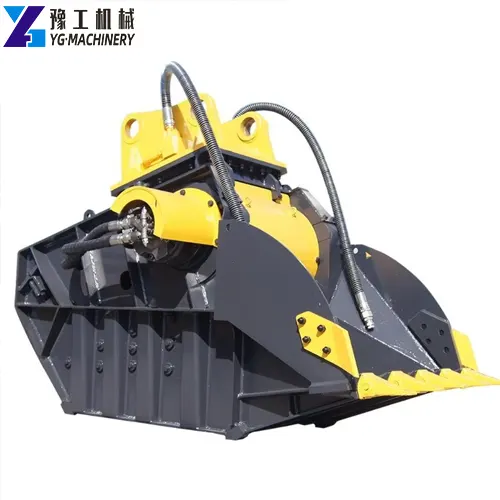
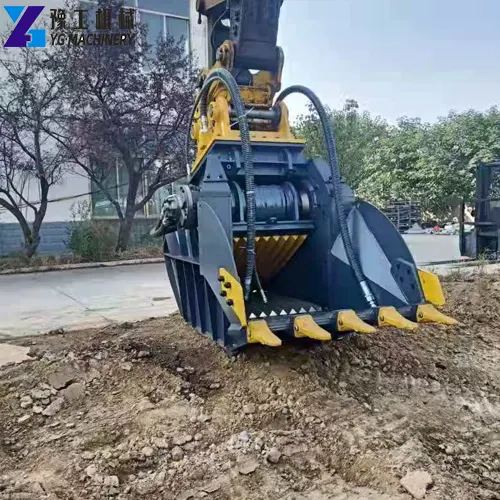
This is a completed YG Machinery export order to a demolition and road rehabilitation contractor in central Thailand. The customer owns a fleet of excavators and specializes in urban building demolition, road repair, and site preparation works.
Before purchasing the excavator rock crusher bucket, the contractor transported all concrete and brick demolition waste off-site for disposal and bought new crushed stone for backfill and road sub-base. High local hauling fees, limited landfill slots, and delays waiting for aggregate deliveries increased project costs and slowed site progress.
The client’s core goal: process demolition rubble on location to make reusable aggregate, reduce outbound waste trucking and inbound virgin aggregate deliveries. They evaluated mobile crushing plants and crusher bucket attachments, and selected the YG-5 hydraulic crusher bucket because it can mount directly to their existing excavator without a standalone crusher setup.
The Material Handling Challenge
The site generated mixed demolition debris from old building tear-out: reinforced concrete slabs, brick rubble, and soft sandstone rock.
- Mixed material: 65% reinforced concrete, 25% brick, 10% soft sandstone
- Large slab pieces were too big to haul economically and difficult to feed into any crushing equipment
- Steel rebar inside concrete created extra wear risk for crushing jaws
- Project required two aggregate grades: 20–40 mm for road sub-base and 40–70 mm for general site backfill
- Limited site space; a large stationary crushing plant was not practical
Transport was the biggest pain point. Every load of rubble leaving the site and every truck bringing in new aggregate added scheduling complexity and site congestion. The contractor wanted a flexible attachment that could move around the demolition zone with their existing 30-ton excavator.
Send Your Specs, Get a Quote in 24 Hours – Start Now
Specifications Table for YG Excavator Hydraulic Breaker Bucket
| SPECIFICATION | UNIT | YG-1 | YG-2 | YG-3 | YG-4 | YG-5 | YG-6 | YG-7 | YG-8 |
| Carrier Weight | Ton | 8-12 | 14-18 | 120-25 | 25-30 | 30-35 | 35-50 | 50-75 | ≥ 75 |
| Load Capacity | m³ | 0.15 | 0.55 | 0.66 | 0.70 | 0.90 | 1.30 | 1.60 | 2.30 |
| Opening Dimensions | mm | L540 H250 | L610 H510 | L740 H510 | L850 H510 | L910 H540 | L1205 H540 | L1300 H600 | L1450 H700 |
| Output Setting | mm | 15-60 | 15-60 | 15-130 | 15-135 | 15-140 | 15 – 145 | 40-150 | 100-200 |
| Length (A) | mm | 1240 | 1745 | 2000 | 2050 | 2185 | 2185 | 2930 | 3560 |
| Width (B) | mm | 1000 | 1000 | 1150 | 1300 | 1340 | 1620 | 1880 | 2090 |
| Height (C) | mm | 770 | 1100 | 1200 | 1400 | 1390 | 1390 | 170 | 2065 |
| Weight | Ton | 0.75 | 1.6 | 2.3 | 3 | 3.5a | 4.8 | 7.5 | 10.5 |
| Oil Flow | l/min | 90 | 98 | 140 | 160 | 180 | 210 | 320 | 380 |
| Pressure | bar | 200 | 220 | 220 | 220 | 220 | 220 | 250 | 230 |
| Counter | bar | 10 | 10 | 10 | 10 | 10 | 10 | 10 | 10 |
| Max. Production | m³/h | 10 | 23 | 31 | 34 | 42 | 53 | 88 | 120 |
Talk to a Crusher Bucket Engineer Now – Free Consultation
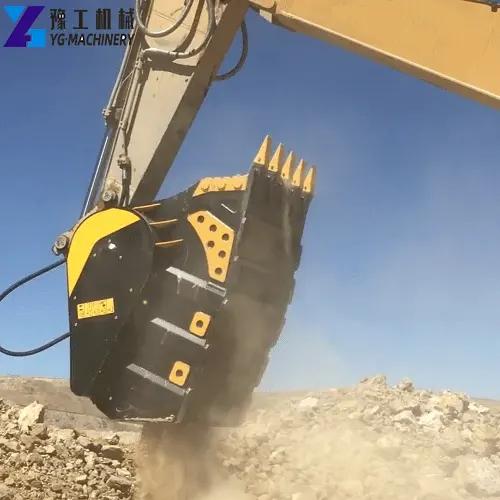
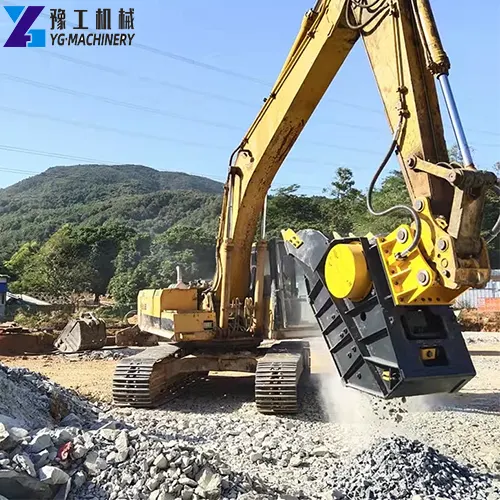
Why the Customer Considered an Excavator Rock Crusher Bucket
The client compared three options: portable wheeled crusher, renting crushing services, and an excavator crusher bucket attachment.
- Wheeled mobile crusher: high rental cost, required a separate operator, larger footprint, and needed dedicated hauling of material to and from the crusher station.
- Outsourced crushing service: long lead times and minimum tonnage requirements that did not match their intermittent site workflow.
- YG-5 concrete crusher bucket: mounts on their current excavator, operated by the existing digger operator, moves around the demolition area, and crushes material directly at the rubble pile.
Key Purchasing Decision Points:
- No extra prime mover required; uses excavator auxiliary hydraulics
- Adjustable discharge gap to produce two aggregate sizes for backfill and road base
- Hardened wear jaw plates for repeated concrete and brick processing
- Can combine with other YG excavator attachments for a full demolition recycling workflow
Excavator and Hydraulic Compatibility Check
Before manufacturing, YG’s engineering team verified the carrier machine and hydraulic parameters to avoid performance issues.
- Excavator brand & model: Komatsu PC300LC-8 (30–35 ton class, matches YG-5 carrier weight range)
- Auxiliary hydraulic flow: 180 L/min (matches YG-5 oil flow requirement)
- Working pressure: 220 bar
- Return line backpressure: ≤10 bar (matches YG-5 counter pressure requirement)
- Pin diameter: [site measured value]
- Center-to-center pin distance: [site measured value]
- Bucket hanging ears matched for direct fit, compatible with YG quick hitch
Critical check confirmed: The excavator’s auxiliary circuit met the flow and pressure requirements for the YG-5 crusher bucket. Mismatched hydraulics will reduce crushing performance or cause component damage.
Design Your Own Bucket Spec – Free Consultation
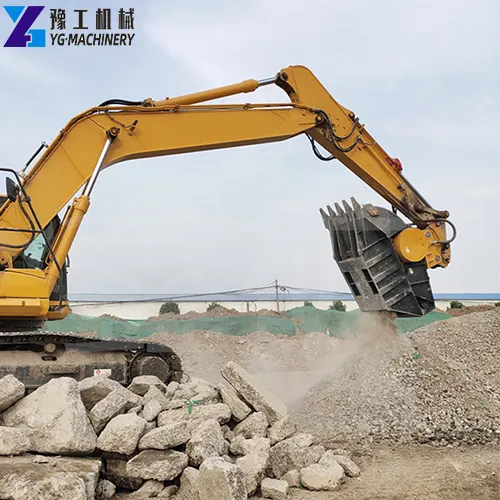
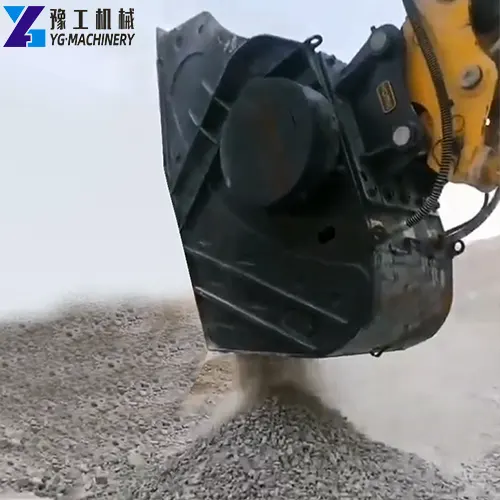
What Materials Were Processed and What Output Was Needed
Processed material: mixed demolition waste – reinforced concrete, red brick, soft sandstone rock. Rebar is present in the concrete slabs. The workflow uses a hydraulic grapple to pull longer steel bars before feeding chunks into the crusher bucket. Small leftover short rebar fragments will pass through the bucket and can be separated later during screening.
Target output sizes:
- 20–40 mm graded aggregate for road sub-base (within YG-5 15–140mm adjustable range)
- 40–70 mm crushed material for site leveling and backfill
Material with high steel rebar content will increase jaw plate abrasion and reduce effective throughput. The client was advised to pre-remove long rebar before crushing.
On-Site Crushing Workflow: Break, Crush, Screen and Reuse
This demolition and concrete recycling workflow uses YG excavator attachments as a modular system. The sequence below shows how contractors combine tools to turn waste material into reusable aggregate on-site. The actual workflow may change based on material type, site access, and available excavator capacity.
Step 1: Primary Breaking with Hydraulic Breaker
Large concrete slabs, reinforced concrete blocks, and solid rock cannot feed directly into the crusher bucket. The team uses a hydraulic breaker to reduce oversized material into chunks that fit the YG-5 feed opening (L910 × H540 mm).
- Target feed size: less than the crusher bucket inlet dimension
- Remove thick steel rebar sections where possible before crushing
- Heavy rebar can wear jaw plates faster and may reduce crushing efficiency
Step 2: Load & Crush with Excavator Rock Crusher Bucket
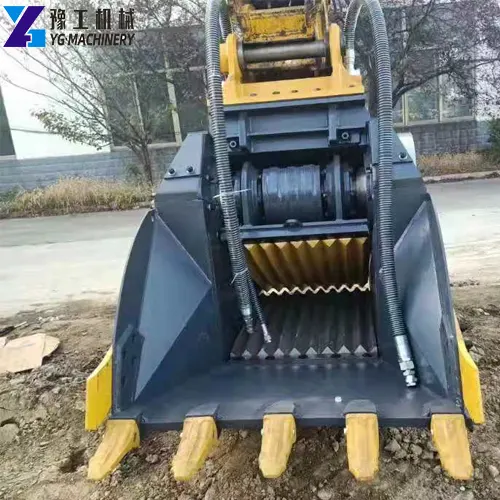
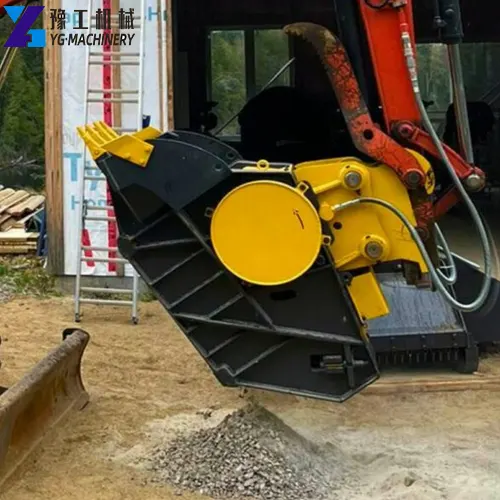
The excavator operator picks up pre-broken material and feeds it into the excavator rock crusher bucket. The hydraulic jaw mechanism crushes material inside the bucket while mounted on the excavator arm.
- Adjustable gap setting (15–140mm) controls the final aggregate size
- Material hardness, moisture, rebar content, and excavator hydraulic performance will affect throughput
- Operators should avoid overfeeding the bucket to prevent jams
Step 3: Material Screening with Screening Bucket (Optional)
If graded aggregate is required for road base or backfill, a screening bucket separates fines and oversized particles after crushing.
- Fine material can be used for site backfill
- Larger leftover stones can be re-fed into the crusher bucket for secondary crushing
- This attachment is not mandatory; skip screening if ungraded crushed material meets project requirements
Step 4: Stockpile & Reuse Recycled Aggregate
Finished crushed material is stockpiled directly on-site. The recycled aggregate can be reused for:
- ✅ Site leveling and backfill
- ✅ Sub-base layers for local road repair
- ✅ Temporary access roads
Key benefit: This workflow reduces the volume of waste material sent off-site and cuts the need to import new virgin aggregate. Savings depend on hauling distance, local transport pricing and total waste volume.
Lock In Today’s Factory Price – Request Quote Now
Results and Project Considerations
For this Thailand demolition project, the YG-5 excavator rock crusher bucket allowed the contractor to recycle rubble on-site. The team produced two sizes of crushed aggregate for immediate reuse on the same road rehabilitation project.
Project observations shared by the client:
- The attachment integrated smoothly with their Komatsu PC300LC-8 auxiliary hydraulic circuit after correct setup
- Pre-breaking with hydraulic breaker and rebar removal before crushing reduced jaw wear and bucket jams
- Adjustable gap (15–140mm) settings made it easy to switch between backfill and road base aggregate
- Operators required a short training session for proper feeding and gap adjustment
Important considerations for every project:
- The 42 m³/h max production listed in our spec sheet is measured under ideal laboratory test conditions; actual site throughput will be lower due to rebar, wet material, and operator feeding rhythm
- Jaw plates are consumable wear parts; spare jaw plates were included in the Thailand shipment
- Operator training is essential to avoid overfeeding and premature wear
- Local Thailand site safety rules and equipment inspection requirements apply on-site
Why Other Excavator Attachments Matter
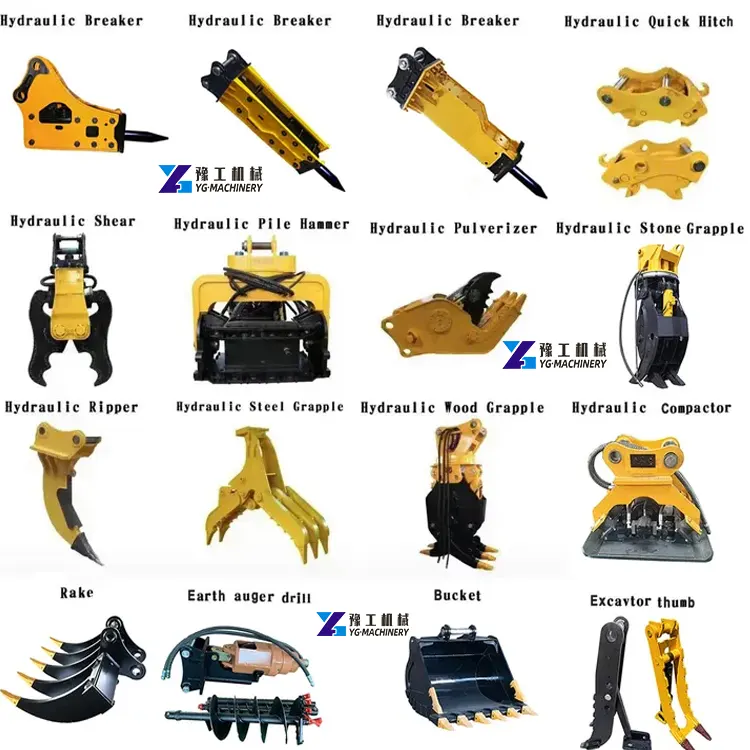
YG supplies a full range of excavator attachments for demolition, site preparation, and recycling workflows. These tools do not replace the excavator crusher bucket; they work together as a complete system for demolition waste recycling.
- Hydraulic breaker: For primary breaking of large concrete slabs and rock before crushing.
- Screening bucket: Separates fines and grades crushed aggregate for road base or backfill.
- Excavator ripper: Loosens hard compacted soil, weathered rock, and frozen ground.
- Hydraulic grapple: Sorts mixed demolition waste, grabs blocks, and pulls steel rebar out of concrete.
- Auger: Drills holes for fence posts, foundation piers, and planting holes.
- Quick hitch: Enables fast switching between all attachments without manual pin removal.
Many Thailand demolition contractors purchase the crusher bucket plus hydraulic breaker and grapple as a combined set for full demolition recycling jobs.
Request a Budgetary Quote for Your Project – Fast Response
Frequently Asked Questions About Excavator Crusher Buckets
A1: Our YG crusher bucket series covers carrier excavators from 8 tons up to ≥75 tons. For the YG-5 model used in this Thailand project, a 30–35 ton excavator is recommended. The critical factor is auxiliary hydraulic flow and pressure, not only excavator weight. YG-5 requires 180 L/min oil flow at 220 bar, with a return backpressure ≤ 10 bar. Send us your excavator hydraulic specs for a compatibility check.
A2: Yes, YG-5 can crush reinforced concrete, but long rebar should be pulled out with a hydraulic grapple before feeding. Small, short rebar fragments will pass through the bucket. Steel rebar accelerates jaw plate wear and may cause occasional jams. For high-rebar jobs, schedule spare wear parts.
A3: YG-5 has mechanical gap adjustment from 15 mm to 140 mm. Narrow gap (20–40 mm) for road sub-base graded aggregate. Wider gap (40–70 mm) for site backfill material. The exact particle distribution also depends on material hardness and feed size.
A4: Use the hydraulic breaker first to reduce large concrete slabs and big rock into chunks small enough for the YG-5 feed opening (910 × 540 mm). The breaker is for primary size reduction; the crusher bucket is for secondary crushing to produce finished aggregate.
A5: Use a hydraulic grapple for mixed demolition waste to separate steel rebar, sort rubble, and load blocks. Add a screening bucket if you require clean, graded aggregate for road base. Screening buckets are optional for simple backfill jobs.
A6: This Thailand order was packed in steel frame packaging for container shipment to Laem Chabang Port. Standard spare wear parts (jaw plates, seals) were included. YG provides PDF installation manuals, hydraulic connection diagrams, assembly videos, and online remote technical support after delivery. Local on-site service can be arranged separately upon request.
Check Crusher Bucket Compatibility With Your Excavator
Send Your Excavator Hydraulic Specification and Material Photos
Fill out the form below and share these details:
- Excavator brand, model, and tonnage
- Auxiliary hydraulic flow, working pressure, and return backpressure
- Bucket ear dimensions, pin diameter, and center distance
- Photos of your material and maximum feed size
- Target discharge aggregate size
- Estimated daily processing volume
- Project location, destination port, and planned purchase timeline
Submit your information, and our engineering team reviews your application and recommends the correct excavator rock crusher bucket for sale for your site.